Billable Hours: What Counts, What Leaks, What to Fix
RedHub AI Editorialupdated August 17, 20265 min read

Jump to a section8
TL;DR
- What it is: Billable hours are the hours a client actually pays for — the numerator in every utilization and staffing decision.
- Who it's for: Agencies, studios, and consultancies that sell time — see the Capacity & Utilization Planner.
- How it works: Bucket the week into billable, productive, and admin; find the leaks (meetings, rework, unbilled scope creep); protect the billable core.
- Bottom line: A full week and a billable week are different things. Every sell-or-hire decision depends on knowing which one you have.
What counts as billable hours?
Billable hours are hours of work a client pays for under an agreement — delivery work, client meetings within scope, and revisions inside the contract. Hours that don't count: internal meetings, admin, sales, training, rework you can't charge for, and scope creep you deliver but never bill. The ratio of billable hours to total capacity is your utilization rate, and it's the number every sell, hire, or say-no decision should run on.
Best for: teams whose weeks feel full but whose invoices don't — part of our capacity planning guide.
Ask a services team how busy they are and you'll hear "completely." Ask how many of last week's hours were billable and the room gets quiet. Both answers matter — but only one of them pays rent.
Billable hours are the raw material of a services business. Payroll buys a fixed number of hours each week; the business only earns on the slice a client pays for. When that slice shrinks quietly — a few extra meetings here, some unbilled revisions there — the team feels busier while the firm earns less. This post is about counting the slice honestly, finding the leaks, and protecting it.
The three buckets of a working week
| Bucket | What's in it | What it does |
|---|---|---|
| Billable | Client delivery, in-scope meetings, contracted revisions | Earns revenue |
| Productive non-billable | Sales, marketing, training, building internal tools | Builds the future — valuable, but not revenue this week |
| Admin & drag | Internal meetings, status shuffling, timesheet wrangling, rework | Costs capacity and returns little |
Healthy weeks contain all three. The trouble starts when bucket three grows silently, or when work that should be billable slides into buckets two and three without anyone deciding it should. That slide has a name: leakage.
The four ways billable hours leak
- Meetings that ate the morning. Standing internal meetings are the most accepted form of capacity loss in business. Each one seems small; a calendar full of them consumes hours you planned to sell. The Meeting Cost Calculator ($29) prices a recurring meeting in about two minutes.
- Unbilled scope creep. The client asks for "one small extra thing," the team delivers it, nobody bills it. The hours were worked — they just earned nothing. This is the sneakiest leak because utilization still looks fine; only margin suffers. The Margin Leak Auditor ($79) is built to catch exactly this pattern.
- Rework. Hours spent redoing work — bad briefs, missed requirements, quality slips — are hours worked twice and billed once, at best.
- Ghost admin. Status updates, file hunting, tool wrangling. Individually invisible, collectively a bucket.
Key insight: the goal isn't to make every hour billable. Sales, training, and slack are how a firm grows. The goal is that non-billable hours are chosen — spent on purpose, not leaked by default.
How to count yours honestly — without a timesheet war
You don't need surveillance software or six-minute increments to get a decision-grade number. You need one honest week:
- Pick a normal week — not launch week, not the holiday lull.
- Have each person bucket their hours into billable, productive, and admin at day's end. Rough is fine; honest matters more than precise.
- Compute the billable ratio per person — billable hours ÷ capacity hours. That's the utilization rate; the full method is in our utilization rate guide.
- Name the biggest leak — for most teams it's meetings or unbilled scope — and fix that one thing before measuring again.
Why this number decides bigger things
Billable hours aren't a bookkeeping detail. They're the input to the two most expensive calls a services firm makes. Whether to hire — because a team leaking ten hours a week per person doesn't need a new seat, it needs the leak fixed (run the hire math here). And whether to take new work — because your real, leak-adjusted capacity is what determines if the next client fits or sinks the team.
See what your billable week is really worth.
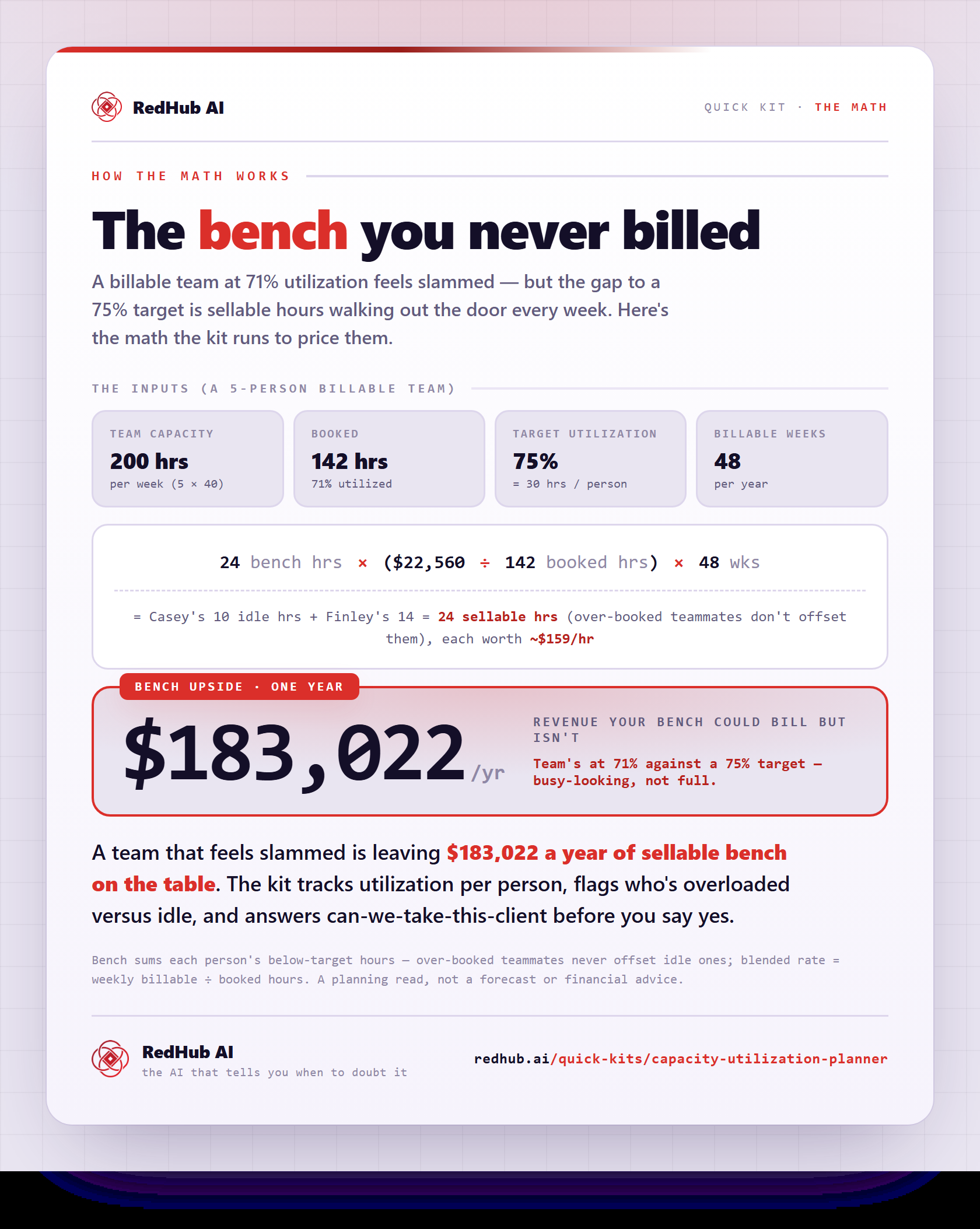
The Capacity & Utilization Planner ($49, one-time) turns per-person capacity, booked hours, and rates into utilization versus target, the bench you can still sell, and a sell/hire/turn-away verdict — plus a New Work Check before your next yes. One .xlsx; Excel, Google Sheets, or Numbers.
Get the Planner — $49 →A last honesty note: the Planner works from the booked hours you enter. If your billable count is inflated by hours you'll never actually invoice, the verdict inherits the error. Count honestly first — then the math is worth trusting.
Decision Guide
Audit your billable hours if: the team feels maxed out but revenue doesn't match, or you're about to make a hire or take a big client based on "we're full."
Skip it if: you don't sell time — flat-rate product businesses need margin math, not hour buckets.
Best first step: run the one-week bucket exercise above. Most teams find their biggest leak — usually meetings or unbilled scope — on day three.
FAQ
What counts as a billable hour?
Any hour of work a client pays for under your agreement: delivery, in-scope client meetings, and contracted revisions. If nobody invoices it, it isn't billable — no matter how useful it was.
How many billable hours should someone have per week?
Against a realistic capacity of 32 to 36 weekly hours, a 75 percent target puts most full-time billable roles at roughly 24 to 27 billable hours a week. The right number varies by role — the target matters more than a universal figure.
Are internal meetings ever billable?
No — and that's fine, as long as they're chosen. The problem isn't that internal meetings exist; it's that they grow silently until they crowd out hours you meant to sell.
What is billable-hours leakage?
Hours that should have earned revenue but didn't — unbilled scope creep, rework, and drag. It's the sneakiest capacity loss because the team still feels fully busy while the firm earns less.
Do I need time-tracking software to measure this?
No. One honest week of end-of-day bucketing into billable, productive, and admin gives you a decision-grade ratio. Add tooling only if you need finer detail later.
How do billable hours relate to utilization?
Billable hours are the numerator: utilization rate = billable hours ÷ capacity hours. Get the billable count honest and the utilization number — and every decision built on it — gets honest too.
Which RedHub tool fits this problem?
The Capacity & Utilization Planner ($49) for the capacity math; the Margin Leak Auditor ($79) if the leak is unbilled scope; the Meeting Cost Calculator ($29) if it's the calendar.
Count the hours. Then decide with them.
Per-person utilization, the sellable bench, and a sell/hire/turn-away verdict from your own honest numbers. One-time $49, instant download, 30-day guarantee.
Get the Capacity & Utilization Planner — $49 →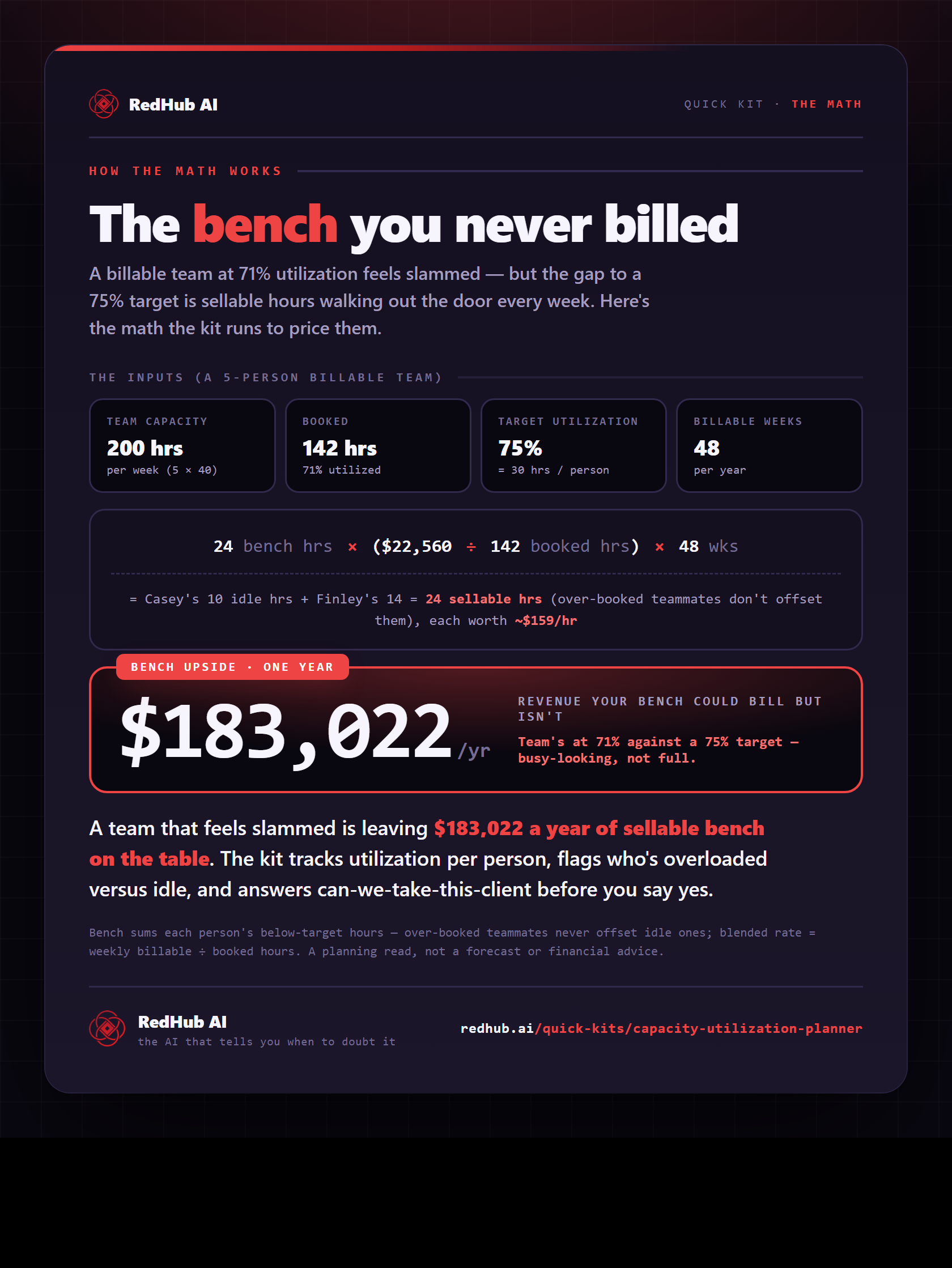
The gate this post refers to, drawn from the tool’s own logic. See the tool.