Utilization Rate: How to Calculate It (and What's Good)
RedHub AI Editorialupdated August 17, 20266 min read

Jump to a section9
TL;DR
- What it is: Utilization rate = billable hours ÷ capacity hours. It tells you how much of the time you're paying for is actually earning.
- Who it's for: Agencies, studios, and consultancies — anyone whose payroll is bought capacity. See the Capacity & Utilization Planner.
- How it works: Pick an honest capacity basis, count booked billable hours, divide, and compare to a target near 75 percent — per person, not just as a team average.
- Bottom line: The number you get is less important than the gap to your target. The gap is the money.
What is a utilization rate?
Utilization rate is the share of a person's available working hours that goes to billable work. The formula is simple: billable hours divided by capacity hours. If someone has 36 realistic weekly hours and 27 are booked to clients, their utilization rate is 75 percent. Most services firms target roughly 70 to 80 percent — deliberately below 100, because sales, training, and slack are part of a healthy week.
Best for: teams deciding whether to sell, hire, or say no — part of our capacity planning guide.
Payroll is the biggest line on almost every services P&L. Utilization rate is the number that tells you what that payroll is producing. Yet plenty of firms that can quote their revenue to the dollar have never once computed it.
The formula takes thirty seconds. The judgment calls around it — what counts as capacity, what counts as billable, and what a fair target is — are where teams go wrong. This post covers all three, plus a calculator to see what your current rate is costing you.
The formula, without the fog
Utilization rate = billable hours ÷ capacity hours.
Both halves need an honest definition:
- Set a realistic capacity basis. Not 40 hours — nobody bills 40. After standing meetings, admin, and internal work, most people have 32 to 36 sellable hours in a week. Pick one basis and use it for everyone, consistently.
- Count hours booked to clients. Committed client work only. Internal projects and "almost billable" time don't count — that's the discipline covered in billable hours: what counts, what leaks.
- Divide, and compare to your target. The rate by itself is trivia. The rate versus your target is a decision: below target means sell, at target means healthy, over means relief — hire, subcontract, or say no.
Billable versus productive utilization
Two versions of this metric exist, and mixing them up flatters everyone:
| Metric | Counts | Answers |
|---|---|---|
| Billable utilization | Hours billed to clients only | Is our capacity earning revenue? |
| Productive utilization | Billable + useful internal work (marketing, R&D, training) | Is our capacity doing anything valuable? |
Both are worth watching. But when the question is "should we hire?" or "can we take this client?", billable utilization is the one that decides. A team that's 95 percent productive but 55 percent billable doesn't need another seat. It needs more sold work.
What's a good utilization rate?
Most services firms set the target around 75 percent of realistic capacity. For context, a 2025 NetSuite benchmark put average billable utilization at 66.4 percent — meaning the typical firm runs meaningfully below the common target. Three bands cover the practical readings:
- Below about 70 percent: you have a bench. That's not a moral failing — it's inventory. Sell it before you add to it.
- Roughly 70 to 85 percent: healthy. Room for select new work; start planning the next hire before you need it.
- Sustained 90 percent or more: the team is running hot. Expect quality slips and burnout if it holds — hire, subcontract, raise rates, or turn work away.
Key insight: 100 percent is not the A-grade. A person booked wall-to-wall has zero room for a sales call, a sick day, or your best client's urgent request. Treat full capacity as a ceiling, not a goal.
What does your current rate cost?
Utilization becomes real when you attach payroll to it. Try your own numbers — this is arithmetic on your inputs, an estimate, not a measured claim:
Utilization & unsold-capacity estimate
With the defaults — one person, $80,000 loaded cost, billing 24 of 40 hours against an 80 percent target — the estimate lands at 60 percent utilization and about $16,000 a year of paid-for capacity going unsold. That's the illustrative version of the point: the gap between your rate and your target is a dollar figure, and it compounds by headcount.
Per person beats the average
One caution before you act on a team-level number: averages hide the story. A "74 percent" team can be two people underwater and two people idle. The fix is the same math, run per person, then rebalanced — that's resource allocation. And if the average is fine but profit still isn't, the hours may be billable at rates that don't hold up — the Margin Leak Auditor ($79) works that side of the problem.
Run this for your whole team in one sheet.
The Capacity & Utilization Planner ($49, one-time) computes per-person and team utilization, the sellable bench in hours and dollars, and a sell/hire/turn-away verdict from your own numbers — plus a New Work Check before your next yes. One .xlsx; Excel, Google Sheets, or Numbers.
Get the Planner — $49 →Once you know your rate, the next question is usually the expensive one: does this number say hire, or does it say sell? That's the whole subject of should I hire? Run the capacity math first.
Decision Guide
Track utilization rate if: you bill for time and payroll is your biggest cost — which is nearly every agency, studio, and consultancy.
Skip it if: your team's output isn't sold by capacity at all; a metric nobody will act on is just overhead.
Best first step: compute one week's billable utilization per person using a realistic capacity basis. Compare each number to 75 percent and see who's over, who's under, and what the spread says.
FAQ
How do I calculate a utilization rate?
Divide billable hours by capacity hours. Use a realistic capacity basis (32 to 36 hours a week for most roles, not 40) and count only hours genuinely booked to client work.
What is a good utilization rate?
Around 70 to 85 percent of realistic capacity for most services teams, with 75 percent a common target. Sustained readings above 90 percent signal overload, not excellence.
Why isn't 100 percent the goal?
Because a fully booked team has no room for sales, training, absences, or opportunities. Slack isn't waste — it's the capacity that lets you grow and absorb surprises.
Should I use billable or productive utilization?
Both, for different questions. Billable utilization decides sell/hire/say-no questions. Productive utilization checks whether non-billable time is going somewhere useful.
What does low utilization actually cost?
As illustrative arithmetic: each point of utilization below your target is that share of loaded cost paid for but unsold. One $80,000 seat at 60 percent against an 80 percent target leaves about $16,000 a year on the table.
Do I need time-tracking software first?
No. Honest weekly estimates per person are enough to compute a useful rate and make the sell/hire call. Add tooling later if you need finer precision.
How does the Planner handle utilization?
The Capacity & Utilization Planner ($49) takes each person's capacity, booked hours, and rate, and returns per-person and team utilization, the sellable bench, and a sell/hire/turn-away verdict. It's a planning tool — the decision stays yours.
Your utilization rate is a decision waiting to be made.
Enter capacity, booked hours, and rates for your team; get utilization versus target, the bench you can still sell, and one clear verdict. One-time $49, works in Excel, Google Sheets, or Numbers. 30-day guarantee.
Get the Capacity & Utilization Planner — $49 →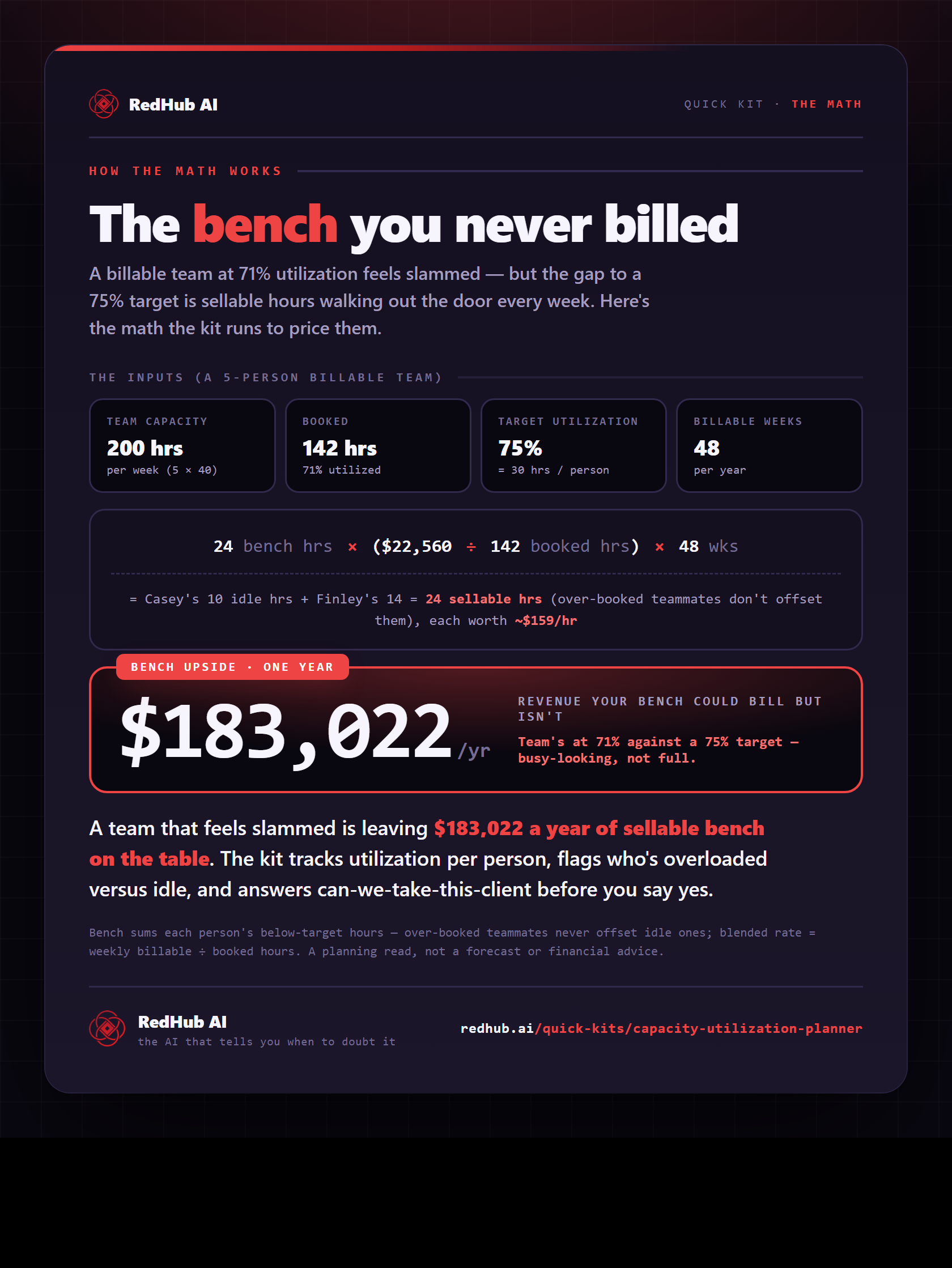
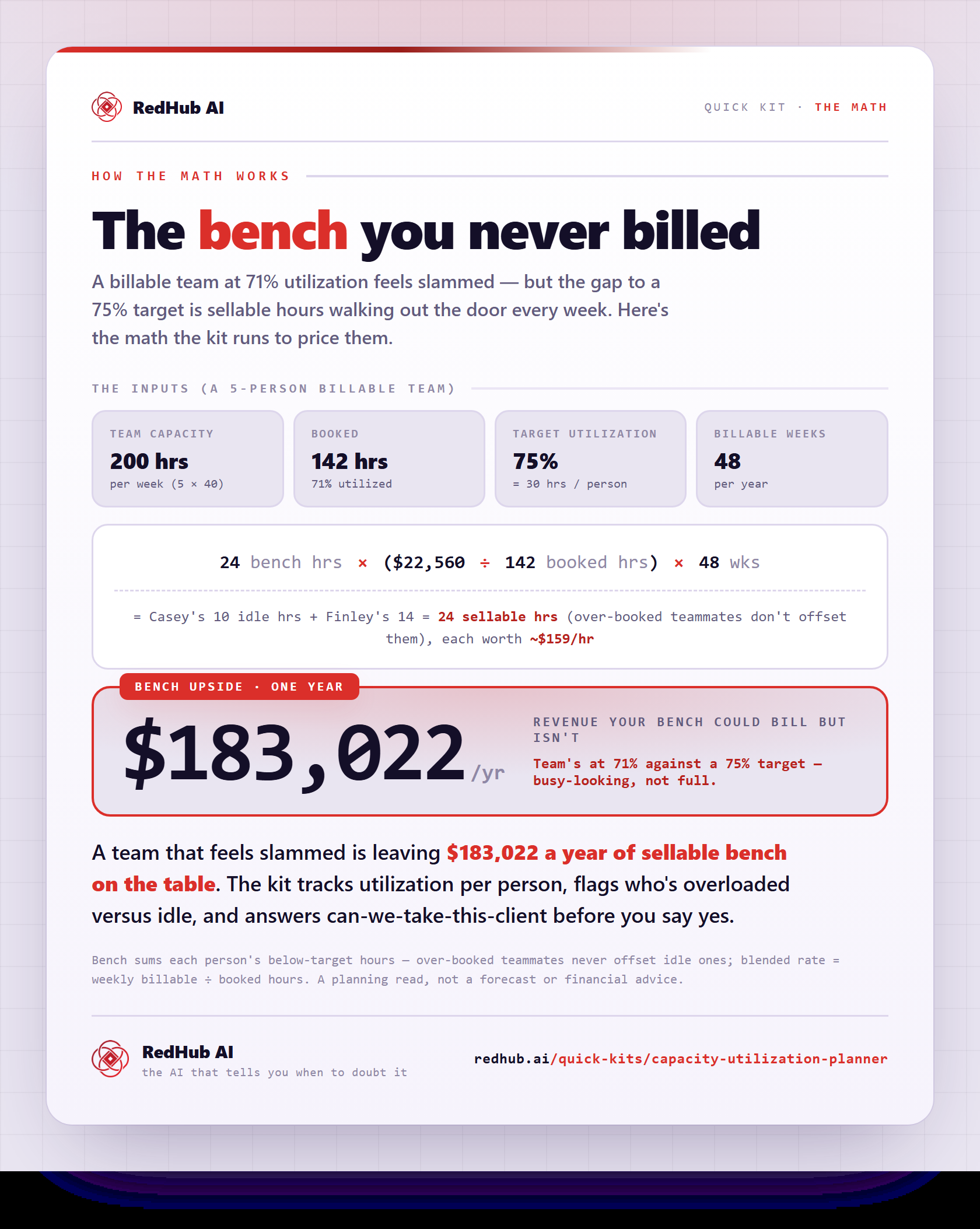
The gate this post refers to, drawn from the tool’s own logic. See the tool.