Business Operating Cadence: Run Your Company on a Rhythm
Todd Brooks, Founder8 min read

Jump to a section12
- Your Business Operating Cadence: Stop Running the Week by Feel
- TL;DR
- What is a business operating cadence?
- The drift problem: "fine" is a feeling
- The four layers of an operating cadence
- The heartbeat: the weekly business review
- The scorecard underneath it
- The founder's Monday page
- How to install an operating cadence in five steps
- Where to go deeper
- Decision Guide
- FAQ
Your Business Operating Cadence: Stop Running the Week by Feel
TL;DR
- What it is: A business operating cadence is the fixed rhythm of reviews — daily, weekly, monthly, quarterly — that a founder and leadership team use to run the company on numbers instead of feel.
- Who it's for: Founders and leadership teams at small companies — browse the RedHub Systems catalog.
- How it works: Every layer reads the same scorecard. The weekly business review is the heartbeat. Targets and red lines make the grade honest, and a written record makes it compound.
- Bottom line: Cadence beats intensity. A company that grades its week honestly every Monday gets a little better every week. A company that runs by feel drifts — and calls the drift "busy."
What is a business operating cadence?
A business operating cadence is the repeating schedule of reviews and decisions a company runs on: a short daily sync, a weekly business review, a monthly deep-dive, and a quarterly planning session. Each layer answers a different question at a different altitude, and all of them read from one shared scorecard with targets and red lines. The cadence turns "how are we doing?" from a feeling into a graded answer — and turns priorities from guesswork into a short written list someone checks next week.
Best for: founders who want the whole rhythm delivered as a working system — see the Operating Cadence Engine.
Most companies do not fail from one bad decision. They drift. A metric slides for six weeks before anyone says it out loud. A commitment slips, then slips again, and by the third week nobody remembers it was a commitment. A business operating cadence exists to make drift impossible to miss — because every week, the same questions get asked, graded, and written down.
Here is the uncomfortable test. Ask yourself, right now: is the company on plan this week? If your honest answer is "I think so," you are running on feel. Feel is fine when things are fine. But a crossed red line — runway under your minimum, churn over your ceiling — hides very comfortably inside a week that feels fine. The cadence is what drags it into the open on Monday, while there is still time to act.
The drift problem: "fine" is a feeling
Without a cadence, the week starts before you decide what it is for. Calendar, inbox, CRM, metrics — four tabs, four partial pictures, zero verdicts. You react all week, and by Friday you have been busy without being sure you moved the things that mattered.
Three things go missing when there is no operating rhythm:
- An honest grade. Nobody says "we are off plan" because nobody defined what on-plan means. There is no target, no floor, no verdict — just vibes.
- Memory. Last week's commitments live in someone's head. What slipped never gets named, so the same problem gets carried for a month without anyone noticing it is the same problem.
- A forcing function for decisions. The one high-leverage decision keeps getting deferred, because no meeting on the calendar exists to force it.
The four layers of an operating cadence
A working cadence has four layers. Each one answers a different question, produces a different artifact, and runs at a different altitude. The mistake most teams make is running all their meetings at the same altitude — every meeting becomes a status update, and no meeting produces a decision.
| Layer | Rhythm | The question it answers | The artifact it produces |
|---|---|---|---|
| Daily sync | 10–15 min, daily | Is anything blocked today? | Unblocked people |
| Weekly business review | 45–60 min, weekly | Are we on plan, and what are this week's three priorities? | A graded scorecard + three priorities + one decision |
| Monthly review | Half-day, monthly | Are the trends real, and is the plan still right? | Adjusted targets, killed or funded initiatives |
| Quarterly planning | Full day, quarterly | Are we building the right things at all? | The next quarter's goals and red lines |
The durations are a starting prescription, not a law. What is non-negotiable is the separation: daily is for blockers, weekly is for grading and priorities, monthly is for trends, quarterly is for direction. When a weekly review tries to do quarterly work, it runs two hours and decides nothing. We break the full stack down — including what each meeting costs you in leadership hours — in the leadership team meeting rhythm.
The heartbeat: the weekly business review
If you build only one layer, build the weekly one. The weekly business review is the heartbeat of the whole cadence — frequent enough to catch drift early, spaced enough that the numbers have actually moved. It has a strict shape: the graded scorecard first, then the at-risk flags, then what slipped since last week, then this week's three priorities and the one decision to make. Numbers before narrative, always.
Run well, it fits in under an hour and people stop dreading it — because it stops being status theater and starts being the place where the company actually decides things. The full agenda, the pre-read, and the rules that keep it honest are in how to run a weekly business review.
The scorecard underneath it
A cadence without a scorecard is just a recurring meeting. The scorecard is a short list — usually five to nine operating areas across cash, pipeline, customers, and execution — where each area has a current value, a target, and a red line. Each area gets graded against pace to target: ON TRACK, WATCH, or OFF TRACK. Then the week rolls up to a single verdict: STEADY, NEEDS ATTENTION, or OFF PLAN.
The floor gate: a metric that crosses a hard red line — runway below your minimum, churn above your maximum — is OFF TRACK no matter how well it is pacing, and it forces the whole week OFF PLAN. This is the single most important rule in the system. A bad week must read as a bad week, even when everything else feels great. Grading systems that let a crossed red line hide inside a good average are worse than no grading at all.
How to pick the metrics, set the targets and red lines, and avoid the averaging trap is its own discipline — covered in how to build a company scorecard that tells you the truth.
The founder's Monday page
Here is where most cadences die: someone has to assemble the pre-read. Every Monday, someone has to pull the calendar, scan the inbox, check the CRM for stale deals, and update the metric lines — and after three weeks of doing that by hand, the ritual quietly stops. The cadence did not fail on principle. It failed on assembly labor.
This is a solvable problem now. An MCP-connected system can read your calendar, inbox, CRM, and metrics source through your own connectors, grade every area against the targets and floors you set, and deliver a one-page operating report to your own inbox every Monday — the grade, the flags, what slipped, three priorities, and the one decision to make. You walk into the weekly review with the pre-read already done. How that works, and the guardrails that make it trustworthy, are in the founder operating system.
How to install an operating cadence in five steps
- Write the scorecard. Five to nine areas across cash, pipeline, customers, and execution. Each gets a current value, a target, and a red line. If you cannot measure one yet, mark it unmeasured — never guess.
- Book the heartbeat. One 45–60 minute weekly business review, same day, same time, leadership only. Protect it like a customer meeting.
- Grade before you talk. The scorecard is graded before the meeting starts — ON TRACK, WATCH, OFF TRACK per area, one verdict for the week. Numbers before narrative.
- Leave with three priorities and one decision. Write them down. Three, not ten. Next week, the first agenda item is which of them actually happened.
- Automate the assembly. The cadence survives when the pre-read builds itself. Wire the collection and grading to run every Monday so the ritual costs minutes, not a morning.
Get the whole cadence as a working system
The Operating Cadence Engine ($299, one-time) is four Claude Skills that read your calendar, inbox, CRM, and metrics through your own connectors and deliver a one-page graded operating report to your inbox every Monday — targets, floors, the floor gate, what slipped, three priorities, and the one decision. It reads and synthesizes; you act. Includes the scoring engine, the workbook, the report template, and the setup playbooks.
Get the Operating Cadence Engine — $299 →Where to go deeper
This pillar is the map. Each layer of the cadence has its own guide:
- How to run a weekly business review — the agenda, the pre-read, and the rules that keep it under an hour and honest.
- The leadership team meeting rhythm — the four-layer stack, what each meeting owns, and what each one costs.
- Build a company scorecard that tells you the truth — metrics, targets, red lines, and why you never average the grades.
- The founder operating system — the one-page Monday report that assembles itself from your real systems.
Decision Guide
Use this approach if: you run a company where cash, pipeline, customers, and execution all cross your desk, and your current answer to "are we on plan?" is a feeling, not a graded number.
Skip it if: you want a full BI platform with historical dashboards, or a bot that runs the company without your review — a cadence is a weekly operating discipline, not analytics software or autopilot.
Best first step: write the scorecard this week — areas, targets, red lines. Everything else in the cadence reads from it.
FAQ
What is a business operating cadence?
It is the fixed rhythm of reviews a company runs on — daily sync, weekly business review, monthly review, quarterly planning — all reading from one shared scorecard with targets and red lines. It replaces "I think we're fine" with a graded answer, every week.
How is an operating cadence different from a meeting schedule?
A meeting schedule tells you when people talk. A cadence tells you what question each meeting answers and what artifact it must produce — a graded scorecard, three priorities, a decision. A meeting with no artifact is just a calendar block.
How long should the weekly business review take?
45 to 60 minutes when the pre-read is done before the meeting. If it regularly runs longer, the meeting is doing monthly or quarterly work that belongs at a different layer of the cadence.
How many metrics should the scorecard track?
Five to nine operating areas is the workable range. Fewer and you have blind spots; more and the review becomes a data recital. Every area needs a target and a red line, or it cannot be graded.
What happens when a red line is crossed?
The area is OFF TRACK regardless of how it is pacing, and the week is OFF PLAN until the line is back inside its limit. That is the floor gate — it exists so a crossed red line can never hide inside an otherwise good-looking week.
Do we need special software to run a cadence?
No — a spreadsheet and a protected hour will run it. What kills most cadences is the weekly assembly labor of building the pre-read by hand. That part is worth automating; the judgment and the decisions stay yours.
What does the Operating Cadence Engine actually do?
The Operating Cadence Engine ($299) is four Claude Skills that read your calendar, inbox, CRM, and metrics through your own connectors and deliver a one-page graded operating report to your own inbox every Monday. It never sends to anyone else, never edits a record, and never invents a number — an unconnected metric is marked not-connected, not guessed.
Run your week from one honest page
One purchase, lifetime access, 12 months of updates. Bring your own calendar, inbox, CRM, and metrics connectors — the engine grades the week and you make the calls.
Get the Operating Cadence Engine — $299 →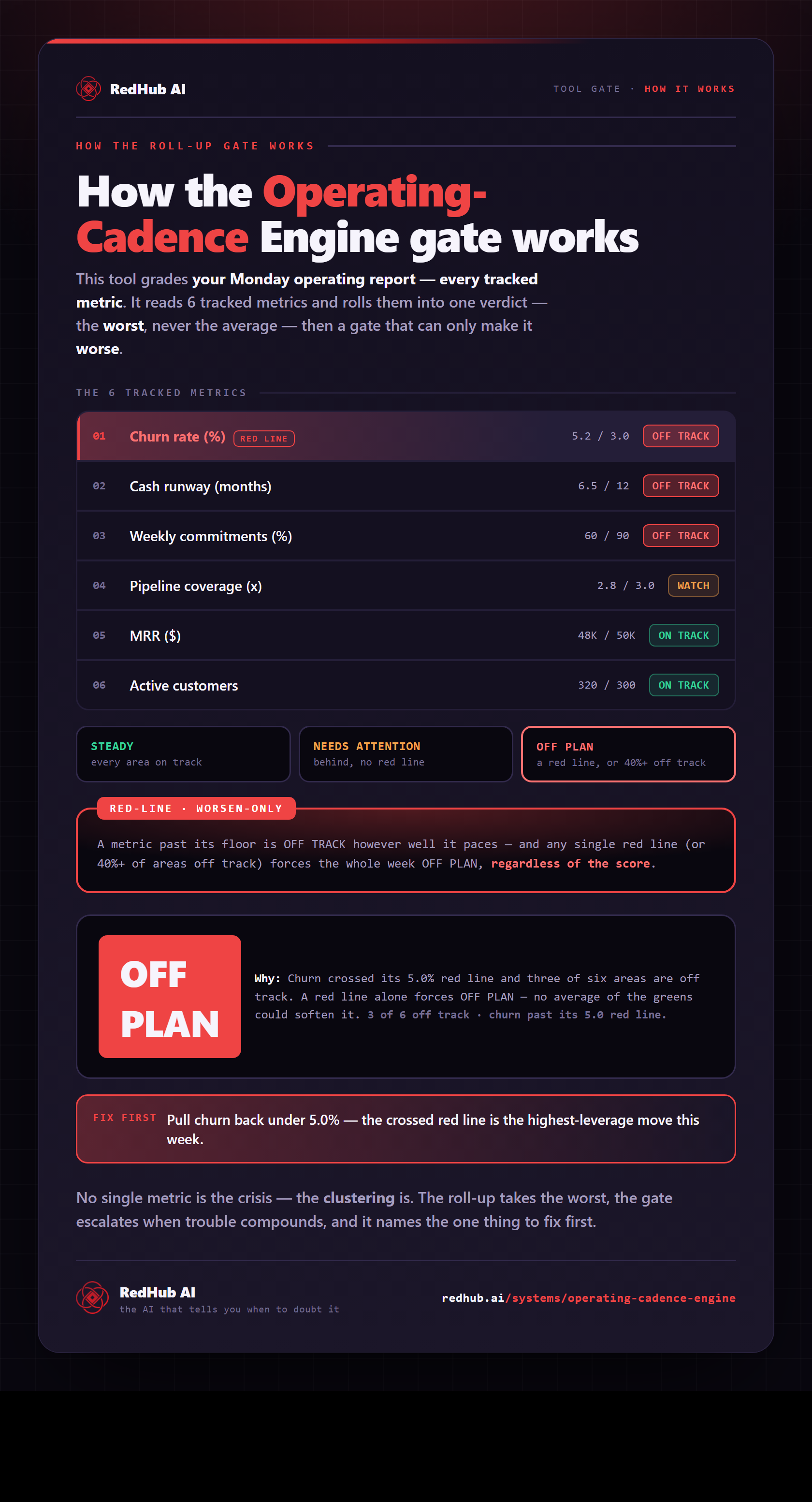
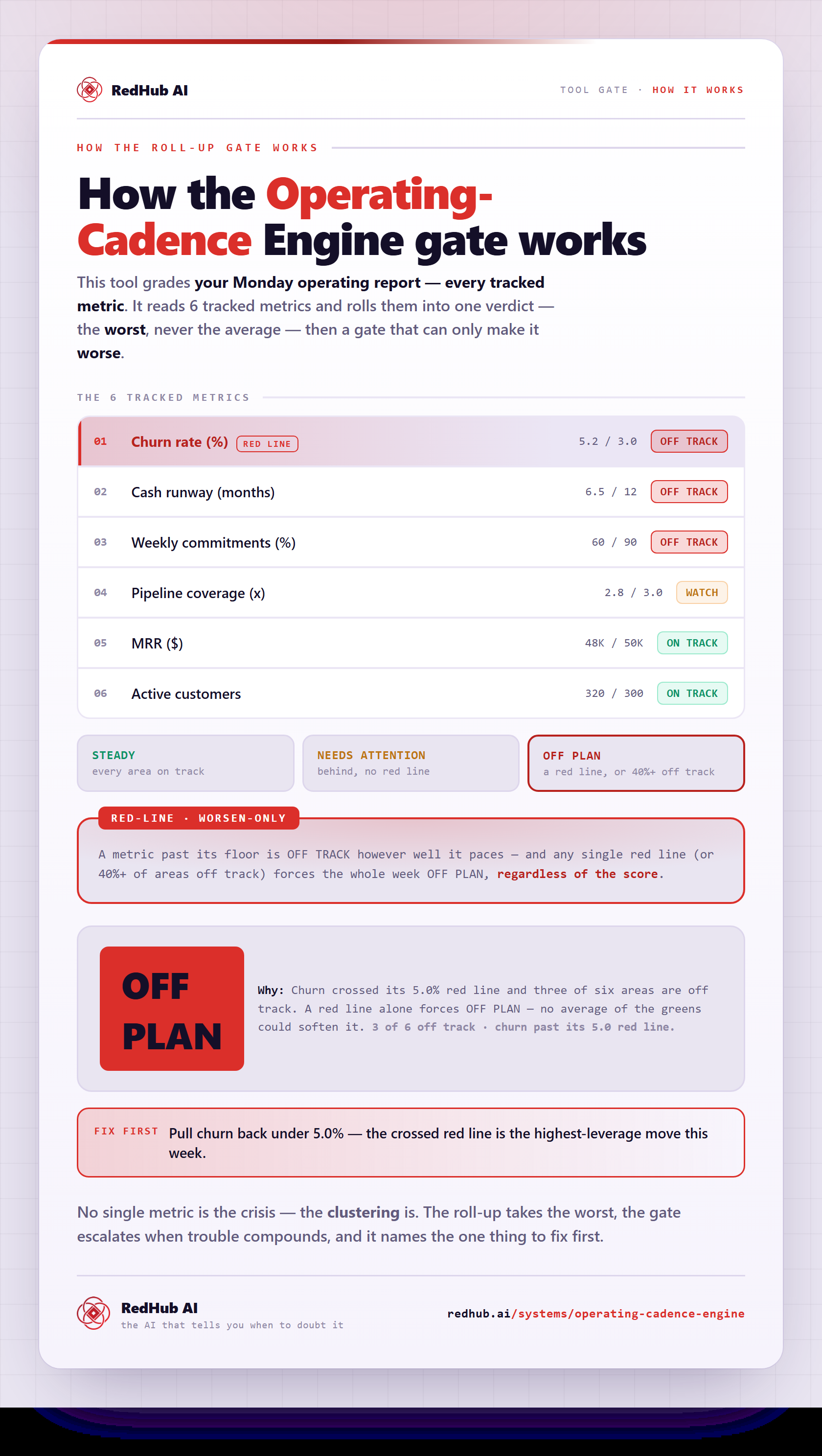
The gate this post refers to, drawn from the tool’s own logic. See the tool.