Weekly Business Review: How to Run One That Works
Todd Brooks, Founder6 min read

Jump to a section10
How to Run a Weekly Business Review That People Trust
TL;DR
- What it is: A weekly business review is a 45–60 minute leadership meeting that grades the week against a scorecard and ends with three priorities and one decision.
- Who it's for: Founders and leadership teams building an operating cadence.
- How it works: Pre-read first, numbers before narrative, what-slipped before what's-new, and a written output someone checks next week.
- Bottom line: The review earns trust when it can deliver bad news. If every week reads "fine," the meeting is theater.
What is a weekly business review?
A weekly business review is the recurring leadership meeting where a company grades its week against a scorecard — cash, pipeline, customers, execution — and converts the grade into this week's three priorities and one decision. It runs 45 to 60 minutes, works from a one-page pre-read prepared before the meeting, and always opens with what slipped since last week. It is the heartbeat of a company's operating cadence: frequent enough to catch drift, spaced enough that the numbers have moved.
Best for: teams whose pre-read never gets built — the Operating Cadence Engine assembles and grades it automatically every Monday.
Most weekly leadership meetings fail the same way: they become status theater. Everyone reports what they did. Nobody grades anything. Nothing gets decided. The meeting runs long, people leave tired, and the company is exactly as informed as it was an hour earlier. A real weekly business review is a different animal — and the difference is structure, not effort.
Status meeting vs. business review
The test is simple: does the meeting produce a verdict and a decision, or just talk? Here is the difference side by side.
| Status meeting | Weekly business review | |
|---|---|---|
| Opens with | "Let's go around the room" | The graded scorecard, already prepared |
| The numbers | Mentioned if convenient | Graded against targets and red lines, first |
| Last week | Forgotten | First agenda item: what slipped, what got done |
| Output | A vague sense of alignment | Three written priorities and one decision |
| Bad news | Softened or skipped | Forced into the open by the grade |
The agenda that keeps it under an hour
- The grade (5 min). The week's verdict, read straight from the pre-read: STEADY, NEEDS ATTENTION, or OFF PLAN, with each area's ON TRACK / WATCH / OFF TRACK status. No discussion yet — just the numbers.
- What slipped (10 min). Which of last week's commitments happened, which didn't, and which problems have now been carried for multiple weeks. This is the meeting's memory — without it, the cadence resets every Monday.
- The at-risk flags (10 min). The two or three items the numbers say are heading wrong — a stale deal, a sliding metric, a red line under pressure. Discuss only these, not everything.
- Three priorities (15 min). Given the grade and the flags, what are the three things that matter most this week? Three. Writing down ten priorities is the same as writing down none.
- The one decision (10 min). Every week carries one decision that keeps getting deferred. Name it, decide it, or explicitly schedule it. Never let it float.
The honesty rule: the review earns trust the first time it delivers bad news plainly. If a crossed red line — runway under minimum, churn over ceiling — reads as OFF PLAN even in a week that otherwise felt great, people learn the grade means something. If "fine" is the answer every week, they learn to stop listening.
The pre-read is where reviews go to die
Everything above assumes a one-page pre-read exists before the meeting starts: the graded scorecard, the flags, what slipped. Someone has to build it — pull the calendar, scan the inbox and CRM, update the metric lines, apply the grades. Done by hand, that is an hour or two of assembly every single week, and it is the reason most weekly reviews quietly stop by week four. The meeting was never the hard part. The pre-read was.
Two fixes work. The manual one: make the pre-read someone's explicit Friday job, with a fixed template, and accept the cost. The automated one: connect the sources once and let the assembly run itself. An MCP-driven system can read your calendar, inbox, CRM, and metrics through your own connectors, grade every area against the targets and floors you set, and land the finished one-page report in your inbox before Monday's meeting. That is exactly what the Operating Cadence Engine does — and it only reports to you; it never sends to anyone else or touches a record. The wider founder-side workflow is covered in the founder operating system.
Who is in the room
Leadership only — the people who own scorecard areas. In a ten-person company that might be three people; in a two-person company it is you and your co-founder; run solo, it is you and the pre-read, held to the same agenda. The review scales down gracefully as long as the structure holds: grade first, slipped second, three priorities, one decision, written down.
What does not scale is inviting everyone. The moment the review has an audience, it becomes a performance, and performances do not deliver bad news. Share the output — the priorities and the decision — with the wider team afterward instead.
Common failure modes
- It runs two hours. The review is doing monthly or quarterly work. Trend analysis and direction changes belong at other layers of the meeting rhythm — park them there.
- Every week is "fine." The targets are too soft or the red lines don't exist. A scorecard that cannot say OFF PLAN isn't a scorecard — see how to build one that tells the truth.
- Priorities never close. Nobody re-reads last week's list. Make "what slipped" the second agenda item, every week, without exception.
- The meeting drifts to whoever talks loudest. Numbers before narrative. The scorecard sets the agenda, not the most animated person in the room.
Walk into Monday with the pre-read already done
The Operating Cadence Engine ($299, one-time) delivers a one-page graded operating report to your inbox every Monday — the verdict, the flags, what slipped, three priorities, and the one decision to make. It reads your real systems and never invents a number. You run the meeting; it does the assembly.
Get the Operating Cadence Engine — $299 →Decision Guide
Use it if: your leadership meeting produces talk but no verdict, or your weekly review keeps dying because nobody builds the pre-read.
Skip it if: you want a broadcast all-hands — this is a working session for the people who own the numbers.
Best first step: next Monday, open with the grade instead of the go-around. One week of numbers-first changes the meeting's character.
FAQ
What is a weekly business review?
A 45–60 minute leadership meeting that grades the week against a scorecard with targets and red lines, reviews what slipped, and ends with three written priorities and one decision. It is the heartbeat of a company's operating cadence.
What day should we run it?
Monday morning works best for most teams — the grade shapes the week instead of autopsying it. Friday works if you prefer to plan the next week before the weekend. What matters is that it is the same slot every week, protected.
How is this different from a daily standup?
A standup clears today's blockers in 10–15 minutes. A weekly business review grades the whole company against plan and sets the week's priorities. They sit at different layers of the cadence and neither replaces the other.
What goes in the pre-read?
One page: the graded scorecard (each area ON TRACK / WATCH / OFF TRACK and the week's overall verdict), the at-risk flags, what slipped since last week, proposed priorities, and the one open decision. If it doesn't fit on a page, it's a report, not a pre-read.
Can a two-person company run one?
Yes — the structure scales down cleanly. Same agenda, same one-page pre-read, same three-priorities-and-one-decision output. The discipline matters more at small scale, not less, because there is no one else to catch the drift.
Can the pre-read really be automated?
The assembly and grading can. The Operating Cadence Engine reads your calendar, inbox, CRM, and metrics through your own connectors and delivers the graded one-page report to your inbox every Monday. The judgment — what to do about the grade — stays with you.
Make the review the easiest meeting you run
One honest page every Monday, built from your real systems. $299 once — engine, Skills, workbook, template, and the setup playbooks.
See how the Monday report works →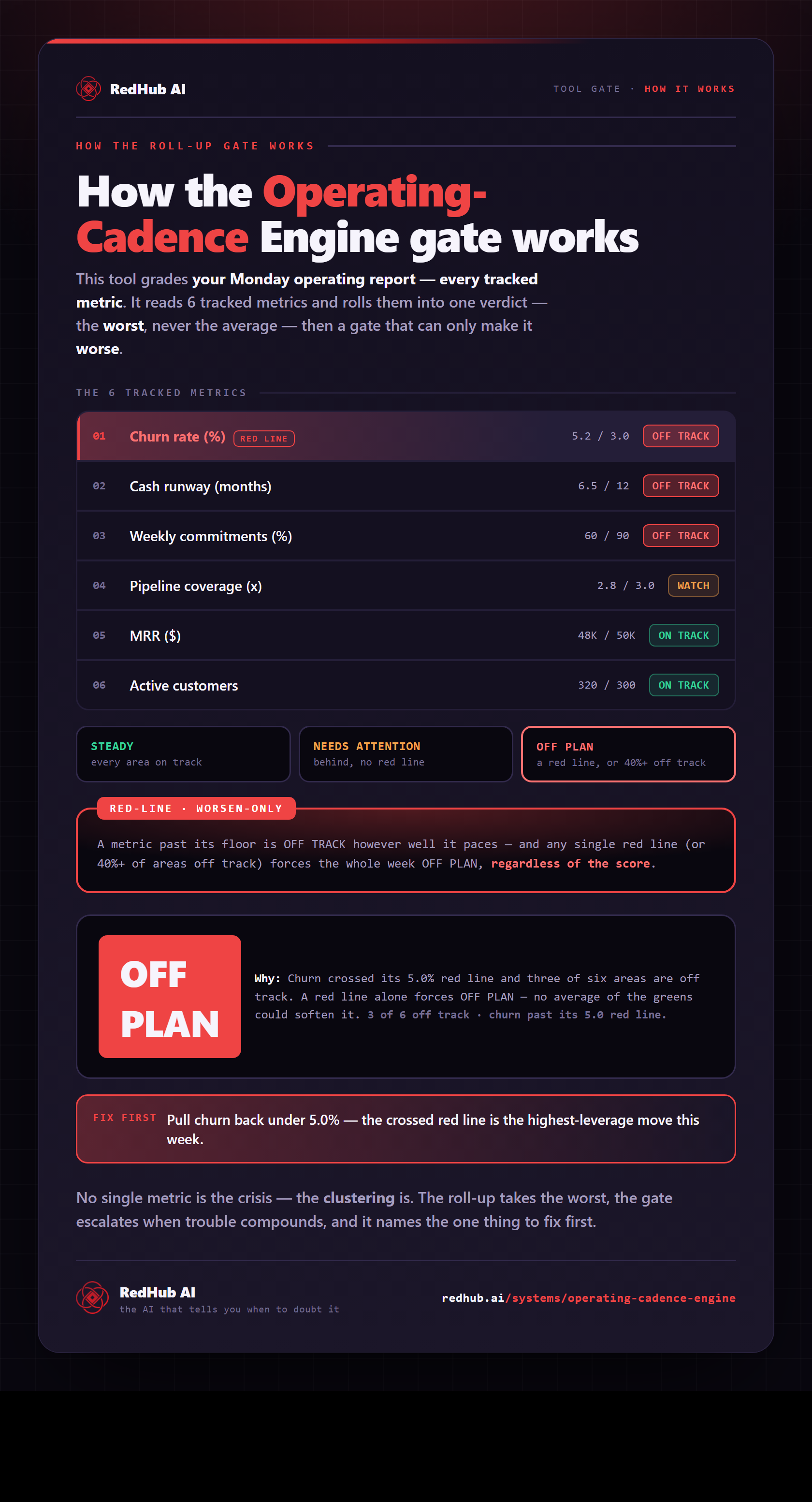
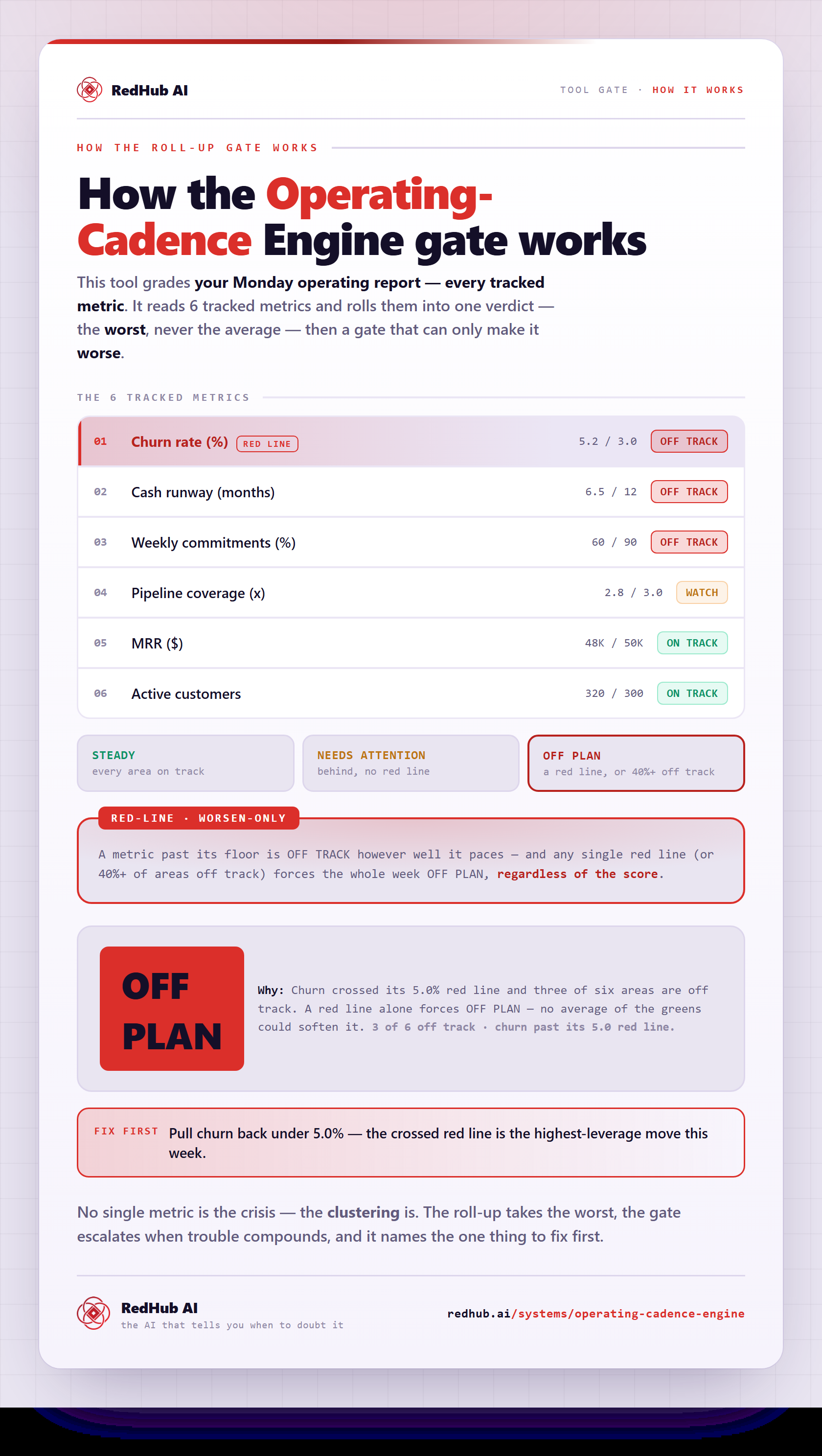
The gate this post refers to, drawn from the tool’s own logic. See the tool.