Founder Operating System: One Honest Page Every Monday
Todd Brooks, Founder6 min read

Jump to a section9
TL;DR
- What it is: A founder operating system reads the company's real systems — calendar, inbox, CRM, metrics — and delivers a graded one-page operating report every Monday.
- Who it's for: Founders running the whole company's operating cadence from their own seat.
- How it works: Collect → grade → set priorities → track week over week. The report lands in the founder's own inbox; the founder acts.
- Bottom line: The cadence that survives is the one that assembles itself. Automate the reading; keep the deciding.
What is a founder operating system?
A founder operating system is the machinery that turns a company's raw signals — booked calendar time, waiting email threads, stale CRM deals, and the metric lines — into one graded page every Monday: the week's verdict, the at-risk flags, what slipped, three priorities, and the single decision to make. It is the founder's side of the company operating cadence: instead of the founder spending Monday morning assembling the picture by hand, the picture arrives assembled, graded against the targets and red lines the founder set, and the founder spends the morning acting on it.
Best for: founders ready to connect their real systems — the Operating Cadence Engine ($299) is this exact system, delivered as four Claude Skills.
The founder is the integration point of the company. Cash, pipeline, customers, and execution all cross one desk — yours — and they arrive in four different tabs that never talk to each other. The calendar knows where the time went. The inbox knows what is waiting. The CRM knows which deals went quiet. The metrics sheet knows the trend. Nobody holds the whole picture, so the whole picture lives in your head, refreshed by anxiety at 6 a.m.
The usual answer is another dashboard. Dashboards do not fix this, because a dashboard is one more tab — it shows numbers and waits for you to visit, interpret, and remember. What a founder needs is the opposite: a report that comes to you, already graded, already prioritized, on a fixed rhythm. One honest page, every Monday, in your own inbox.
What the Monday page contains
- The verdict: the week graded STEADY, NEEDS ATTENTION, or OFF PLAN — with each tracked area marked ON TRACK, WATCH, or OFF TRACK against the target and red line you set. The grading rules live in the company scorecard.
- The at-risk flags: the stale deals, the threads waiting on you, the metric under pressure.
- What slipped: which of last week's commitments happened, which didn't, and which problems have now been carried for weeks.
- Three priorities and a calendar reality-check: the three things that matter this week — and whether your booked time actually matches them.
- The one decision: the highest-leverage call being deferred, named so it stops floating.
How the page assembles itself
Under the hood, a working founder operating system is four jobs run in sequence. In the Operating Cadence Engine, each job is a Claude Skill working through your own MCP connectors:
- Collect. Read the calendar, inbox, CRM, and metrics source and assemble a dated snapshot. If a source isn't connected, say so — never guess.
- Grade. Score every area against its target and red line, call the week's verdict, list the flags, and name the one area to fix first. A crossed red line forces the week OFF PLAN — the floor gate.
- Set priorities. Turn the graded week into three priorities, check them against the booked calendar, and surface the one decision. Recommend what to protect, clear, or decide — never move anything.
- Track. Keep the running week-over-week log so next Monday knows what slipped and which problems are being carried. This is what makes the cadence compound instead of resetting.
The guardrails that make it trustworthy
A system that reads your inbox and CRM has to earn trust, and it earns it through hard boundaries, not promises:
| It reads | It never |
|---|---|
| Your calendar, through your connector | Moves or deletes an event |
| Your inbox threads awaiting you | Replies to email, or sends to anyone but you |
| Your CRM's stale and at-risk deals | Edits a record |
| Your connected metrics source | Invents a number for an unconnected one |
Self-reporting, not autonomy: the report is delivered to your own inbox only. The system reads and synthesizes; you act. That division of labor is deliberate — the honest read is automatable, and the judgment is not. Any tool that offers to do both should worry you.
It feeds the leadership rhythm, too
The Monday page is not just a personal artifact. It is the natural pre-read for the weekly business review — the graded scorecard, the flags, and the slipped items are exactly the first three agenda blocks. A founder who walks in with the page already built runs a 45-minute review instead of a two-hour reconstruction, and the whole leadership meeting rhythm above it gets sharper fuel.
The report also creates work downstream, in a good way. When it flags gone-silent deals week after week, that is a queue to be worked — a system like the CRM Win-Back System turns those flags into a re-engagement sequence, and if the pipeline line itself is the shaky one, The Forecast Floor grades it down to a committed floor before it feeds the Monday page.
Scheduling: "every Monday" is yours to wire
One honest caveat: the delivery rhythm runs on your own automation. The Operating Cadence Engine ships a Scheduled-Delivery & Multi-MCP playbook covering the three common wirings — GoHighLevel, Zapier/Make, or a Claude Code cron — and if you would rather not automate at all, it runs as a one-click Monday ritual. Either way, the cadence costs you minutes, not the Monday morning it used to.
Get your founder operating system, delivered
The Operating Cadence Engine ($299, one-time) — four Claude Skills, a runnable scoring engine, the cadence workbook, the one-page report template, and two setup playbooks. Reads your real systems, grades honestly with a floor gate, reports only to you. One purchase, lifetime access, 12 months of updates.
Get the Operating Cadence Engine — $299 →Decision Guide
Use it if: you run cash, pipeline, customers, and execution out of your own head, and the Monday picture currently assembles itself only via your anxiety.
Skip it if: you want a bot that acts without your review, or you won't connect your systems — a report built on guesses would be worse than none, and this one refuses to guess.
Best first step: write your targets and red lines for the four lanes. The system grades against your numbers, so the numbers come first.
FAQ
What is a founder operating system?
The machinery that reads a company's real systems — calendar, inbox, CRM, metrics — and delivers a graded one-page operating report to the founder every Monday: verdict, flags, what slipped, three priorities, and the one decision to make.
How is this different from a dashboard?
A dashboard waits for you to visit and interpret it. An operating system delivers a graded verdict to your inbox on a fixed rhythm, with priorities and a decision attached. Push beats pull, and a grade beats a chart.
Does it take actions in my systems?
No. It reads through your own connectors and self-reports to your own inbox only. It never sends to anyone else, replies to email, edits a CRM record, or moves a calendar event. You act on the priorities.
What if one of my sources isn't connected?
The report marks it not-connected and moves on — it never invents a number to fill the gap. If a required source is missing, it stops rather than fabricating. That refusal is what keeps the page trustworthy.
Do I need a leadership team to use this?
No. The Monday page works for a founder running solo, and it becomes the leadership team's weekly pre-read the day you have one. The cadence scales up without changing shape.
Is this financial advice?
No. It is operating hygiene — the targets, red lines, and decisions are your own calls. The system grades your numbers against your limits; it does not advise on what those limits should be.
What exactly ships in the Operating Cadence Engine?
Six deliverables: the Python operating-report engine, four Claude Skills (collector, synthesizer, priority-setter, tracker), the Operating Cadence workbook, the one-page report template, the Weekly Operating Cadence playbook, and the Scheduled-Delivery & Multi-MCP playbook. $299 once — see the full page.
Stop reacting to your week. Start running it.
One honest page every Monday, from your own systems, with the judgment left with you. $299, once.
Get the Operating Cadence Engine →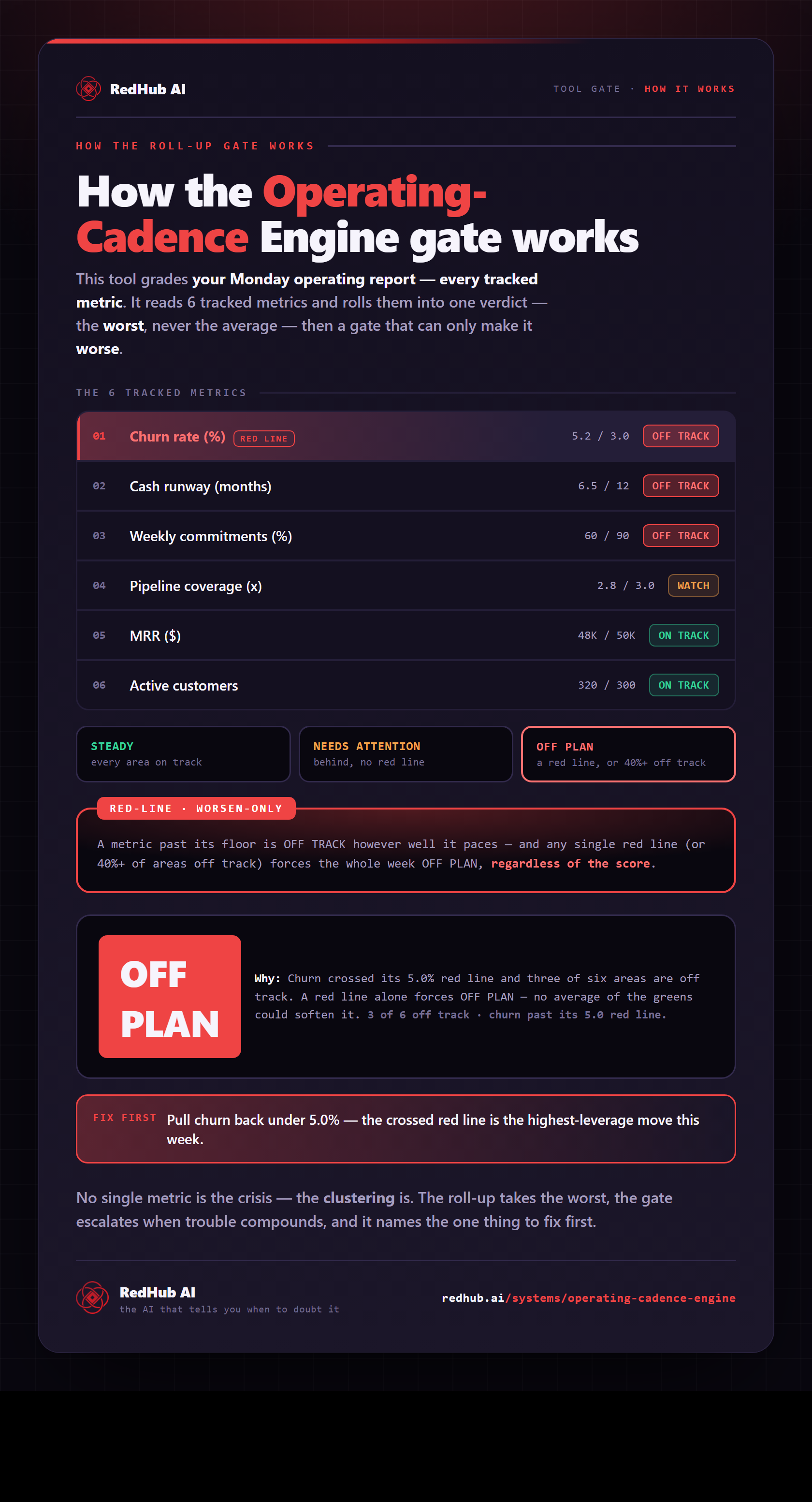
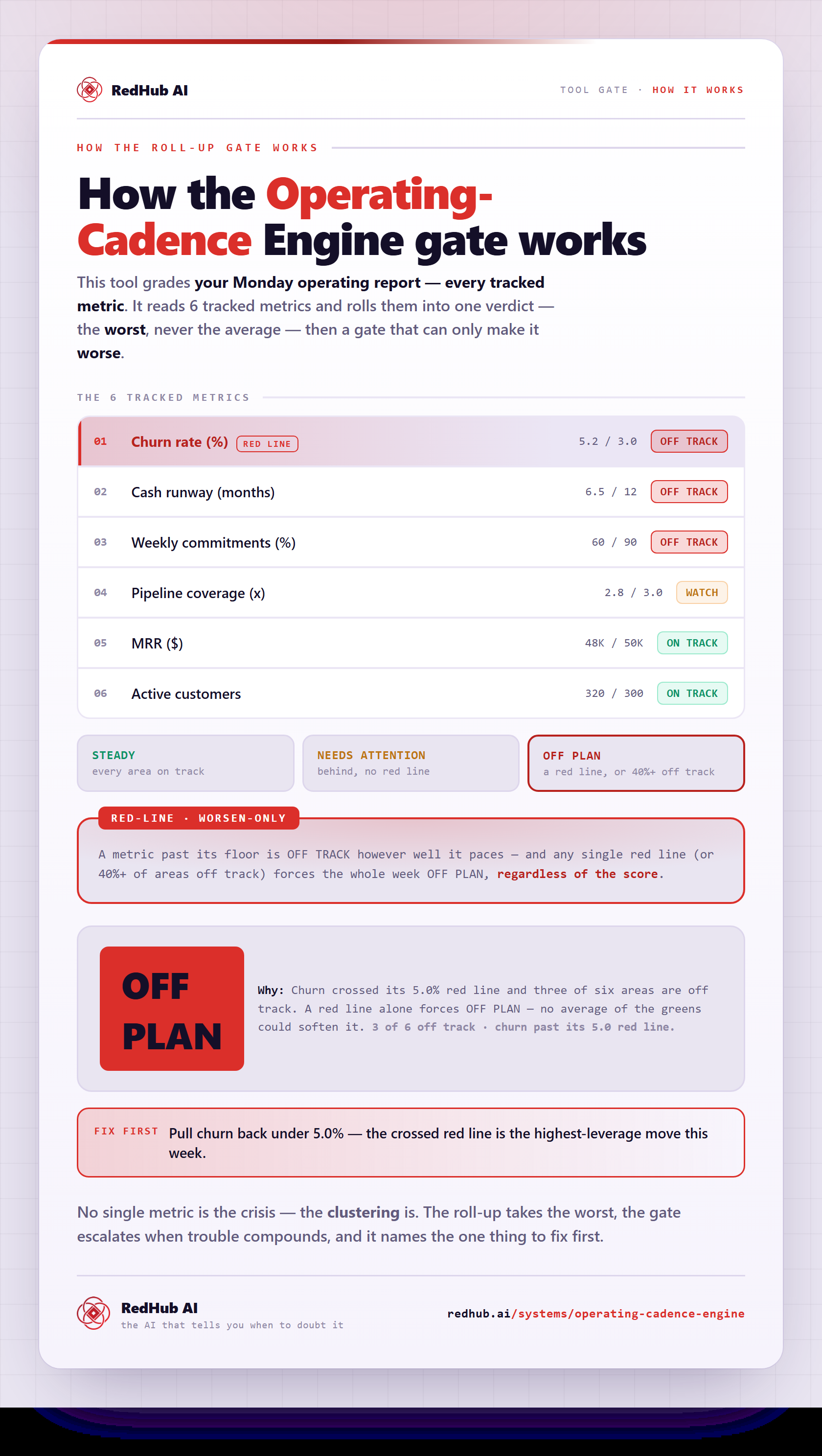
The gate this post refers to, drawn from the tool’s own logic. See the tool.