How to Red Team Your Decision Before You Commit
RedHub AI Editorial6 min read

Jump to a section9
TL;DR
- What it is: To red team a decision is to assign someone — or something — the explicit job of building the strongest case against it before you commit.
- The rules: Steelman, don't strawman. Challenge before you score. Split the attack across five distinct lenses. Let one fatal objection veto everything.
- Who it's for: Founders about to commit to a pivot, raise, price change, or key hire — see the Devil's-Advocate Board.
- Bottom line: A decision that has never faced its strongest opponent hasn't been tested. It's been admired.
What does it mean to red team your decision?
To red team your decision means assigning a dedicated adversary the job of attacking it before you commit. Borrowed from security practice — where a red team attacks a system to find its weaknesses before real attackers do — the decision version builds the strongest honest case against your plan across several angles: evidence, demand, downside, execution, and the single objection that kills it. The decision passes only if it survives the attack, and one fatal objection is enough to fail it.
Best for: the adversarial step of any hard call — part of our guide on how to make a hard decision without a board.
Security teams learned something a long time ago that most founders haven't applied to their own decisions: the people who built a thing are the worst people to find its flaws. Not because they're careless — because they're invested. So security practice splits the roles. One side builds. A separate side, the red team, attacks. The attack isn't hostility. It's the test.
When you red team your decision, you apply the same split to a pivot, a raise, a price change, a key hire. You stop asking "is this a good plan?" — a question your own brain will happily answer yes — and start asking "what is the strongest case that this plan fails?" Then you see whether your plan survives it.
Steelman, don't strawman
The most common way founders fake this exercise is by attacking a weak version of the objection. "Some people might say it's risky" is a strawman — easy to knock over, and knocking it over feels like diligence. A real red team steelmans: it builds the strongest, most evidence-grounded version of the case against, the one a smart, motivated opponent would actually make.
A useful honesty check here is the rival test: would you judge this move the same way if a competitor made it? Founders routinely describe their own pivot as bold and a rival's identical pivot as desperate. If the two answers differ, the difference is your bias talking — not the evidence.
Key insight: the goal of a red team isn't to kill the decision. It's to make sure that if the decision survives, it deserved to. A plan that beats its strongest opponent is a plan you can commit to without flinching.
One skeptic isn't enough — use five lenses
A single devil's advocate has a single perspective, and big decisions fail in more ways than one person naturally thinks about. Splitting the attack across five distinct lenses covers the main failure modes:
| Lens | Attacks the decision on | Typical objection |
|---|---|---|
| The Skeptic | Evidence | "Your case rests on assumptions tagged as facts." |
| The Customer | Demand | "Nobody asked for this. You inferred they want it." |
| The CFO | Downside | "If this misses, you can't survive the miss." |
| The Operator | Execution | "This plan requires a team and a timeline you don't have." |
| The Contrarian | The kill-shot | "Here is the one thing everyone is politely not saying." |
The Contrarian seat matters most and gets skipped most. The other four lenses attack known categories. The Contrarian's only job is to find the objection that doesn't fit a category — the one that, once said out loud, everyone realizes they'd been avoiding.
How to run a decision red team
- Frame the decision first — one sharp, time-boxed sentence, with its assumptions listed and tagged. A vague decision can't be attacked honestly. (If you haven't framed it yet, start with a pre-mortem analysis.)
- Take each lens in turn and write the strongest case against the decision from that angle. Challenge before score — no numbers yet.
- Apply the rival test to each case: would this objection stand if a competitor made the same move? Rewrite any case where your answer changes.
- Now score: for each lens, rate 0–5 how well your decision survives that case. Score the survival, not your enthusiasm.
- Apply the veto: any lens where the case against wins outright is a fatal objection, and a fatal objection means no-go — regardless of the other four scores.
The order is the discipline. Scoring first turns the exercise into self-defense; every objection after the number becomes something to argue down. Challenge first, score second, veto last.
Where red teaming wins — and where it doesn't
Where it wins
- Irreversible, high-cost decisions
- Plans everyone already agrees with
- Decisions where excitement is doing the arguing
- Solo founders with no natural dissent
Where it doesn't
- Small, reversible calls — just decide
- Decisions already made (that's a post-mortem)
- When you won't accept a no-go verdict anyway
- As a substitute for gathering real evidence
That last point deserves a beat. A red team argues from the evidence you bring it. If your evidence is thin, the honest output isn't a clever counter-argument — it's "go get the evidence." A red team that invents facts in either direction is theater.
Running the red team when you have no team
All of this assumes someone plays the opposition — and solo founders don't have five skeptical colleagues on call. Playing all five roles yourself works better than nothing, but you'll pull punches without noticing. This is where a structured AI board earns its place: not a chatbot you ask to argue with you (that drifts back to agreeable — see AI devil's advocate), but fixed adversarial roles with scoring rules the model can't soften.
The Devil's-Advocate Board ($199) is that structure packaged: the five lenses above as Claude Skills, challenge-before-score enforced, the rival test built into the method, a 0–100 conviction score on fixed weights, and a veto gate where one fatal objection forces NO-GO no matter the total. It stress-tests the decision; it doesn't make it. You still decide, and you still own the outcome.
Two natural places to point it: the deals in your pipeline you're about to bet a quarter on — Pipeline Commander ($249) tells you which commitments your forecast actually rests on — and, if you run the full Executive Suite, the Agentic Executive Harness ($299) rolls the board's verdicts into one company status alongside the rest of your operating signals.
Decision Guide
Red team your decision if: it's expensive or irreversible, everyone already agrees, or you notice you're gathering support instead of evidence.
Skip it if: the call is small and reversible, or you've already decided and nothing will change your mind — then be honest about that instead.
Best first step: write the strongest one-paragraph case against your pending decision, as if a smart competitor wrote it. If you can't, you don't understand the decision yet.
FAQ
What does it mean to red team a decision?
It means assigning a dedicated adversary — a person, a structured process, or a structured AI — the explicit job of building the strongest case against your decision before you commit, then seeing whether the decision survives.
What's the difference between a red team and a devil's advocate?
A devil's advocate is one dissenting voice. A red team is a structured attack across multiple angles — evidence, demand, downside, execution, and the kill-shot — with rules that keep the attack honest and a verdict at the end.
What is steelmanning?
Building the strongest, fairest version of the argument against your position instead of a weak version you can easily dismiss. It's the difference between testing your plan and rehearsing its defense.
What is the rival test?
A bias check: would you judge this move the same way if a competitor made it? If your own pivot reads as bold but a rival's identical pivot would read as desperate, bias is doing the scoring.
Why score after the challenge instead of before?
Because a number stated first becomes the thing you defend. Writing the case against first means the score measures how well the decision survived a real objection, not how attached you are to it.
Why does one fatal objection override a high score?
Because averages hide lethal flaws. A decision can score well on four of five lenses and still contain one objection that ends the company. The veto makes that objection impossible to paper over.
Can I red team my own decision without a team?
Partly — write the case against yourself using the five lenses and the rival test. The honest limit is that you'll pull punches. A structured tool like the Devil's-Advocate Board holds the adversarial frame for you; the final call stays yours.
Give your decision a real opponent
The Devil's-Advocate Board ($199, one-time) runs the full red team: five skeptical lenses, challenge before score, the rival test, a 0–100 conviction score, and a veto gate where one fatal objection forces NO-GO. A stress-test, not a decision-maker. Instant download, 30-day guarantee.
Get the Devil's-Advocate Board — $199 →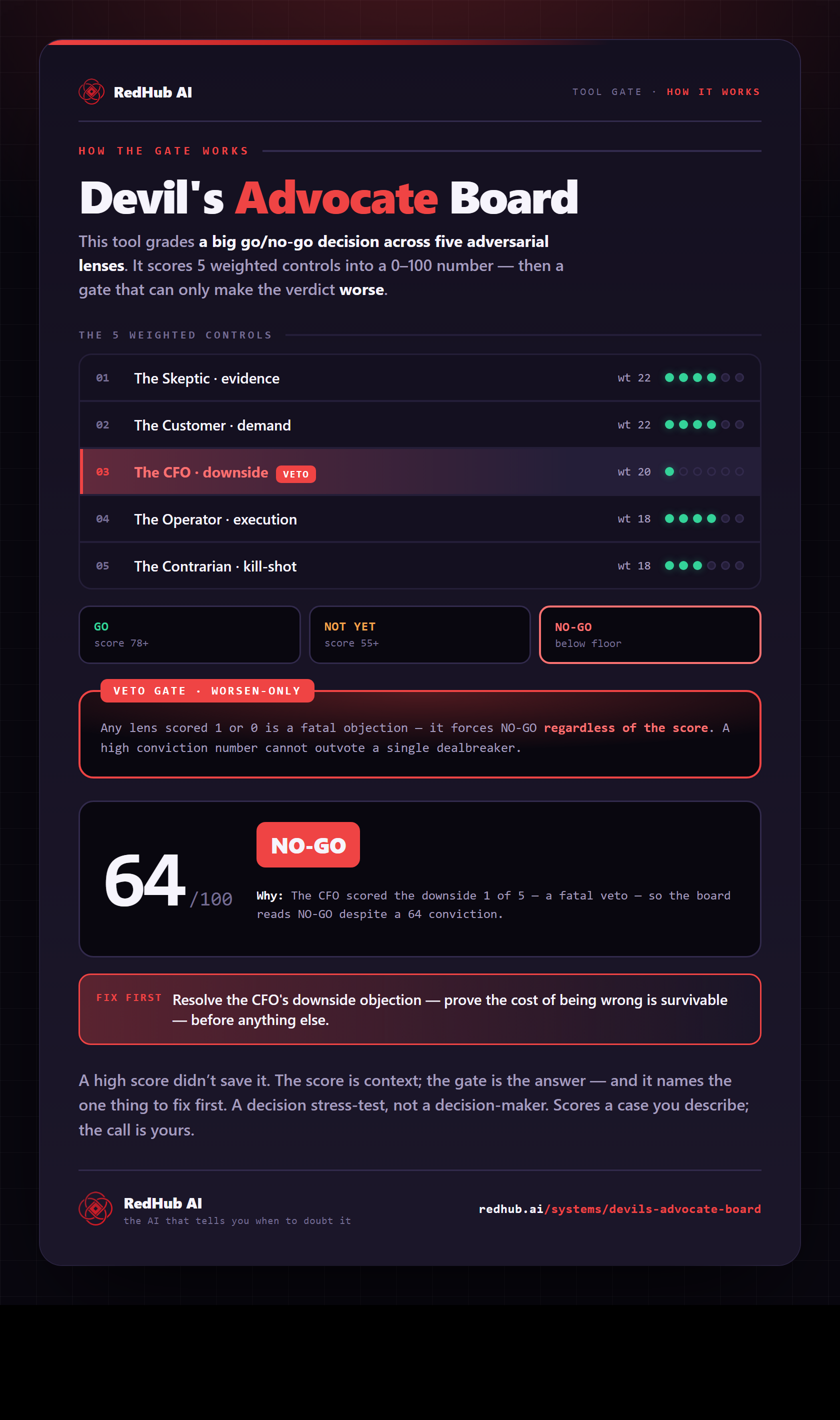
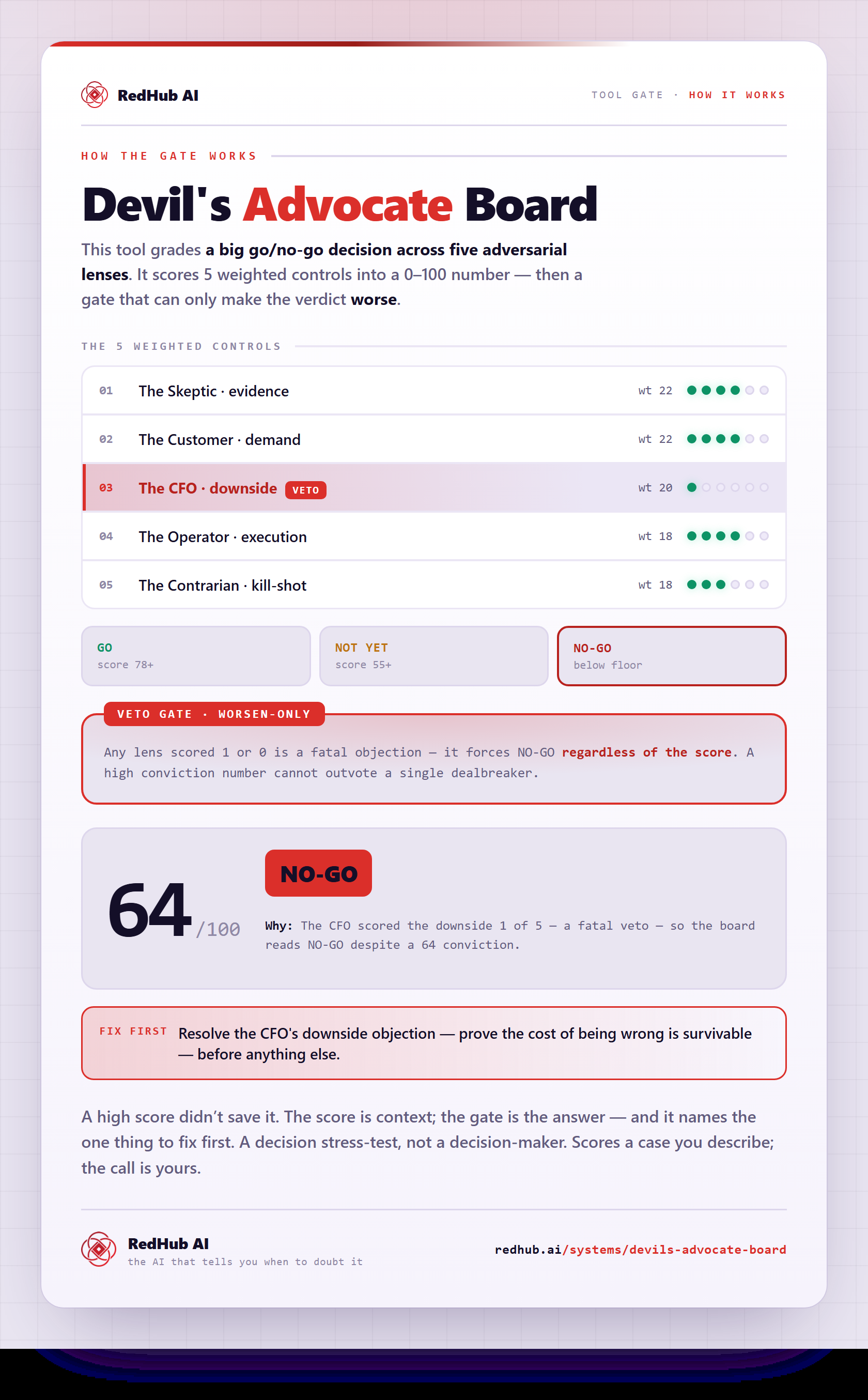
The gate this post refers to, drawn from the tool’s own logic. See the tool.