How to Make a Hard Decision Without a Board
RedHub AI Editorial9 min read

Jump to a section12
- TL;DR
- How do you make a hard decision without a board?
- Why hard decisions go wrong for solo founders
- The four-step method
- Step 1 — Frame the decision so it can be tested
- Step 2 — Build the strongest case against it
- Step 3 — Score it, and let one fatal objection veto
- Step 4 — Journal it, and re-test when assumptions break
- Can AI run this for you?
- Which decisions deserve this treatment
- Where to go deeper
- Decision Guide
TL;DR
- The problem: Solo founders make the biggest calls — pivots, raises, price changes, key hires — with nobody paid to disagree.
- The method: Frame the decision as one sharp question, build the strongest case against it, score how well the case survives, and let one fatal objection veto everything.
- Who it's for: Founders and operators with a hard-to-reverse decision pending and no real board to pressure-test it — see RedHub Systems.
- Bottom line: The quality of a hard decision is set by the quality of the dissent it survived. Manufacture the dissent before you commit.
How do you make a hard decision without a board?
You make a hard decision without a board by replacing the missing dissent with structure. Frame the decision as one specific, time-boxed question. Then build the strongest case against it from several angles — evidence, demand, downside, execution, and the one thing that kills it. Score how well your case survives each challenge, and treat any fatal objection as a veto, no matter how good the rest looks. The decision stays yours; the structure just makes sure you heard the argument against it first.
Best for: founders facing a pivot, raise, price change, or key hire — see the Devil's-Advocate Board ($199).
Every founder eventually faces a decision that could sink the company. A pivot. A raise. A price change. A key hire. A big contract with terms you can't easily exit. These calls have two things in common: they're hard to reverse, and you'll probably make them alone.
That's the real gap in how to make a hard decision as a solo or lightly-advised founder. It isn't intelligence, and it isn't information. It's dissent. A real board exists to tell a CEO no. Without one, the biggest decisions of your company's life get reviewed by exactly one person — the person most excited about them.
This guide walks through a four-step method for stress-testing a hard decision when nobody else will: frame it, red-team it, score it with a veto, and journal it so the verdict stays honest over time.
Why hard decisions go wrong for solo founders
Three forces push a solo founder toward rubber-stamping their own plan.
First, everyone around you is invested. Your team wants the plan to work because their jobs depend on it. Your investors want momentum. Your friends want to be supportive. Honest dissent is the scarcest resource a founder has, and it gets scarcer as the stakes rise.
Second, your tools agree with you too. Ask a chatbot whether your pivot is a good idea and it will call it promising. Describe the same idea as a competitor's move and it often says the same thing. That's not judgment — it's a mirror with a vocabulary. We dig into why in AI devil's advocate: make AI argue against you.
Third, the dangerous decisions feel like progress. The pivot, the raise, the new market — the moves that can kill a company are exactly the ones that feel most exciting. Excitement is not evidence. Your own mind quietly filters for the facts that support the plan, a pattern covered in confirmation bias in decision making.
Key insight: a hard decision doesn't fail because nobody could see the problem. It fails because nobody in the room had a reason to say it out loud. If your room is just you, the structure has to do that job.
The four-step method
Here's the whole method at a glance. Each step gets its own section below.
- Frame the decision as one sharp, time-boxed question — and list the assumptions it rests on.
- Build the strongest case against it from five distinct angles.
- Score how well your case survives each challenge, and let one fatal objection veto everything.
- Journal the decision and re-test it when an assumption breaks.
Step 1 — Frame the decision so it can be tested
A fog can't be stress-tested. "Should we pivot?" is a mood, not a decision. "Should we move the product to usage-based pricing for new customers starting next quarter?" is a decision — specific, time-boxed, testable.
Framing has three parts. State the question in one sentence. List the options you're skipping, especially the smaller test and the option of doing nothing. Then write down every assumption the case rests on, and tag each one honestly: evidenced, assumed, or hoped. That last tag is where most hard decisions quietly fall apart — the plan looks solid until you notice how much of it is hoped.
The single best framing exercise is the pre-mortem: assume the decision already failed, and write the story of why. It's a real research-backed technique, and it works because it makes pessimism a task instead of a betrayal. The full walkthrough is in pre-mortem analysis: kill the plan before it kills you.
Step 2 — Build the strongest case against it
One devil's advocate isn't enough, because one skeptic has one blind spot. The failure modes of a big decision cluster into five distinct angles, and each deserves its own advocate:
| Lens | The question it asks | What it catches |
|---|---|---|
| The Skeptic | What does the evidence actually show? | Cases built on hope tagged as fact |
| The Customer | Does anyone actually want this? | Demand you assumed instead of observed |
| The CFO | What does the downside cost? | Bets you can't survive losing |
| The Operator | Can you actually execute this? | Plans that need a team you don't have |
| The Contrarian | What's the one thing that kills it? | The kill-shot nobody else was assigned to find |
The rule that keeps this honest: the case against comes first, before any scoring. If you score first, the score becomes the thing you defend. Write the strongest argument against your decision — not a strawman you can knock over — and only then judge how well your case survives it. The full technique, including the rival test, is in how to red team your decision before you commit.
Step 3 — Score it, and let one fatal objection veto
Scoring turns a pile of objections into a verdict. Rate how well your case survives each lens on a simple scale, roll it up to an overall conviction score, and map the score to a verdict: go, go with conditions, not yet, or no-go.
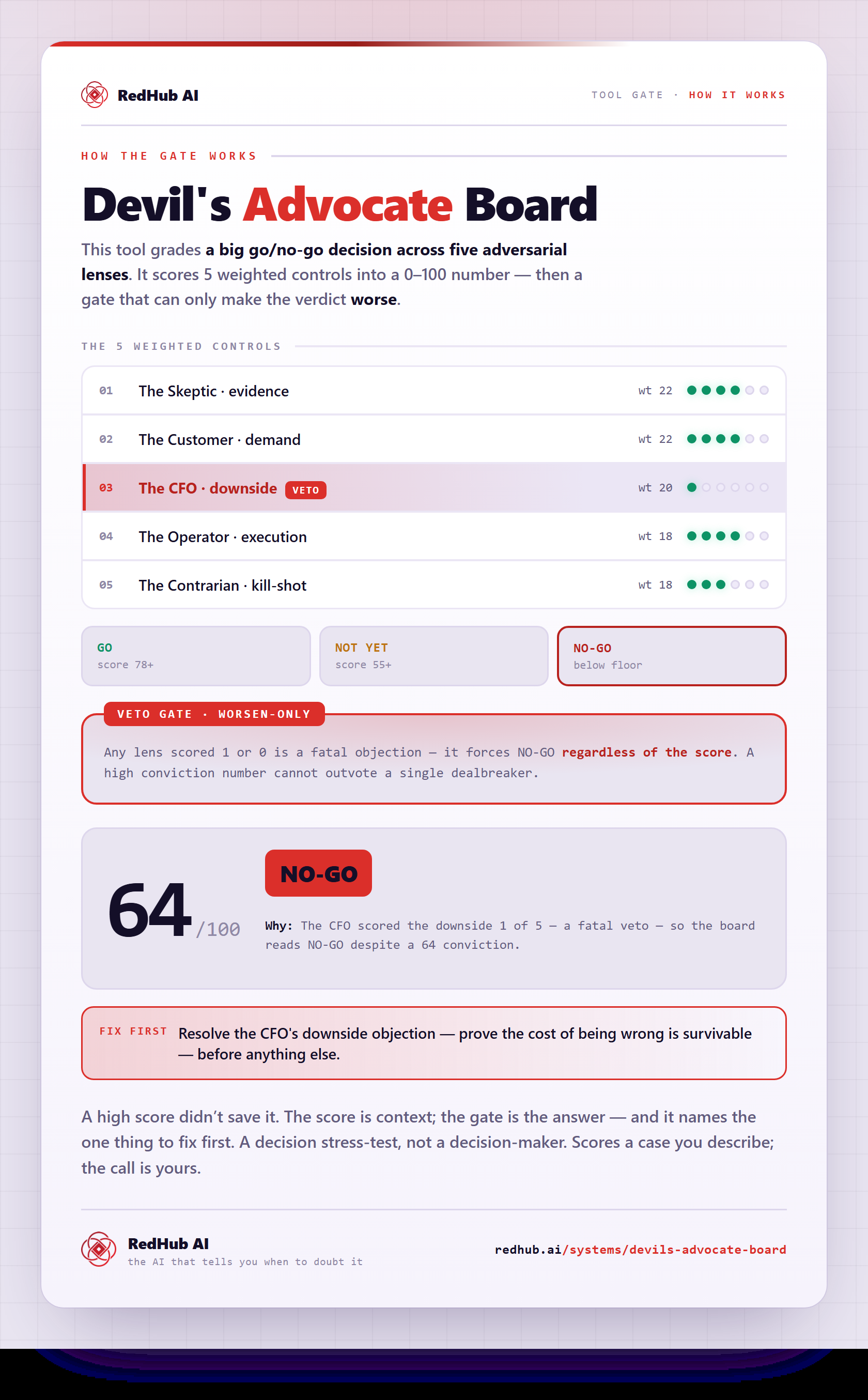
But an average hides the thing that matters most. A decision can score well on four lenses and still contain one objection that kills the company. That's why the method needs a veto gate: if any single lens finds a fatal objection, the verdict is no-go — no matter how high the total.
Here's what that looks like in practice. In the built-in demo scenario of the Devil's-Advocate Board, a decision scores a respectable 64 out of 100 — and still comes back NO-GO, because the CFO lens rates the downside case a fatal objection. Four lenses liked the plan. One found the thing that kills it. Without the veto, that decision ships. That worked example is the product's own demo math, not a customer story — but it's exactly the shape of the mistake the veto exists to catch.
Step 4 — Journal it, and re-test when assumptions break
A verdict is only as good as the assumptions under it. A GO that rested on "demand shows up in 60 days" stops being a GO on day 61 if demand didn't show. So the last step is a decision journal: log the decision, the verdict, and the assumptions it rested on. When an assumption breaks, re-run the test. You want to find out the ground moved before it costs you — not at the post-mortem.
Can AI run this for you?
Partly — and the boundary matters. AI is genuinely good at generating the case against a decision, holding five distinct lenses at once, and applying scoring rules without flinching. What a plain chatbot is bad at is staying adversarial: ask it to argue with you and within a few exchanges it drifts back to agreeable. Structure fixes that — named lenses, challenge-before-score, fixed weights, and a veto the model can't soften. The comparison is in AI devil's advocate.
What AI should never do is make the call. A stress-test tells you what the strongest case against your decision is and whether your case survives it. The decision — and its consequences — stay yours. Any tool that promises otherwise is selling you a coin with extra steps.
The board that tells you no
The Devil's-Advocate Board ($199, one-time) packages this whole method: four Claude Skills that frame, red-team, synthesize, and journal one decision; a runnable Python stress-test engine; a decision workbook; a board-verdict template; and two playbooks. Five lenses, a 0–100 conviction score, and a veto gate that forces NO-GO on any fatal objection.
Get the Devil's-Advocate Board — $199 →Which decisions deserve this treatment
Not every decision earns a stress-test. If a call is cheap and reversible, deciding fast beats deciding well — just pick and move. Reserve the full board for the calls that are expensive, hard to reverse, or both. As a rough filter: if being wrong would cost you a quarter of runway, a key relationship, or the ability to change course, it qualifies.
The same logic runs through the rest of a founder's operating stack. The Operating Cadence Engine ($299) surfaces the high-stakes calls your weekly operating report keeps flagging — those are exactly the ones to bring to the board. And when the decision is a money decision — the raise, the big spend — Cash-Flow Sentinel ($249) gives the CFO lens real numbers to argue with instead of vibes.
Where to go deeper
This pillar is the map. Each part of the method has its own guide:
- Pre-mortem analysis — imagine the failure before you commit.
- Red team your decision — build the strongest case against, fairly.
- Confirmation bias in decision making — why you rubber-stamp your own plans, and the structural fixes.
- AI devil's advocate — why "argue with me" prompts drift, and what holds the line.
Decision Guide
Use this method if: you have a high-stakes, hard-to-reverse decision pending — a pivot, raise, price change, key hire, or big contract — and no real board to pressure-test it.
Skip it if: the decision is cheap and reversible. Decide fast, learn, and adjust — speed beats process on small calls.
Best first step: write your decision as one sentence, list its assumptions, and tag each one evidenced, assumed, or hoped. The tags alone will tell you if you're ready to commit.
FAQ
How do you make a hard decision without a board?
Replace the missing dissent with structure: frame the decision as one sharp question, build the strongest case against it from several distinct angles, score how well your case survives, and treat any fatal objection as a veto. Then make the call yourself, with the argument against it fully heard.
What counts as a hard decision?
One that's expensive, hard to reverse, or both — a pivot, a raise, a price change, a key hire, a major contract. If being wrong would cost serious runway or the ability to change course, it qualifies for the full stress-test.
Why five lenses instead of one devil's advocate?
Because one skeptic has one blind spot. Big decisions fail on evidence, demand, downside, execution, or a single kill-shot — five different failure modes that need five different advocates.
What is a veto gate?
A rule that says one fatal objection forces a no-go verdict no matter how high the overall score. It exists because averages hide the one thing that kills you — a decision can score 64/100 and still contain a company-ending flaw.
Can AI make hard decisions for me?
No, and it shouldn't try. AI is useful for generating the case against your decision and applying scoring rules without flinching. The verdict is an input. The decision, and its consequences, stay yours.
Isn't this just overthinking?
For small decisions, yes — decide fast and move. For irreversible ones, a structured half-day of dissent is cheap insurance against a mistake you can't undo. The method includes the filter for which is which.
Which RedHub tool runs this method?
The Devil's-Advocate Board ($199, one-time) — four Claude Skills, a runnable stress-test engine, a decision workbook, a verdict template, and two playbooks. It's a stress-test, not a decision-maker: it will tell you no, and the call is still yours.
Bring one decision. Let the board try to kill it.
Five skeptical lenses build the strongest case against your decision and score how well it survives — GO, GO WITH CONDITIONS, NOT YET, or NO-GO, with a veto gate for fatal objections. One-time $199, instant download, yours to keep. 30-day guarantee. It will tell you no — that's the point.
Get the Devil's-Advocate Board — $199 →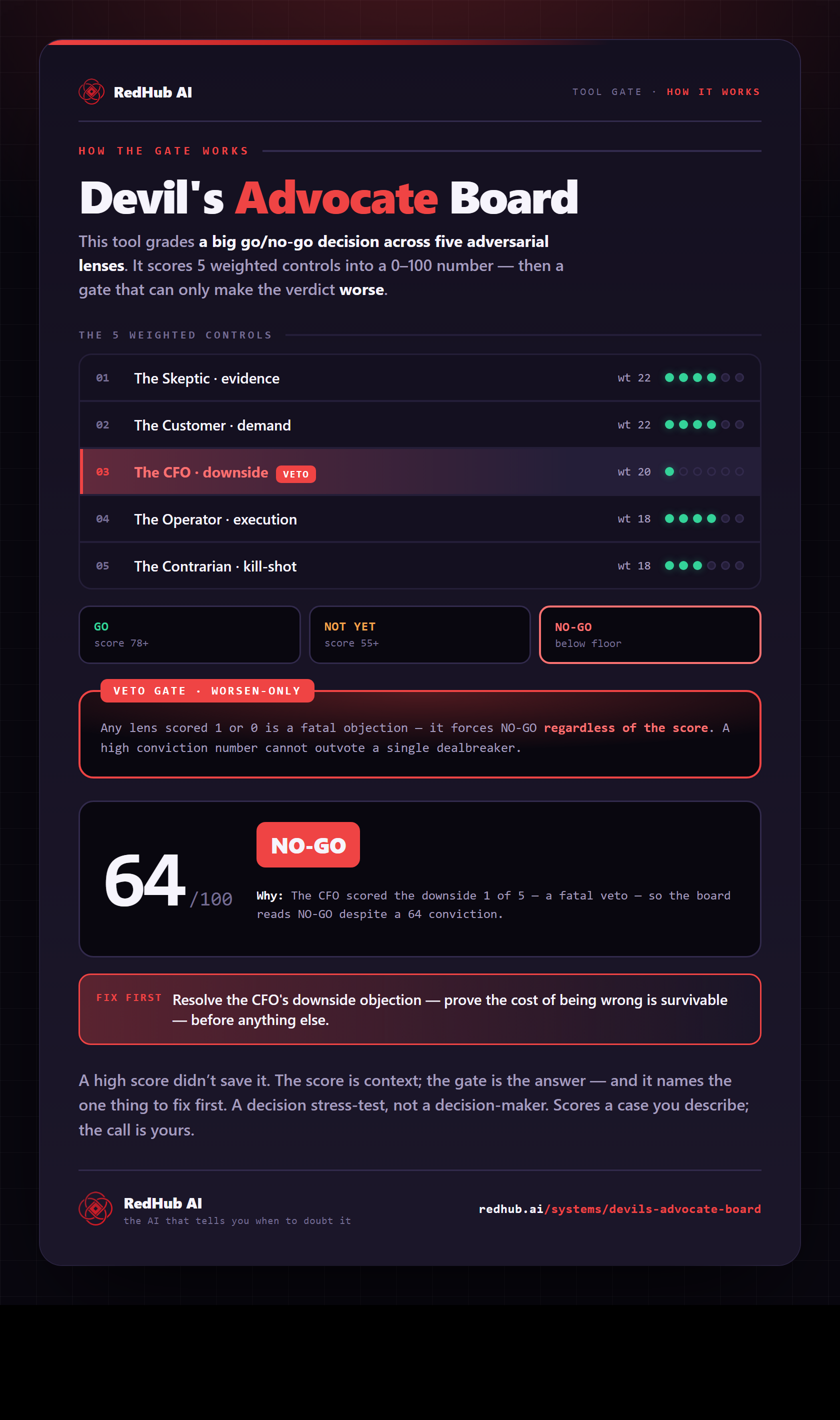
The gate this post refers to, drawn from the tool’s own logic. See the tool.