Pre-Mortem Analysis: Kill the Plan Before It Kills You
RedHub AI Editorial6 min read

Jump to a section9
TL;DR
- What it is: A pre-mortem assumes your decision has already failed, then asks everyone to write the story of why — before you commit.
- Why it works: Imagining the failure as a fact makes pessimism a task instead of a betrayal, so the real objections finally get said.
- Who it's for: Founders facing a pivot, raise, price change, or key hire with no board to push back — see the Devil's-Advocate Board.
- Bottom line: Every plan gets a post-mortem eventually. The pre-mortem is the one you get to hold while the plan can still change.
What is pre-mortem analysis?
Pre-mortem analysis is a decision technique where, before committing to a plan, you assume it has already failed — completely — and work backward to explain why. Instead of asking "what could go wrong?", which invites polite hedging, it asks "the plan failed; write the story of the failure." The technique was described by research psychologist Gary Klein, and it works because framing the failure as a settled fact frees people to name the risks they were holding back.
Best for: the framing step of any hard call — part of our guide on how to make a hard decision without a board.
Ask a team "what could go wrong with this plan?" and you get soft answers. Timelines might slip. Adoption could be slower than hoped. Nobody names the thing that actually worries them, because naming it sounds disloyal — especially when the founder is visibly excited.
Pre-mortem analysis flips the frame. The plan has failed. It's a fact. Now explain it. That one move changes what people are willing to say, because they're no longer criticizing your plan — they're solving a puzzle you handed them.
Where the technique comes from
The pre-mortem was described by Gary Klein, a research psychologist who studies how people make decisions under pressure, in a widely cited Harvard Business Review piece, Performing a Project Premortem (opens in a new tab). The mechanism it leans on is called prospective hindsight: imagining that an outcome has already happened makes people better at generating concrete reasons for it than asking about the same outcome as a possibility.
In plain terms: "this might fail" produces hedges. "This failed — why?" produces causes.
Key insight: the pre-mortem doesn't make anyone smarter. It makes honesty cheaper. The information about why your plan will fail usually already exists — in your team, in your own head — and the frame is what decides whether it gets said before or after the money is spent.
How to run a pre-mortem solo
Klein's version assumes a room full of people. Most founders don't have the room. Here's the solo version:
- Write the decision as one sharp sentence — what you're doing, by when. "Should we pivot?" won't work. "We move all new customers to usage-based pricing next quarter" will.
- Set the scene: it's twelve months later and the decision failed badly. Say it as fact, not possibility.
- Set a timer and write every reason the failure happened. Aim for volume. Don't filter, don't defend, don't stop at the comfortable ones.
- Sort the reasons into three piles: things you can test cheaply now, things you can watch for early, and things that would be fatal if true.
- For each fatal reason, write what evidence would tell you it's real — before you commit, not after.
The fatal pile is the one that matters. A plan with three cheap-to-test risks is a plan with homework. A plan with one fatal risk you can't rule out is a plan that isn't ready — no matter how exciting it feels.
Does this decision even need a pre-mortem?
Not every call deserves the full treatment. Small, reversible decisions should be made fast. The checklist below is a rough filter — it counts common risk markers and returns a reflection. It's a prompt for thought, not advice, and it doesn't know your business.
Decision-stakes checklist
Check the statements that apply to your pending decision.
This is a reflection prompt, not advice. It counts checkboxes — it doesn't know your decision.
Note the fourth marker. Universal agreement isn't reassurance — for a big decision, it's often a sign nobody has done the dissent yet. That's the pattern covered in confirmation bias in decision making.
The pre-mortem's limit — and what comes after
A pre-mortem generates the failure stories. It doesn't tell you what to do with them. That's its limit: you end the exercise holding a list of reasons your plan might die, with no structured way to weigh them, no verdict, and — if you ran it solo — no one checking whether you went easy on yourself.
The next step is to turn the failure stories into a real stress-test. Assign each story to a skeptical lens — evidence, demand, downside, execution, the kill-shot — build the strongest version of each case against the plan, and score how well your plan survives. That's the adversarial half of the method, covered in how to red team your decision.
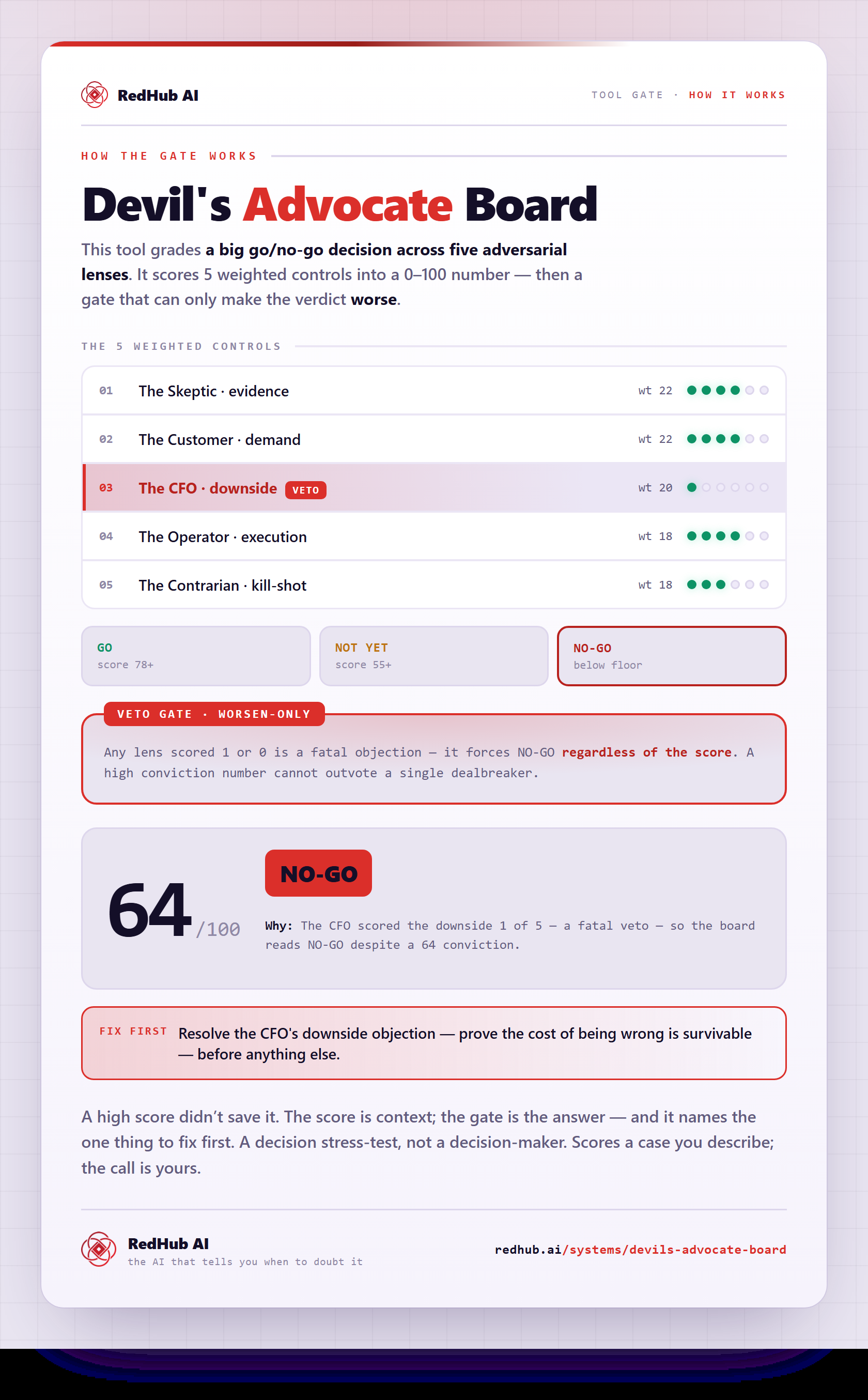
This is exactly the pipeline the Devil's-Advocate Board ($199) runs. Its decision-framer skill does the pre-mortem's framing work — one sharp question, the options you're skipping, every assumption tagged evidenced, assumed, or hoped. Then five board-member lenses each build the strongest case against the decision and score it, a veto gate forces NO-GO on any fatal objection, and a decision journal re-tests the verdict when an assumption breaks. It's a stress-test, not a decision-maker — the call stays yours.
Which decisions to bring first
Money decisions are the natural starting point, because their failure stories are the most concrete. If the decision is a raise or a major spend, ground the downside story in your actual runway math first — Cash-Flow Sentinel ($249) exists for exactly that. And if you're not sure which pending call deserves the treatment, the Operating Cadence Engine ($299) surfaces the high-stakes decisions your weekly numbers keep pointing at.
Decision Guide
Run a pre-mortem if: the decision is hard to reverse, commits real money, or everyone around you already agrees — especially if all three.
Skip it if: the decision is cheap and reversible. Decide fast; a wrong small call teaches more than a slow one.
Best first step: set a 15-minute timer, write "it's a year later and this failed" at the top of a page, and list every reason. Then sort for the fatal ones.
FAQ
What is a pre-mortem analysis?
A technique where you assume a plan has already failed and work backward to explain why — before committing. It surfaces the objections a "what could go wrong?" discussion politely suppresses.
Who invented the pre-mortem?
Research psychologist Gary Klein described it, most famously in a Harvard Business Review article called "Performing a Project Premortem." It builds on research into prospective hindsight — imagining an outcome as already true.
Can I run a pre-mortem alone?
Yes. Frame the decision in one sentence, declare it failed, list every reason under a timer, then sort the reasons into testable, watchable, and fatal. The solo weakness is going easy on yourself — which is why a structured adversarial pass afterward helps.
How long should a pre-mortem take?
The core exercise fits in 15 to 30 minutes. The follow-up — testing the fatal reasons before you commit — takes as long as the evidence takes. That trade is the point: minutes of imagined failure against months of real failure.
What do I do with the failure reasons?
Sort them. Cheap-to-test reasons become homework. Early-warning reasons become things you watch. Fatal reasons become the case against the decision — and if you can't rule one out, the honest verdict is not yet.
Is a pre-mortem the same as a risk register?
No. A risk register lists possibilities with probabilities and owners. A pre-mortem generates causes by treating the failure as a fact — it's a discovery tool, not a tracking document. Many teams feed one into the other.
How does the Devil's-Advocate Board relate to a pre-mortem?
It's the pre-mortem taken to a verdict. The framer skill structures the decision and its assumptions, five skeptical lenses build the strongest case against it, and a scored verdict with a veto gate replaces the loose list of worries. The final call is still yours.
Turn your failure stories into an honest verdict
The Devil's-Advocate Board ($199, one-time) frames your decision, red-teams it from five skeptical lenses, and returns GO, GO WITH CONDITIONS, NOT YET, or NO-GO — with a veto gate that lets one fatal objection kill a high score. Instant download, yours to keep, 30-day guarantee.
Get the Devil's-Advocate Board — $199 →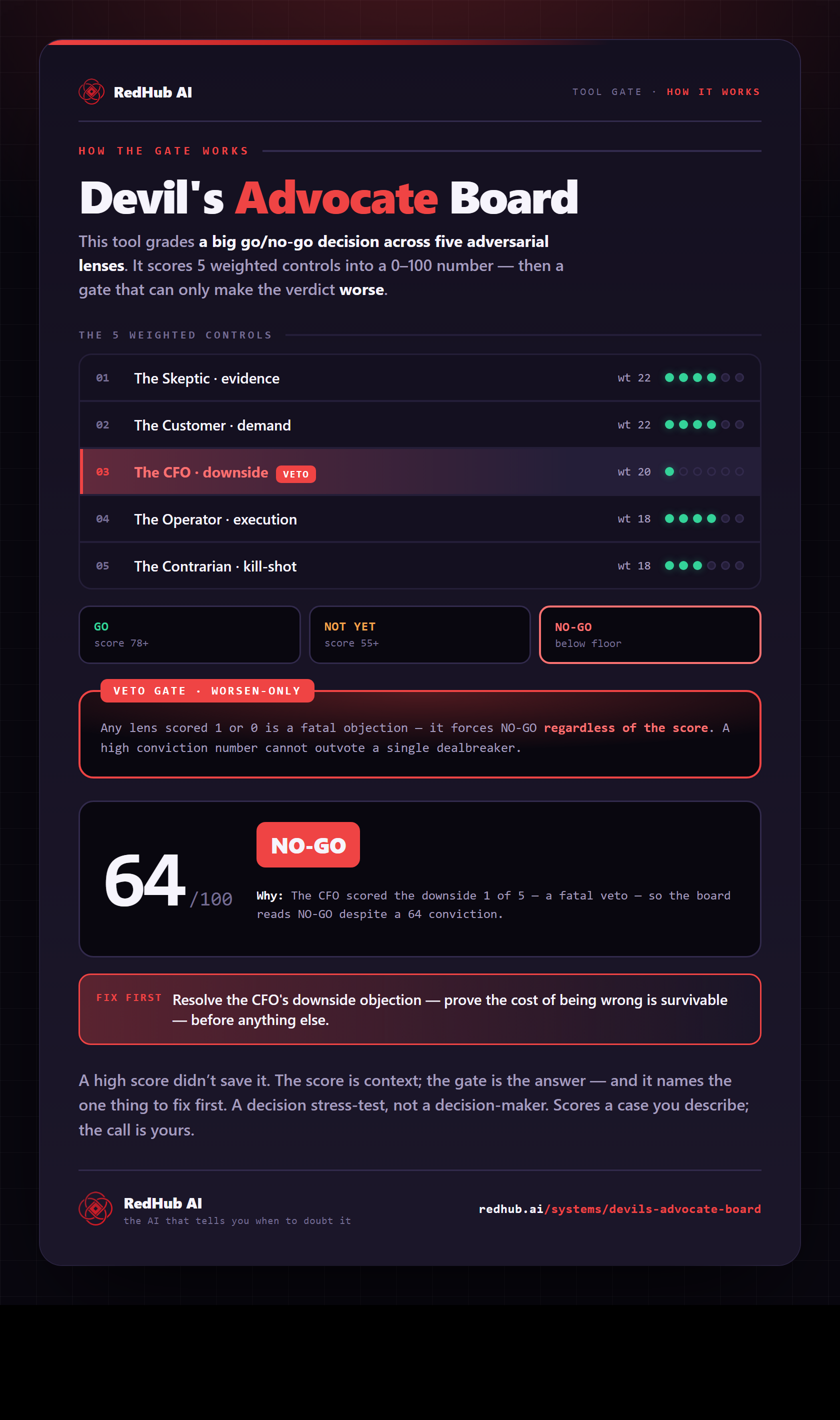
The gate this post refers to, drawn from the tool’s own logic. See the tool.