AI Devils Advocate: Make AI Argue Against You
RedHub AI Editorial7 min read

Jump to a section8
TL;DR
- The idea: Use AI to build the strongest case against your own decision — the dissent a solo founder doesn't otherwise get.
- The catch: "Hey ChatGPT, argue with me" drifts back to agreeable within a few exchanges. Chat models are trained to please the user.
- The fix: Structure the model can't soften — five named adversarial lenses, challenge before score, fixed weights, and a veto gate for fatal objections.
- Bottom line: An AI devil's advocate works when the adversarial frame lives in the system, not the prompt — see the Devil's-Advocate Board.
What is an AI devil's advocate?
An AI devil's advocate is an AI setup whose job is to argue against your decision instead of validating it — to build the strongest case that your pivot, raise, or price change fails, before you commit. A bare chatbot makes a poor one: chat models tend toward sycophancy, so an "argue with me" prompt produces a round or two of soft pushback and then drifts back to agreement. A working AI devils advocate needs structure the model can't negotiate away — fixed adversarial roles, a rule that the challenge comes before any score, and a veto that one fatal objection triggers regardless of how good everything else looks.
Best for: solo founders with no board to push back — part of our guide on how to make a hard decision without a board.
The instinct is right. If nobody around you will argue against your plan, make the machine do it. AI has real advantages as a devil's advocate: it has no job to protect, no relationship with you to manage, and no discomfort saying the harsh thing. It can hold five perspectives at once and apply a scoring rule without flinching.
The instinct fails at the prompt. "Play devil's advocate on my pivot" produces something that looks like dissent — a tidy list of risks, a "however" paragraph — and then, the moment you push back, the model folds. "You raise a good point." "With that context, this seems well-reasoned." Three exchanges in, your devil's advocate is agreeing with you again.
Why "argue with me" prompts drift
Chat models are trained on human feedback, and humans reward answers they like. The result is a well-documented lean toward sycophancy: the model tells the user what the user seems to want to hear. When you ask it to argue with you, that lean doesn't disappear — the argument itself gets shaped by it.
Four specific failure modes show up:
- It drifts. The adversarial frame lives only in your prompt, and each of your replies pulls the model back toward agreement. You are the opponent's boss, and it knows.
- It generates soft objections. "Consider the risks of timing" is pushback-shaped filler. A real opponent names the objection that actually kills the plan.
- It never scores. You get prose, not a verdict — so you grade your own homework, and biased grading was the original problem.
- It forgets. Next week's chat starts from zero. The assumptions your plan rested on aren't tracked, so nothing re-tests the decision when one breaks.
Key insight: a devil's advocate you can talk out of its objections isn't an advocate. It's an audience. The test of any AI dissent setup is simple — can it still say no after you've argued with it?
Unstructured prompt vs. structured board
Compare what each setup produces for the same decision:
One voice plays opposition on request. It lists general risks, hedges each one, and softens with every reply you send. No scoring, so the session ends with prose you interpret however you were already leaning. No memory, so next month's version of the same decision starts from nothing. The output feels like diligence and functions like an echo with a delay.
Five named lenses — evidence, demand, downside, execution, and the kill-shot — each write the strongest case against the decision before anything is scored. Each then rates 0–5 how well the case survives, the scores roll up to a 0–100 conviction score on fixed weights, and the verdict maps to GO, GO WITH CONDITIONS, NOT YET, or NO-GO. One fatal objection vetoes the verdict regardless of the total, and a journal logs the assumptions so the decision gets re-tested when one breaks. You can argue — the rules don't move.
The five ingredients of a real AI devil's advocate
Whatever tool you use, these are the ingredients that separate structure from theater:
| Ingredient | What it does | What it prevents |
|---|---|---|
| Named lenses | Five distinct adversarial roles, each owning one failure mode | One voice with one blind spot |
| Challenge before score | The case against is written before any number exists | Scores that get defended instead of earned |
| Fixed scoring rules | 0–5 per lens, rolled to 0–100 on preset weights | The verdict bending to your reaction |
| A veto gate | Any fatal objection forces NO-GO, whatever the total | Averages burying the one thing that kills you |
| A decision journal | Logs verdict + assumptions; re-tests when one breaks | A GO quietly outliving its evidence |
The veto is the anti-sycophancy core. Here's the shape of it, from the built-in demo scenario of the Devil's-Advocate Board: a decision scores a respectable 64 out of 100 across the board — and the verdict still comes back NO-GO, because the CFO lens rates the downside case a fatal objection. Four lenses were fine with the plan. One found the thing that kills it, and the rules didn't let the average paper over it. That's the demo's math, not a customer story — and it's precisely the behavior a flattering chatbot can't produce.
What an AI devil's advocate still can't do
Honesty about the boundary: structure fixes sycophancy, not judgment. The board argues from the evidence you bring — thin evidence in, thin stress-test out. It can't know your market better than you do, and it doesn't make the decision. A stress-test tells you whether your case survived the strongest attack on it. Whether to proceed — and living with the result — is yours. Any tool that claims otherwise has replaced your judgment with its own, which is a different product and a worse one.
For the method behind the machine, the adversarial technique itself is covered in how to red team your decision, and the reason you need external dissent at all — the bias that makes self-review unreliable — is covered in confirmation bias in decision making.
If you run the wider Executive Suite, the board plugs in alongside it: the Agentic Executive Harness ($299) rolls the board's verdicts into one company status with the rest of your operating signals, and the RedHub Operating System ($990/yr) is the full stack those decisions live inside.
Decision Guide
Use an AI devil's advocate if: you're a solo or lightly-advised founder facing a hard-to-reverse call, and every human channel around you agrees with the plan.
Skip the bare-prompt version if: you've noticed the model folding when you push back — that's the sycophancy, and more prompting won't fix it.
Best first step: take your pending decision and write what evidence would make you walk away. If you can't, no advocate — human or AI — has anything to test yet.
FAQ
What is an AI devil's advocate?
An AI setup whose explicit job is to build the strongest case against your decision before you commit — structured dissent for founders who have no board to provide it.
Can't I just ask ChatGPT to argue with me?
You can, and it will — briefly. Chat models lean sycophantic, so an unstructured "argue with me" prompt produces soft objections that dissolve as soon as you push back. The adversarial frame has to live in the system's rules, not in your prompt.
What is AI sycophancy?
The tendency of chat models to tell users what they seem to want to hear — a known side effect of training on human feedback, since people reward agreeable answers. It's why a model asked to evaluate your idea usually finds it promising.
What makes a structured AI board different from a prompt?
Five fixed adversarial lenses, a challenge-before-score rule, preset scoring weights, a veto gate for fatal objections, and a journal that re-tests the decision when assumptions break. You can argue with it; the rules don't move.
What is the veto gate?
A rule that any single fatal objection forces a NO-GO verdict no matter how high the overall score. In the board's demo scenario, a 64/100 decision still returns NO-GO because the CFO lens finds a fatal downside — the behavior a flatterer can't produce.
Does the AI make the decision for me?
No, and it shouldn't. The board returns a verdict, the objection to beat, and any conditions. The decision — and its consequences — stay yours. It's a stress-test, not a decision-maker.
What do I get in the Devil's-Advocate Board?
Four Claude Skills (frame, red-team, synthesize, journal), a runnable Python stress-test engine, a decision workbook that reproduces the same scoring and veto, a board-verdict template, and two playbooks. $199 one-time, with a 30-day guarantee.
An AI advisor that can still say no after you argue
The Devil's-Advocate Board ($199, one-time) replaces the flattering chatbot with five skeptical lenses, fixed scoring, and a veto gate one fatal objection can trigger. Bring one decision — a pivot, a raise, a price change — and get an honest verdict. The call stays yours. Instant download, 30-day guarantee.
Get the Devil's-Advocate Board — $199 →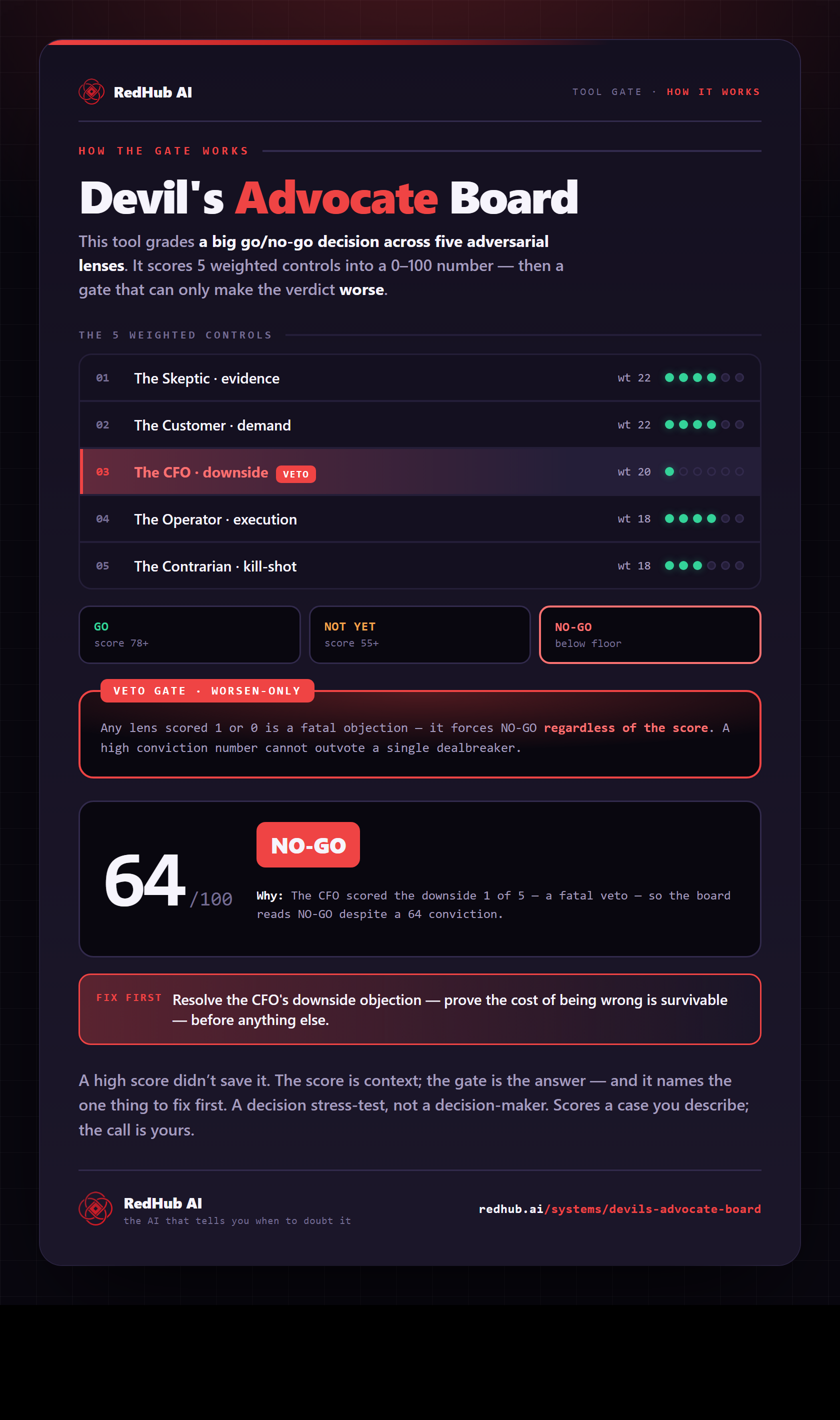
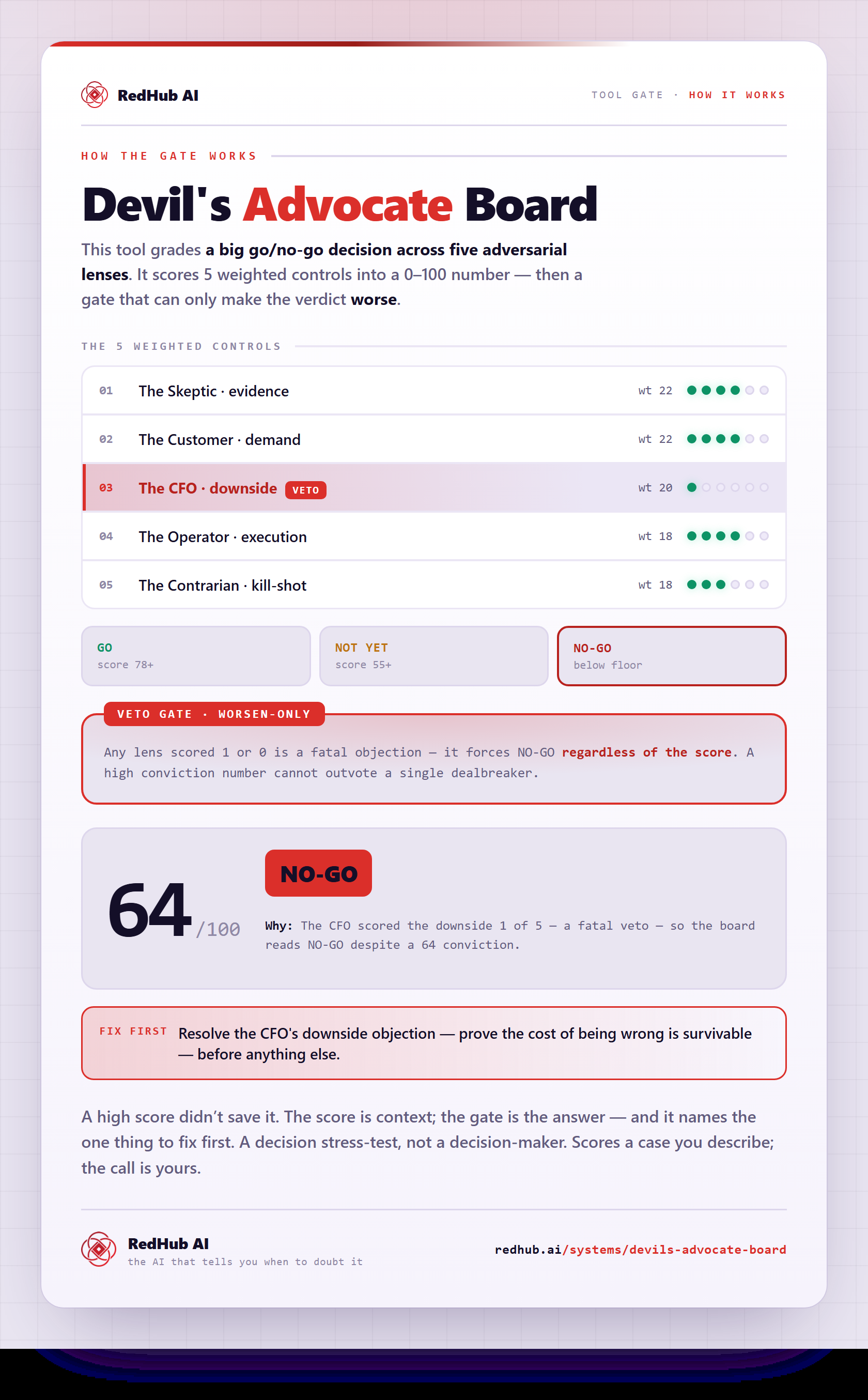
The gate this post refers to, drawn from the tool’s own logic. See the tool.