The Great Decoupling: Impressions Up, Clicks Down
RedHub AI Editorialupdated August 17, 20266 min read

Jump to a section8
TL;DR
- What it is: the Great Decoupling is when a page's Search Console impressions hold steady or climb while its clicks fall — the two numbers stop moving together the way they used to.
- Who it's for: anyone whose traffic dropped without a matching ranking drop — start with the AI Overview Traffic-Loss Diagnostic.
- How it works: compare impressions change and clicks change per page, over two matched date ranges, in Google Search Console.
- Bottom line: the pattern is easy to spot once you know to look for the gap, not the total.
What is the Great Decoupling?
The Great Decoupling is the name marketers use for a specific pattern in Google Search Console data: a page's impressions stay flat or increase, but its clicks drop. Historically, impressions and clicks moved together — more visibility meant more clicks. Google's AI Overviews break that link, because the AI answer can satisfy the searcher directly on the results page. The page still gets counted as an impression. It just stops getting the click.
Best for: anyone comparing two Search Console date ranges — the AI Overview Traffic-Loss Diagnostic ($79) automates the page-by-page read and names your worst-hit page.
For most of Google Search's history, impressions and clicks were joined at the hip. If a page showed up more often, it got clicked more often — not always at the same rate, but the two numbers rose and fell together. That relationship is why "check your rankings" was always the right first move when traffic dropped.
The Great Decoupling breaks that assumption. It's the pattern where impressions hold or rise while clicks fall — a page that Google still surfaces just as often, or more often, but that fewer people actually click into. The cause, in a growing share of cases, is Google's own AI Overview answering the query before anyone reaches the results list.
| Normal pattern | The Great Decoupling | |
|---|---|---|
| Impressions | Rise and fall with ranking | Flat or rising |
| Clicks | Track impressions closely | Falling, sometimes sharply |
| Rankings report | Shows the problem | Looks fine — hides it |
| Likely cause | Position change, competition | AI Overview answering on the SERP |
Why AI Overviews cause this specific pattern
Google's AI Overview sits above the organic results and generates a written answer to the query, often citing a handful of sources. Your page can be one of those cited sources — or not cited at all — and either way, Google still logs an impression for your listing further down the page. The searcher, though, may never scroll that far, because the AI Overview already told them what they wanted to know.
That's the mechanism behind the decoupling: the impression still fires the same way it always did. The click depends on whether the searcher needed to go further — and increasingly, they don't.
Key insight: the pages most exposed to this pattern are the ones answering plain factual questions — definitions, "how to," "what is," cost ranges. An AI Overview handles those cleanly. Pages built around comparisons, live pricing, local specifics, or a transaction are harder for an answer box to fully replace.
How to spot it in your own Search Console
You can run this check by hand in about ten minutes. Here's the exact sequence:
- Open Performance → Search Results and set a custom date range — the trailing 90 days is a good default.
- Add a comparison against the prior 90-day period, so you can see the change, not just the raw numbers.
- Click the Pages tab and sort by clicks change (ascending), so your biggest losers surface first.
- For each losing page, check its impressions change too. If impressions are flat or positive while clicks are meaningfully negative, that page is a decoupling candidate.
- Spot-check the query. Search the page's top query yourself and see whether an AI Overview appears above the results.
Do this across your top 20–30 pages by impressions, and you'll usually find a clear split: some pages moved normally, and a handful show the gap. That handful is where to focus first.
What counts as real decoupling — and what's just noise
Not every small wobble is meaningful. Search Console data moves around from week to week for reasons that have nothing to do with AI Overviews — seasonality, a small ranking shuffle, a data sampling quirk. A useful rule of thumb, and the one the diagnostic uses as a gate: treat it as a real decoupling signal when impressions are flat-to-up (within about 5%) while clicks are down more than 25% over the same window. Below that threshold, keep watching before you act.
Why this matters: a page can look fine on every individual signal — good rankings, healthy impressions, no obvious content problem — and still be actively bleeding clicks to an AI Overview. That's the case worth catching, because it's the one a normal report won't flag on its own.
Decoupling is one symptom of a bigger shift
The Great Decoupling is the Search Console-visible symptom of a larger trend: more searches ending without any click at all, to anyone. That trend is called zero-click search, and it didn't start with AI Overviews — but they've made it far more common. We cover which of your pages are most exposed to that trend, and which still reliably earn the click, in zero-click search.
Once you've flagged your decoupling pages, the next question is what to do with each one — and the answer isn't the same for every page. We walk through the full page-by-page decision in how to recover traffic from AI Overviews.
Grade every page automatically
The AI Overview Traffic-Loss Diagnostic ($79) turns this manual Search Console check into a repeatable score — HOLDING, DECOUPLING, or EVAPORATING per page, plus a site rollup and a routed fix.
Get the Diagnostic — $79 →Decision Guide
Investigate this if: a page's impressions are flat or rising, but its clicks have dropped by 25% or more over the same window.
Skip it if: impressions and clicks are falling together — that points to a ranking or demand problem, which needs a different fix.
Best first step: sort your Search Console pages by clicks change, and cross-check the top losers against their impressions change.
FAQ
What is the Great Decoupling?
It's the pattern where a page's Google Search Console impressions hold steady or rise while its clicks fall — the two numbers that used to move together stop tracking each other, usually because an AI Overview is answering the query on the results page.
Why do AI Overviews cause impressions and clicks to split apart?
Google still counts an impression whenever your listing appears on the results page, whether or not the AI Overview answered the question. But the click depends on whether the searcher needed to scroll past the AI answer — and for plain factual questions, they increasingly don't.
How do I check for this in my own Search Console?
Compare two matched date ranges in Performance → Search Results, sort pages by clicks change, and check each losing page's impressions change alongside it. Flat-or-rising impressions paired with falling clicks is the signal.
How much of a clicks drop counts as real decoupling versus normal noise?
A reasonable threshold is impressions within about 5% of the prior period while clicks fall more than 25%. Smaller wobbles are usually normal week-to-week variation, not a genuine AI-Overview effect.
Does the Great Decoupling affect every page equally?
No. Pages answering plain factual questions — definitions, "how to," cost ranges — are the most exposed, because an AI Overview can fully answer those. Pages built around comparisons, live pricing, or a transaction are harder for an answer box to fully replace.
Is this the same thing as a ranking drop?
No, and that's the whole point. A ranking drop shows up in both impressions and rankings falling together. The Great Decoupling shows stable or improving impressions and rankings, with only the click falling — which is why it hides from a normal rankings report.
See the gap in your own data
Stop guessing whether it's a ranking problem or an AI Overview problem. Read your own Search Console export and get a page-by-page verdict.
Get the AI Overview Traffic-Loss Diagnostic — $79 →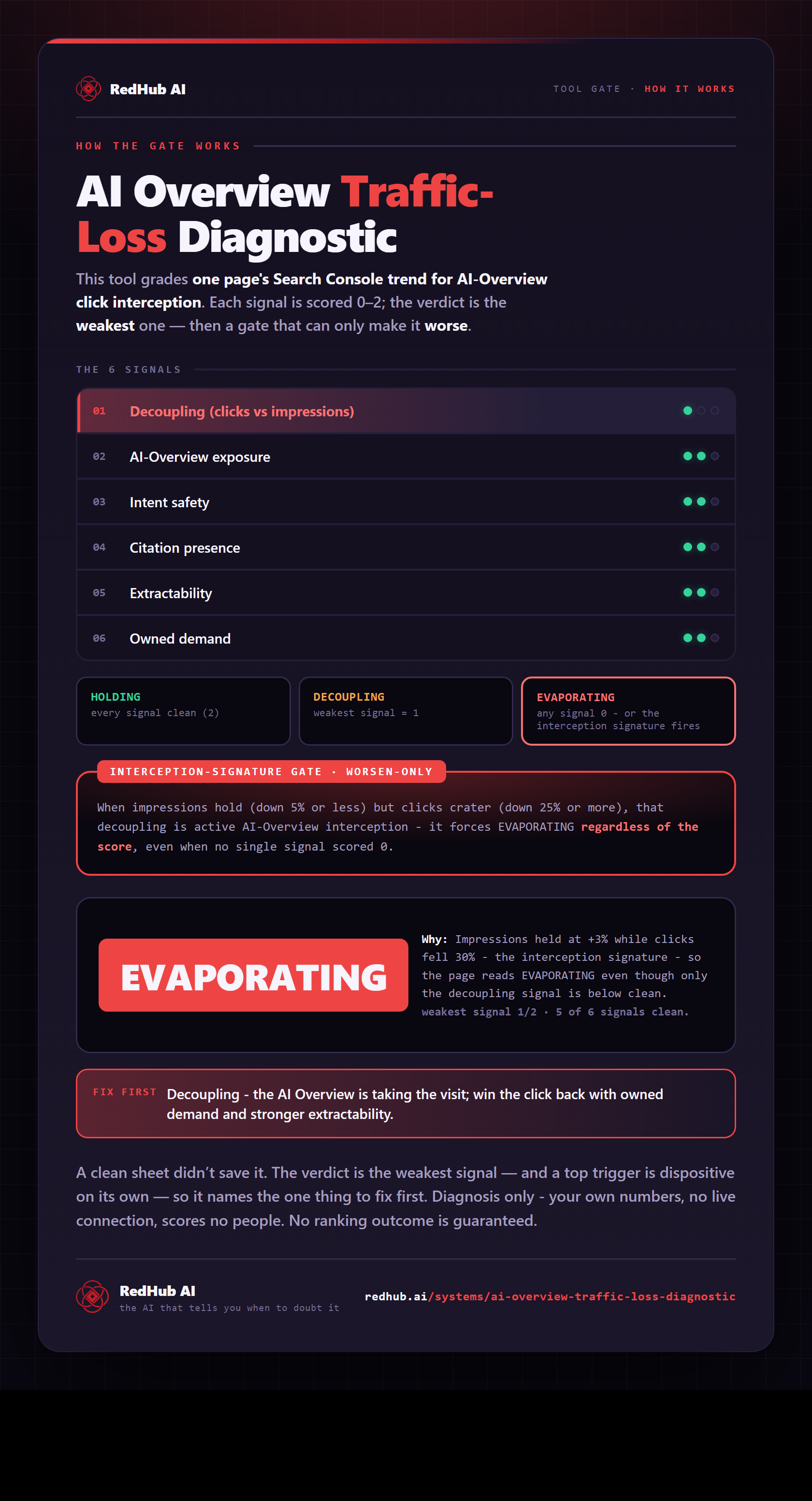
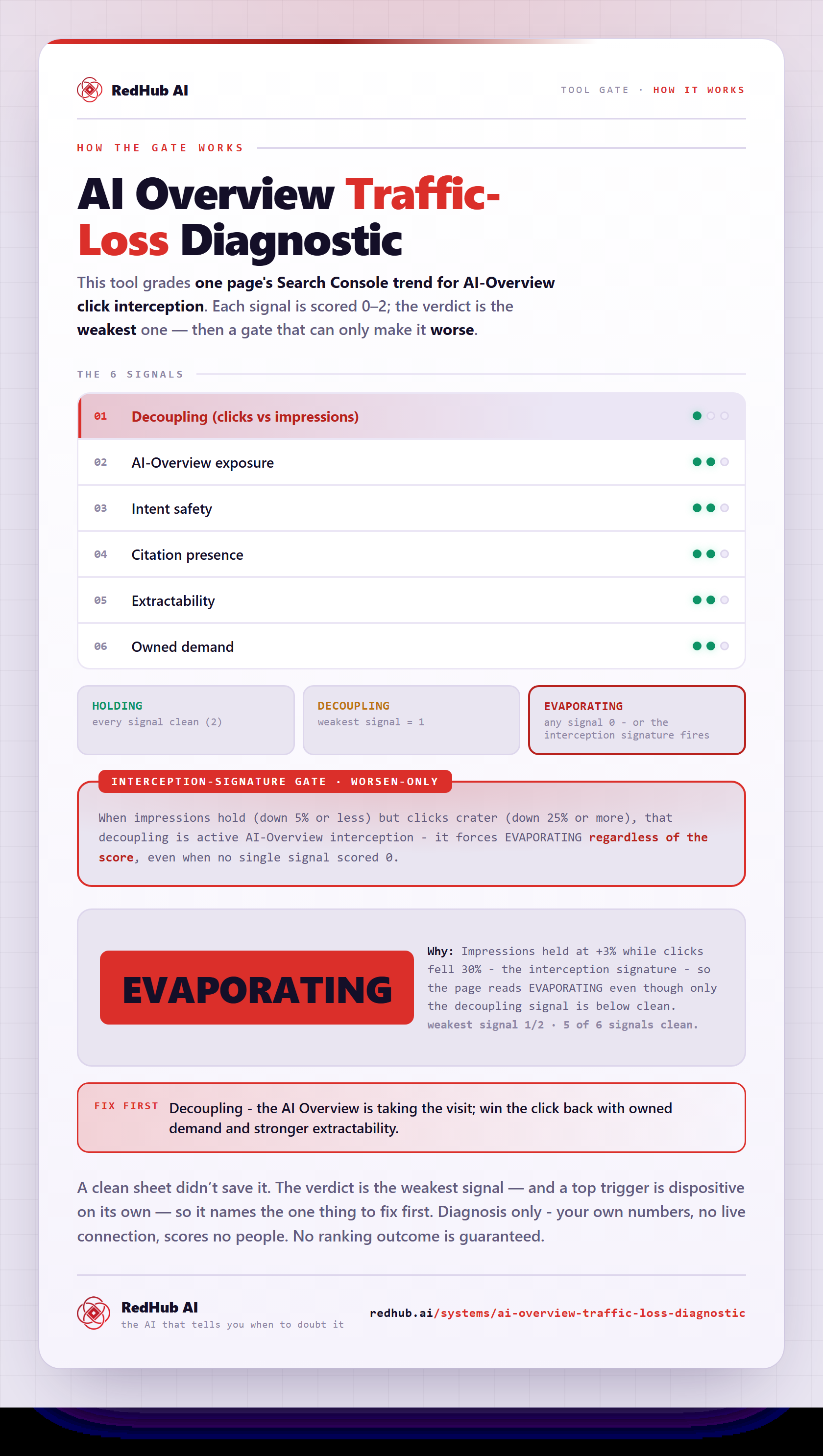
The gate this post refers to, drawn from the tool’s own logic. See the tool.