AI SEO Agents: What to Automate and What to Avoid
RedHub AI Editorialupdated October 30, 202616 min read

Jump to a section12
- TL;DR
- What are AI SEO agents?
- What an SEO agent does all day
- Why volume stopped being a signal
- What a listing is worth, in Google's words
- The governed agent
- What to measure instead of link counts
- The AI-answer side of the same problem
- The identity check that comes first
- The rest of this set
- Pairs well with
- Decision Guide
TL;DR
- What changed: an AI agent can research, submit, and post at a volume no human team could match. That makes activity nearly free, and a thing that is free stops being a signal of anything.
- What Google says: its spam policy names "Using automated programs or services to create links to your site" as an example of link spam. The agent that builds links at scale is the agent the policy describes.
- What to automate first: the checking. Read-only audits of your own business listings, your competitors' public profiles, and the links a vendor says it built. Results a second person can verify.
- The governed agent: one written identity record for the business, read-only by default, a named approval for every action that touches the outside world, and evidence for every claimed result.
- What to measure instead of link counts: listing accuracy, verified corrections, links still live at recheck, and qualified leads. Get the free SEO Agent and Listing Audit Checklist.
What are AI SEO agents?
AI SEO agents are software agents that carry out search-marketing work with little human input per task: finding directories and publishers, filling out listing forms, drafting outreach, writing pages, and checking what is live. The useful split is not by task but by direction. Some workflows only read the world (audits, inventories, competitor checks) and some act on it (account creation, submission, outreach, payment). The read-only half is safe to automate first, because its output can be checked. The acting half needs a named approval per action, because the same automation that makes it cheap is what Google's spam policy names.
Best for: owners and marketing leads at local and regional businesses, and the agencies that serve them, deciding what an SEO agent should be allowed to do. The identity check that every listing audit starts from is also the top gate in the Google Business Profile Suspension-Risk Gate.
A vendor pitch for AI SEO agents, this year, sounds something like this: the agent finds more than 2,000 directories and publishers, submits your business to all of them, runs around the clock, and produces ten times what a human team could. We have heard versions of that claim and have not verified any of them, and the numbers are not the point. Suppose every word is true. What you would own at the end is 2,000 submissions. Not 2,000 listings. Not 2,000 links. Not one new customer. A count of things the agent did.
RedHub is not affiliated with Google or Ahrefs. This post describes their published documentation. It is not a promise about rankings.
That gap, between what an agent did and what it produced, is the whole subject of this post. Automation makes activity nearly free, and anything free stops meaning anything. The old proxy for SEO effort was volume: links built, directories submitted, pages published. When a person had to do each one, volume was a rough measure of work. When an agent does them for pennies, volume measures nothing, and a vendor report built on volume is a report of nothing. What an agent can also do cheaply is check. It can read every listing you have, compare each one to a record of who you are, and tell you which ones are wrong. That output can be verified by a second person in an afternoon. It is the half of the agent that is worth buying first.
This is the house position applied to SEO. RedHub sits in the verdict layer between an AI and a business decision. It does not sell production engines, and it does not sell links. Four posts follow this one with the detail: the business listing audit, whether AI backlinks are worth it, where link building ends and link spam begins, and how to pay an SEO vendor for evidence instead of activity.
What an SEO agent does all day
Strip the pitch deck and an SEO agent runs about eight workflows. Here they are, described by what each one touches, not by how much a vendor thinks each one is worth.
- Identity audit. Reads the business name, address, phone, hours, categories, and website from the sources you control and checks whether they agree with each other. Touches nothing.
- Listing inventory. Finds every place the business is listed online, from the map platforms down to the directory nobody remembers signing up for. Touches nothing.
- Listing verification. Opens each listing it found, compares every field to the identity record, and marks each one correct, wrong, duplicated, or dead. Touches nothing.
- Competitor monitoring. Reads competitors' public profiles, review counts, categories, and the directories they appear in, and reports differences. Touches nothing. This is the only competitor workflow that belongs in a governed setup, because it reads public pages and writes a report.
- Research for outreach. Finds publishers, associations, and local organizations that cover your field, and drafts a note to each one. Touches nothing until a person sends the note.
- Directory submission. Creates an account on a directory, fills in the form, and submits it. Acts on the world, in your name.
- Content production. Writes location pages, service pages, and posts at whatever volume you ask for. Acts on the world the moment it publishes.
- Rank and index checks. Runs searches to see where you appear and whether new pages were indexed. Reads, but the way it reads matters, and we come back to that below.
Five of the eight are read-only. Two act on the world. One is a read that can turn into a violation depending on how it is done. That split is the only grading of these workflows that this post offers, and it is the split that decides what you should let an agent do without asking you first.
Why volume stopped being a signal
Google's spam policy defines the problem in one sentence: "Link spam is the practice of creating links to or from a site primarily for the purpose of manipulating search rankings." The list of examples (opens in a new tab) that follows includes "Using automated programs or services to create links to your site" and, two lines later, "Low-quality directory or bookmark site links". An agent that submits your business to 2,000 directories so that each one links back to you is doing the first thing by way of the second. The policy does not say "AI agent". It did not need to. It names the method.
The same page covers the content side. Under scaled content abuse, the first example is "Using generative AI tools or other similar tools to generate many pages without adding value for users". And under machine-generated traffic, Google says the practice "includes scraping results for rank-checking purposes or other types of automated access to Google Search conducted without express permission." That last one is the rank-check workflow. An agent that scrapes Google results to tell you where you rank is itself doing something the spam policy names, and a vendor that does it on your behalf has put your name on it.
None of this is a prediction about what Google will do to any particular site, and this post makes no ranking promise in either direction. It is a reading of a published policy, and the reading is short: the thing an agent makes cheap is the thing the policy describes. So the question is not whether an agent can build 2,000 links. It can. The question is why anyone would want it to.
What a listing is worth, in Google's words
If volume is not the signal, something else is, and Google's Business Profile help page on local ranking says what. "Local results are mainly based on relevance, distance, and popularity." The page's own headings then name the three as Relevance, Distance, and Prominence, and it describes Prominence as "also based on info like how many websites link to your business and how many reviews you have." The wording trap is worth noticing: the summary sentence says popularity and the heading says prominence. Quote both, as we have here, and do not let anyone tell you the page says one word only.
Two more lines from the same page (opens in a new tab) do most of the work for a business owner. "Businesses with complete and accurate info are more likely to show up in local search results." And: "There's no way to request or pay for a better local ranking on Google." Read those together and the shape of a sane program appears. The part you control is whether your information is complete and accurate everywhere it appears. The part you cannot buy is the ranking. A listing audit works on the first. A link-volume service sells the second, which the page says is not for sale.
The governed agent
An SEO agent you can trust is not a smarter one. It is one with four properties, and all four are about what surrounds the model, not what is inside it.
1. One source of truth for the business identity
Before an agent reads or writes anything, there is a written record of who the business is: legal name as used on signage, street address, phone under the business's direct control, hours, primary category, and website. One record, one owner, one date. Every audit compares to this. Every submission copies from this. Without it, the agent's idea of your business is whatever it scraped first, and an agent that propagates a wrong phone number across 2,000 directories has done harm at scale. Google's own guidelines ask you to represent the business as it is "consistently represented and recognized in the real world across signage, stationery, and other branding", and that consistency is the thing the record exists to enforce.
2. Read-only by default
The agent's standing permissions let it read public pages and your own accounts and write a report. Nothing else. Every workflow in the read-only half of the list above runs under this permission. The output is a document a second person can check, and the worst case of a bad run is a wrong report, which you can throw away. The permission design for agents that reach into real systems is its own subject, covered in AI agent permissions: enough access to help, not to harm.
3. A named approval for every outward action
Creating an account, submitting a form, sending an outreach note, publishing a page, paying for anything: each one is an action in your name on someone else's system, and each one gets a named person's approval before it happens. Not a blanket approval of the campaign. An approval of the action, with the target and the content attached. This is slower than letting the agent run. That is the point. The actions it slows down are the ones a spam policy names and the ones that cannot be undone. The free Decision Fit Check applies this logic to one task at a time: eight questions place a task on a ladder from deterministic code up to a person, and its irreversibility gate routes any task whose wrong answer cannot be undone, and that nobody reviews first, to human judgment regardless of what a model would score. An agent submitting listings in your name is that task.
4. Evidence for every claimed result
A result is a published URL, opened by a person or a second script, with the identity fields matching the record, the link resolving to your site, a capture with a date on it, and a recheck later showing it is still there. "Submitted" is not a result. "Live" without a URL is not a result. An HTTP 200 on a page is not a result either, because a 200 says a server answered. It does not say the listing exists on that page, that the fields are right, or that anyone indexed it. We learned that one on our own deploys, where we verify by what a host serves, never by a status code.
| Workflow | Direction | Standing permission | What counts as output |
|---|---|---|---|
| Identity audit | Read | Allowed | A list of fields that disagree, with sources |
| Listing inventory | Read | Allowed | Every listing found, with its URL |
| Listing verification | Read | Allowed | Per listing: correct, wrong, duplicate, or dead, with a capture |
| Competitor monitoring | Read | Allowed | A difference report from public pages |
| Research for outreach | Read, then draft | Allowed to draft | Targets and draft notes for a person to send |
| Directory submission | Act | Named approval per submission | A published URL, verified later, or nothing |
| Content production | Act | Named approval per page | A page a person read before it went live |
| Rank and index checks | Read, with a catch | Only through permitted tooling | Search Console data, not scraped results |
Before an agent is given any standing permission on a public account, it helps to score the controls around it. The AI Agent Go-Live Readiness Gate grades five operational controls from your own marks (an approval gate on destructive actions, full tool-call logging, a tested rollback path, bounded scope, and a human escalation path) and returns READY, FIX, or DO NOT DEPLOY, with a hard gate: a destructive action with no human approval step is DO NOT DEPLOY no matter how high the rest scores. An agent that can create and submit listings in your name has a destructive capability in the sense that matters, because a wrong listing is public and the cleanup is yours.
What to measure instead of link counts
If a vendor report cannot say "500 links built" and mean anything, it has to say something else. These four measures are what an SEO agent's work looks like when it is reported as evidence.
- Listing accuracy. Of every listing in the inventory, how many match the identity record on every field. A number, with the list behind it, and the date it was checked.
- Verified corrections. Of the listings that were wrong, how many are now right, shown by the published URL after the fix, not by the correction request. A request is activity. The corrected page is evidence.
- Links still live at recheck. Of every link the vendor claims, how many resolved to your site on the day they were claimed and again thirty days later. A link that was never published, or was removed, drops out of the count on recheck. That is the number the vendor will not volunteer.
- Qualified leads. Calls, forms, and direction requests from people who could become customers, counted in your own systems, not in the vendor's dashboard. This is the one that pays for the others.
For the third measure, RedHub sells a paid instrument, the Listing Delivery Verification Gate. You mark each listing your vendor delivered on five points (published URL found, identity fields match, link resolves, evidence captured, still live at recheck). It grades each listing and rolls them up, and a listing that was submitted but never published never counts as delivered. It grades your marks. It does not scan anything, and it is not a monitor.
The AI-answer side of the same problem
Everything above is about search results and map results. There is a second surface now, and it has the same shape. When a buyer asks an AI assistant which plumber, which firm, or which clinic to call, the answer names businesses, and either yours is among them or it is not. No ranking position, no click, no session. The AI Search Brand-Presence Diagnostic is the read-only check for that surface: you run a fixed prompt battery across ChatGPT, Perplexity, Gemini, Google AI Mode, and Claude, mark what you observe per engine, and it scores PRESENT, PARTIAL, or ABSENT, with a presence gate that reads ABSENT when an engine never mentions you, whatever the accuracy or sentiment would have been. Your observations, no API. Why rankings and AI citations come apart is the subject of SEO vs GEO: why rankings don't get you cited, and what Google's own AI answers change is in AI Overviews SEO: what changes when Google answers.
The identity check that comes first
One more reason to start with the read-only identity audit: the same inconsistency that makes a listing program worthless is also a guideline condition on your Google Business Profile. The Google Business Profile Suspension-Risk Gate scores one profile GUIDELINE-READY, GUIDELINE GAPS, or HIGH SUSPENSION RISK against seven guideline conditions the gate checks, from your own description of it, and two of its signals are gate signals: business name, and NAP consistency across your profile, site, and directories. A mark of 1 or 0 on either produces HIGH SUSPENSION RISK regardless of the other marks. It is not affiliated with Google, connects to no account, reads nothing live, and grades the profile, never a person. The background on how suspensions happen, and what to do about one, is in Google Business Profile suspension: why it happens and Google Business Profile guidelines, in plain English.
So the order is: identity record, then the read-only audit against it, then the suspension-risk check on your own profile, and only then any outward action, each behind a name. An agent that runs in that order is doing what an agent is good for. An agent that starts at step six of the workflow list, submitting before anyone has agreed what the business is called, is the one that produces 2,000 of something you will spend a year cleaning up.
Check the identity gate before the agent touches anything
The Google Business Profile Suspension-Risk Gate scores one profile GUIDELINE-READY, GUIDELINE GAPS, or HIGH SUSPENSION RISK against seven guideline conditions the gate checks, with a Name-and-NAP gate on business name and NAP consistency, a portfolio rollup, and a priority control where a signal is short. Deterministic, offline, not affiliated with Google. Grades the profile, not people.
Get the Suspension-Risk Gate →The rest of this set
Four posts carry the detail. Business listing audit with AI: 8 read-only steps is the audit itself, with its quality gates and a worked example. Are AI backlinks worth it does the arithmetic on volume against relevance and explains what Ahrefs' Domain Rating does and does not measure. AI link building vs. link spam puts the line where Google's own words put it, with a decision table. And SEO vendor accountability: pay for evidence, not activity is the sharpest of the four, with ten questions to ask before you renew and the free checklist. Get the free SEO Agent and Listing Audit Checklist below.
Pairs well with
The Google Business Profile Suspension-Risk Gate grades one profile GUIDELINE-READY, GUIDELINE GAPS, or HIGH SUSPENSION RISK, with a Name-and-NAP gate on business name and NAP consistency. The AI Search Brand-Presence Diagnostic scores PRESENT, PARTIAL, or ABSENT per AI engine from your own observations. The AI Agent Go-Live Readiness Gate returns READY, FIX, or DO NOT DEPLOY on an agent's guardrails before it acts on a public account.
Keep going: for the stop that has to exist before any agent gets standing permission on your accounts, read AI agent kill switch: what to build before you grant access. For routing every agent and tool through one set of checks, read enterprise AI control plane: when agents skip the checkpoint.
Decision Guide
Use an SEO agent now if: you have never had a full inventory of where your business is listed, or you cannot say today whether every listing shows the same phone number. The read-only audit is the job, and an agent is the cheapest way to do it.
Hold off if: the only thing on offer is submission volume, links by the thousand, or "indexed overnight." Those are the workflows Google's spam policy names by method, and the output cannot be verified.
Best first step: write the identity record. One page: name as it appears on signage, address, the phone the business controls, hours, primary category, website. Everything an agent does next compares to it, and until it exists there is nothing to compare to.
FAQ
What are AI SEO agents?
Software agents that do search-marketing work with little human input per task: finding directories and publishers, filling out listing forms, drafting outreach, writing pages, and checking what is live. The useful distinction is between workflows that only read (audits, inventories, competitor checks) and workflows that act in your name (submission, outreach, publishing, payment).
Is using an AI agent to build links against Google's rules?
Google's spam policy lists "Using automated programs or services to create links to your site" as an example of link spam, and defines link spam as creating links "primarily for the purpose of manipulating search rankings." That is Google's published wording, not a prediction about any particular site. An agent that automates research and drafts notes for a person to send is doing something different from an agent that places links at scale.
What should an SEO agent be allowed to do without asking?
Read and report. Audit your own listings against one identity record, inventory where you appear, compare competitors' public profiles, and draft outreach for a person to send. Anything that creates an account, submits a form, sends a message, publishes a page, or pays for something gets a named approval per action.
What does Google say decides local ranking?
Google's Business Profile help page says "Local results are mainly based on relevance, distance, and popularity." Its headings name the third factor Prominence, described as "also based on info like how many websites link to your business and how many reviews you have." The same page says "There's no way to request or pay for a better local ranking on Google."
Does an HTTP 200 prove a listing is live?
No. A 200 means a server answered the request. It does not show the listing exists on the page, that the name, address, and phone are correct, or that anyone has indexed it. Evidence is the published URL opened and read, the fields compared to your identity record, the link followed to your site, a dated capture, and a recheck later.
Does the Listing Delivery Verification Gate check my listings for me?
No. You mark each listing your vendor delivered on five points (published URL found, identity fields match, link resolves, evidence captured, still live at recheck), and it grades each listing and rolls them up. A listing that was submitted but never published never counts as delivered. It grades your marks and scans nothing.
Is a local citation the same as an AI citation?
No. Local SEO uses "citation" for a directory listing of your name, address, and phone, which this series calls a business listing. An AI citation is an AI engine naming your business in an answer. Different surfaces, different checks, and this post links the AI meaning separately so the two are never confused.
Free: The SEO Agent and Listing Audit Checklist
Ten questions to put to any SEO vendor or agent before you pay for listing or link work. One page, printable.
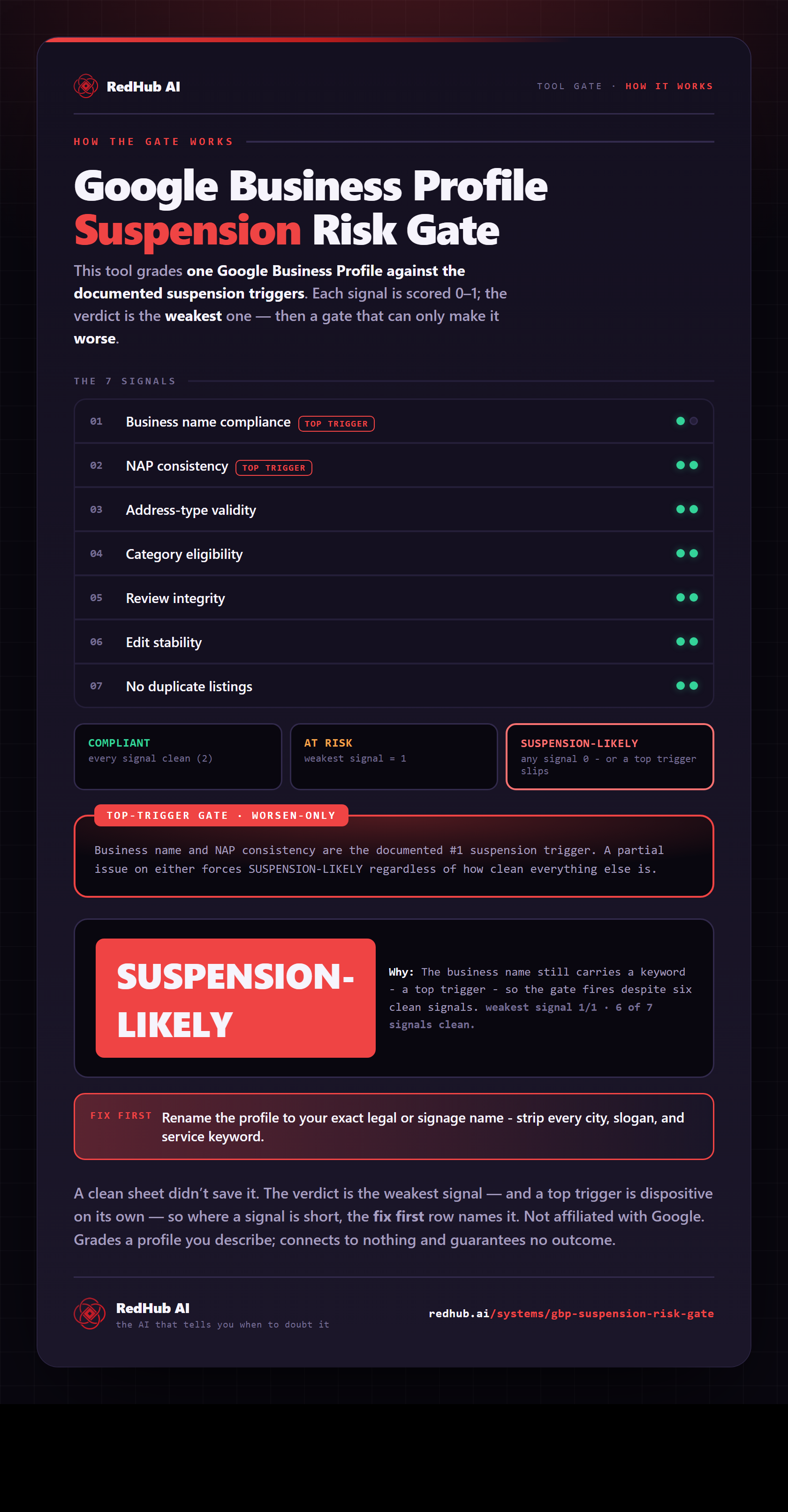
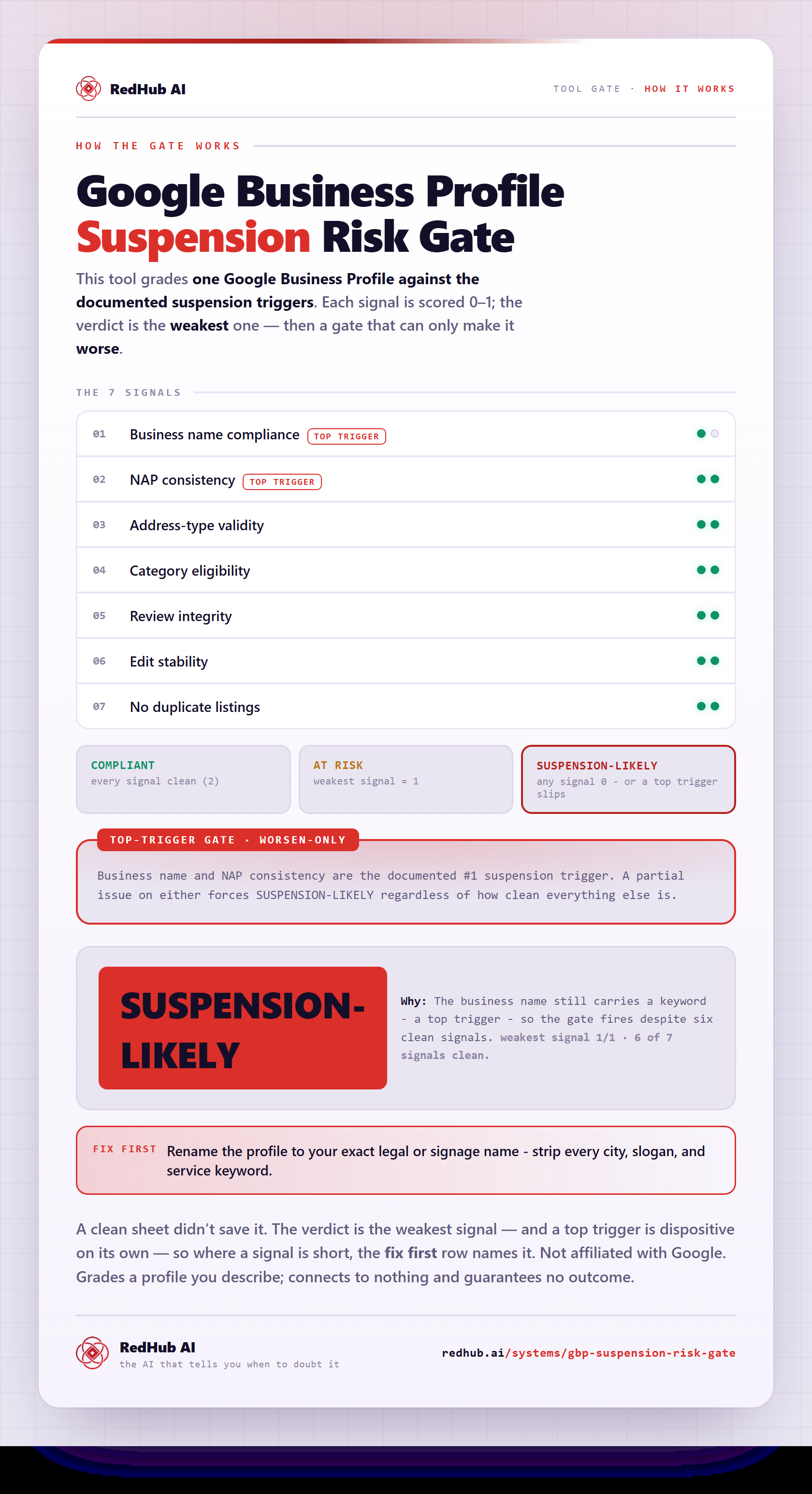
The gate this post refers to, drawn from the tool’s own logic. See the tool.