AI Overviews SEO: What Changes When Google Answers
RedHub AI Editorialupdated August 17, 20265 min read

Jump to a section8
TL;DR
- What it is: AI overviews SEO is optimizing pages for the click that survives once Google's own AI answer has already satisfied part of the query — not just optimizing for rank.
- Who it's for: anyone whose ranking checks out fine but whose traffic doesn't — pair this with the AI Overview Traffic-Loss Diagnostic.
- How it works: keep the fundamentals, but shift what "winning" means from position to whether the page still earns a click after the AI answer.
- Bottom line: a #1 ranking that never gets clicked isn't a win anymore. Measure the click, not just the position.
What is AI overviews SEO?
AI overviews SEO is the practice of optimizing content so it still earns a click, or a citation, even after Google's AI Overview has already answered part of the searcher's question. Traditional SEO measured success mostly by ranking position, on the assumption that a top ranking reliably produced a click. AI Overviews break that assumption for a growing set of queries, so AI overviews SEO adds a second target: making the page worth clicking, and easy for the AI Overview to cite, on top of ranking well.
Best for: anyone whose pages still rank well but whose click-through has quietly dropped — the AI Overview Traffic-Loss Diagnostic ($79) confirms it from your own Search Console data.
For years, SEO had a simple scoreboard: rank higher, get more clicks. That relationship still mostly holds — but for a growing set of queries, Google's AI Overview now answers the question before the searcher reaches the ranked list at all. Ranking #1 for a query the AI Overview fully answers doesn't guarantee the click it used to. AI overviews SEO is the adjustment that follows: keep doing the fundamentals that earn rank, and add a second discipline that earns the click, or the citation, after the answer box.
What stays exactly the same
Most of SEO doesn't change. Technical health, page speed, mobile usability, backlinks, and genuinely useful content are still the foundation. Google still needs to crawl, understand, and trust your page before anything about AI Overviews even enters the picture. Skipping the fundamentals to chase AI-answer tactics is a mistake — you need both.
| Focus area | Before AI Overviews | With AI Overviews |
|---|---|---|
| Primary success metric | Ranking position | Ranking position and click-through rate |
| Content goal | Rank for the query | Rank for the query, and be worth clicking past the answer |
| Structure | Helpful headers, good UX | Same, plus a direct, extractable answer up top |
| What to measure | Rank tracker | Rank tracker plus impressions vs. clicks per page |
What actually changes
The shift is in what "good" looks like on top of the fundamentals. Three things matter more now than they used to:
- Answer clearly and fast — then go further. Give the direct answer near the top so it's easy to extract and cite, then use the rest of the page for depth an AI Overview can't fully replicate: specifics, comparisons, current numbers, or a next step.
- Build toward defensible query types. Comparisons, live pricing, and transactional intent hold onto the click far better than plain factual questions. Weighting new content toward those types protects future traffic.
- Track clicks against impressions, per page. A rank tracker alone can't show you this shift. You need the impressions-versus-clicks comparison in Search Console to see where it's actually happening.
Key insight: the goal isn't to "beat" the AI Overview or trick it into not appearing. It's to make sure that when it does appear, your page is either the one it cites, or the one the searcher still wants to visit for the part the answer box can't cover.
How this connects to citation and visibility work
AI overviews SEO, as covered here, is specifically about Google's own AI Overview inside the Google results page — the impressions-versus-clicks pattern you can see in your own Search Console. It's a related but different discipline from earning citations across AI assistants like ChatGPT, Perplexity, and Claude, which is the broader field of generative engine optimization. If you want the full strategic picture of AI visibility across all of those engines, that's covered in our GEO pillar and the GEO / AI Visibility Playbook.
The two disciplines share a foundation — clear structure, strong entity signals, answer-first content — so improving one tends to help the other. But measuring them is different: this one is read from your own Search Console, not from manually querying AI assistants.
Where to start
Before rewriting anything, find out which of your pages are actually affected. Rank-and-hope doesn't tell you where the AI overviews SEO adjustment is worth making. Pull your Search Console data, look for the impressions-up/clicks-down pattern covered in the Great Decoupling, and check which query types are driving it, covered in zero-click search. Then work the fix in how to recover traffic from AI Overviews.
See exactly where AI Overviews are costing you clicks
The AI Overview Traffic-Loss Diagnostic ($79) reads your own Search Console export and grades every page HOLDING, DECOUPLING, or EVAPORATING — the starting point for any AI overviews SEO adjustment.
Get the Diagnostic — $79 →Decision Guide
Apply AI overviews SEO if: your rankings look healthy but your click-through rate on informational pages has fallen.
Focus on fundamentals first if: your rankings themselves are weak — AI overviews SEO is an addition to solid SEO, not a replacement for it.
Best first step: check your top informational pages' impressions versus clicks in Search Console before changing anything.
FAQ
What is AI overviews SEO?
It's optimizing content so it still earns a click, or a citation, even after Google's AI Overview has already answered part of the query — added on top of traditional SEO fundamentals, not replacing them.
Do I need to rethink my whole SEO strategy because of AI Overviews?
No. Technical health, useful content, and strong fundamentals still matter as much as ever. What changes is adding a second measure of success — click-through after the answer box — on top of ranking position.
Should I stop targeting factual, informational keywords?
Not entirely, but weight new content toward query types that are harder for an AI Overview to fully replace — comparisons, current pricing, and anything requiring a next step. Plain factual content still has value; it just carries more risk of losing the click.
Is AI overviews SEO the same as generative engine optimization (GEO)?
No, though they're related. AI overviews SEO is specifically about Google's own AI Overview inside Google's results page. GEO is the broader discipline of earning citations across AI assistants like ChatGPT, Perplexity, and Claude. Improving one tends to help the other, but they're measured differently.
How do I measure whether my AI overviews SEO changes are working?
Track impressions against clicks per page in Search Console, not just rank. A page that was DECOUPLING or EVAPORATING should show its clicks recovering relative to impressions after a genuine fix — allow four to six weeks for the change to show in real traffic.
What's the first practical step?
Find out which pages are actually affected before changing anything. The AI Overview Traffic-Loss Diagnostic ($79) reads your own Search Console export and grades every page, so your AI overviews SEO effort goes where it's actually needed.
Optimize for the click that survives
Find out which pages are ranking fine but losing the click, straight from your own Search Console data. $79, once, yours to keep.
Get the AI Overview Traffic-Loss Diagnostic →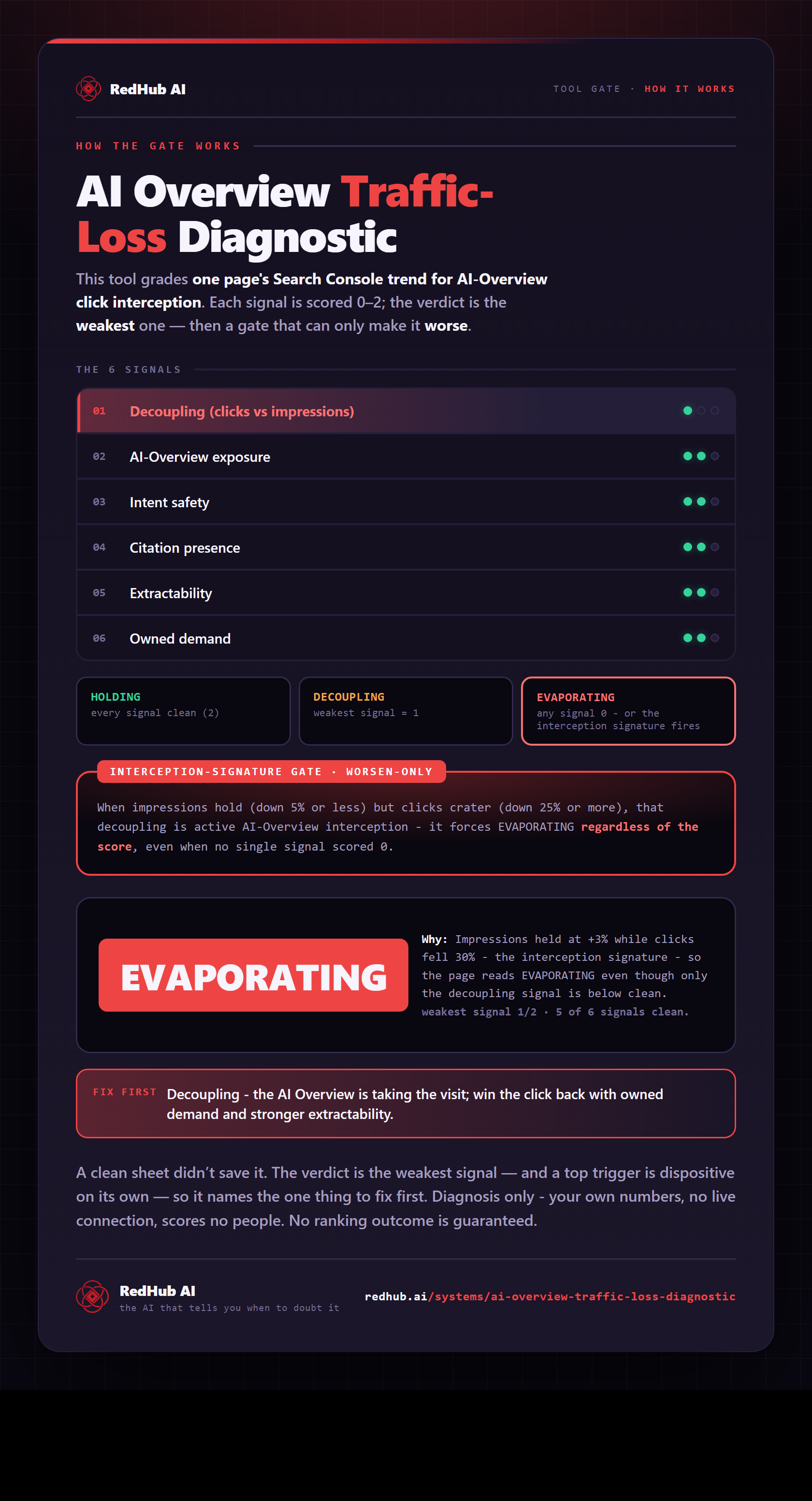
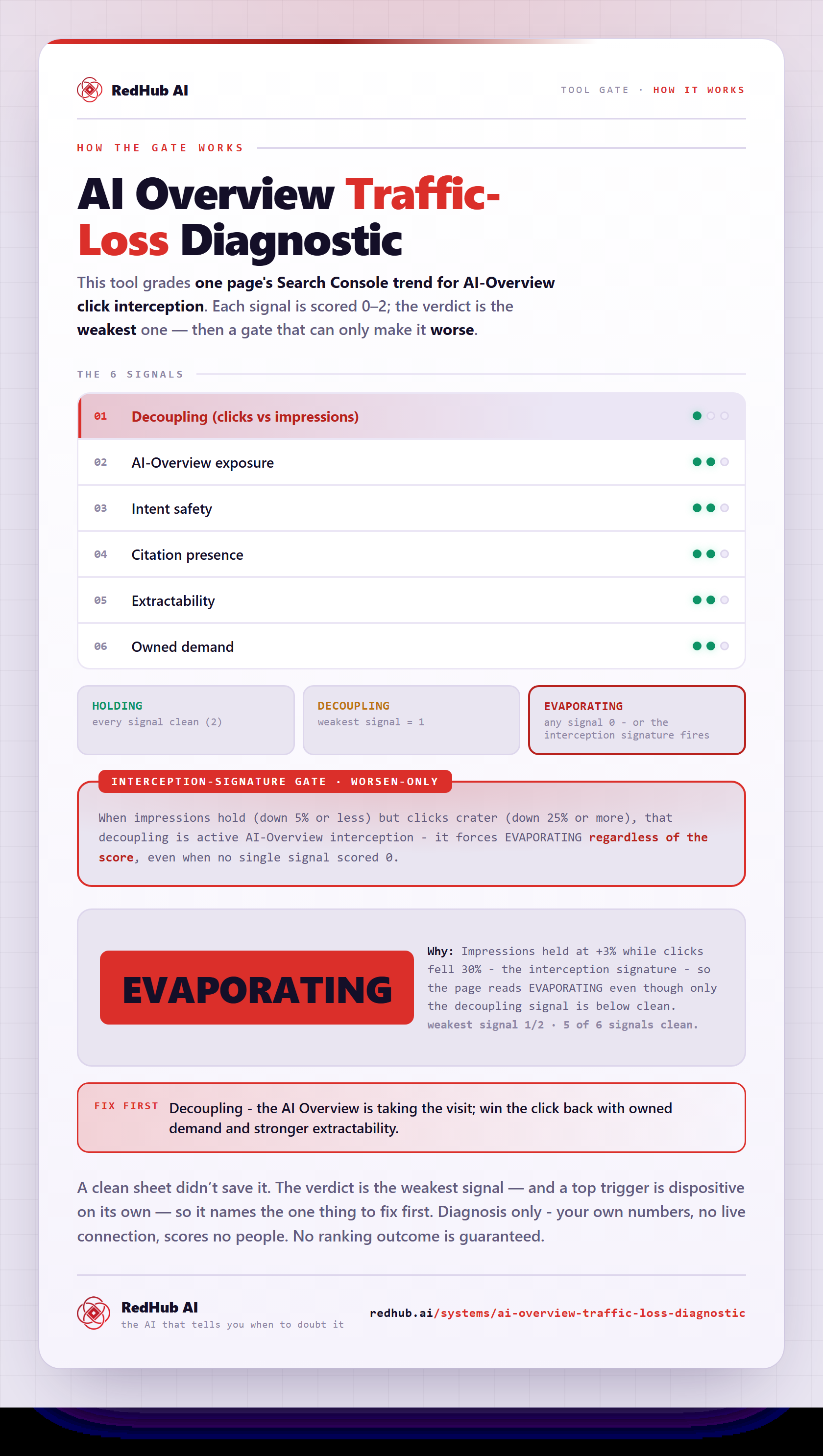
The gate this post refers to, drawn from the tool’s own logic. See the tool.