

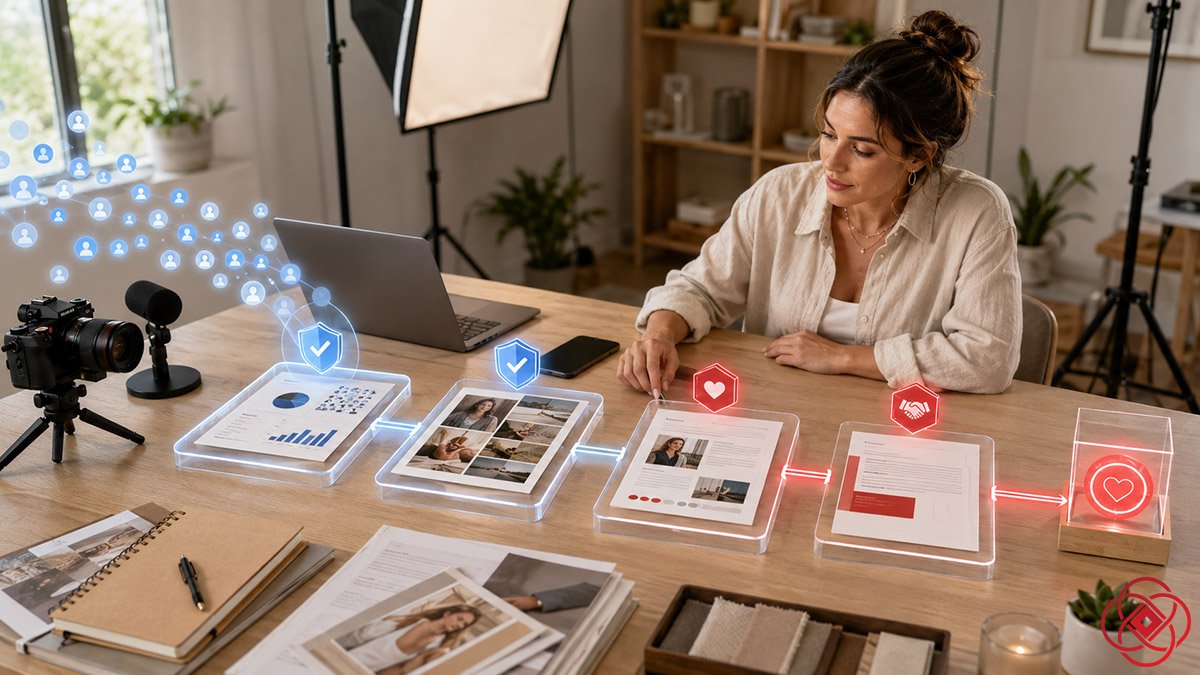
How to Get Brand Deals as a Creator
⏱ 8 min read
TL;DR
- What it is: Getting brand deals is a four-part system — know your rate, build an honest media kit, pitch a specific idea, and judge every offer against your own numbers.
- Who it's for: Creators, newsletter writers, and podcasters who want sponsorships without undercharging — see the Creator Sponsorship & Media Kit System.
- How it works: Brands pay for engaged reach, not follower count. Price from your real numbers, put your target on the kit, keep your floor private, and let the brand's offer come first.
- Bottom line: The creators who land deals are not the biggest. They are the ones a brand can trust — and the ones who can defend their number.
How do you get brand deals as a creator?
You get brand deals by making yourself easy to say yes to: compute a sponsorship rate from your own engaged reach and a realistic CPM, put it in an honest media kit, pitch brands that genuinely fit your audience with a specific content idea, and grade every inbound offer against your own target and floor. Follower count alone does not land deals — brands buy the attention you can actually deliver, and they check the numbers you claim.
Best for: creators fielding their first offers, or established creators pricing by gut — start with the Creator Sponsorship & Media Kit System.
Most advice on how to get brand deals starts with "grow your following." That skips the part that actually decides whether you get paid — and how much. Creators with 20,000 engaged followers close deals that creators with 200,000 passive followers never see, because the smaller creator showed up with a number they could defend and a kit the brand could trust.
The deals you land, and the money you keep, come down to four moments: the rate you compute, the kit you send, the pitch you make, and the verdict you give each offer. Get any one wrong and the others leak. This guide is the map; each part links to a deeper guide.
What brands are actually buying
A sponsorship is a media buy. The brand is paying to put a message in front of people who will actually see it and act on it. That is why follower count is the wrong headline number: it counts accounts, not attention. A brand's media team converts everything back to cost per thousand real impressions — so the honest starting point for your rate is the reach you reliably deliver per post, not the audience you accumulated over five years.
This is good news for smaller creators. If your average video gets 22,000 real views from a niche audience a brand wants, you are selling something concrete. You do not need to apologize for your size. You need to know what that attention is worth — which is a math problem, not a confidence problem. We break the math down fully in how much to charge for sponsored posts.
Key insight: undercharging does not just cost you on one deal. Your first accepted rate becomes the anchor for every renewal and every brand that asks "what did you charge them?" A cheap yes today prices your work down for a year.
The four moments where deals are won or lost
| Moment | The common mistake | What works instead |
|---|---|---|
| Setting your rate | Guessing, or copying another creator's number | Compute it from your reach, engagement, and a realistic CPM |
| The media kit | Padding the numbers to look bigger | Report real reach, label estimates, show your best proof |
| The pitch | Mass emails that say "let's collab" | A specific content idea for a brand that genuinely fits |
| The offer | Naming your price first, or taking any yes | Let them anchor, then grade the offer against your target and floor |
Step 1 — Know your number before anyone asks
Your rate should be built from three inputs you can point to: your effective reach (the views or impressions you reliably get per post), your engagement, and a CPM that matches your niche and format. Multiply them out and you get a target — the number that goes on your media kit — and a floor, the private walk-away line below it. No invented "creators like you charge 3×" multiplier. Every figure traces to an input you entered, which is exactly why the number survives a brand's pushback.
A dedicated video integration is worth more than a passing mention, so the format carries a weight too. The full walkthrough, with a working calculator, is in how much to charge for sponsored posts.
Step 2 — Build a media kit a brand can check
Your media kit is not a brag sheet. It is a due-diligence document. The person reading it will check your claimed numbers against what they can see on your profile, and any gap kills the deal quietly — no reply, no explanation. An honest kit that reports real reach, labels estimates as estimates, and separates paid results from organic ones closes more deals than a padded kit, because it removes the brand's biggest fear: that you are inflating.
What goes in it, what brands actually look at, and the padding traps to avoid are all in the creator media kit brands actually read.
Step 3 — Pitch like a partner, not a fan
Waiting for inbound works once you have momentum. Before that, you pitch — but almost every creator pitch fails the same way: it is about the creator, not the brand. "I love your product, let's collaborate" gives the brand nothing to evaluate. A pitch that names the audience overlap, proposes one specific content idea, and attaches a kit with real numbers gives a busy marketing manager something they can forward to their boss.
The pitch structure, follow-up cadence, and fit test are in how to pitch brands as a creator.
Step 4 — Grade every offer: Fair, Negotiate, or Walk
When an offer lands, the question is not "is this a lot of money?" It is "how does this compare to my target and floor for what they are asking?" An offer at or above your target is fair — accept it or hold for a small upside. An offer between your floor and target is a negotiation — the gap is your room to counter. An offer below your floor is a walk, even if it is the biggest check anyone has offered you, because taking it sets a bad anchor for everything after.
And the ask matters as much as the dollars. Two deliverables, six months of usage rights, and an exclusivity window can more than triple what a fair price looks like. Grading offers, countering, and pricing usage and exclusivity are covered in brand deal negotiation: fair, negotiate, or walk.
The sequence, start to finish
- Compute your target and floor. Effective reach × CPM × format weight. Target goes public on the kit; the floor stays private.
- Build the honest kit. Real reach, labeled estimates, paid and organic shown separately, your strongest proof of results.
- Pitch brands that fit. One specific idea per brand, kit attached, polite follow-up. Fit beats volume.
- Let the brand name the first number. Your target is on the kit; you never volunteer the low end.
- Grade the offer and act on the verdict. Fair: accept. Negotiate: counter toward target. Walk: decline or re-scope — never take a deal below your floor.
Run the whole loop on your own numbers
The Creator Sponsorship & Media Kit System ($79, one-time) computes your target and floor from your real reach and engagement — no invented multiplier — then grades every inbound offer Fair / Negotiate / Walk. It ships a runnable calculator, the same math as a workbook, a media kit builder guide, a negotiation playbook, and an editable sample set.
Get the System — $79 →Where to go deeper
This pillar is the map. Each moment has its own guide:
- How much to charge for sponsored posts — the rate math, with a working calculator.
- The creator media kit brands actually read — what to include and why honest beats padded.
- How to pitch brands as a creator — the pitch that gets forwarded instead of deleted.
- Brand deal negotiation: fair, negotiate, or walk — grading offers, countering, and pricing usage rights.
And if the audience itself is the bottleneck, the Organic Social & Short-Form Video System is the growth side of the same story — build the reach your media kit will report.
Decision Guide
Use this approach if: you are fielding your first brand offers, pricing by gut, or tired of hearing nothing back after sending a kit.
Skip it if: you have an agent or talent manager who already handles rates and negotiation for you.
Best first step: compute your target and floor before the next offer arrives. The worst time to figure out your number is with a brand's deadline in your inbox.
FAQ
How do creators get brand deals?
Through a mix of inbound offers and outbound pitching. Either way, the deal closes on the same things: a rate you can defend, a media kit the brand can verify, a pitch that fits their audience, and a clear read on whether their offer is fair.
How many followers do I need to get brand deals?
There is no magic threshold. Brands buy engaged reach, not follower count. Niche creators with a few thousand highly engaged followers land paid deals — often at strong per-view rates — because their audience is exactly who the brand wants.
Should I name my price first or wait for the brand's offer?
Put your target rate on your media kit, but let the brand's specific offer come first. The first number named anchors the negotiation, and you never want to volunteer your low end.
What is a media kit and do I really need one?
A media kit is a short document with your audience numbers, engagement, formats, and rates. Yes, you need one — it is what a marketing manager forwards internally to get your deal approved.
Is it okay to turn down a brand deal?
Yes — and sometimes it is the profitable move. An offer below your defensible floor sets a bad anchor for every future deal. Decline politely or propose a smaller scope that fits the budget.
Do I have to disclose sponsored posts?
Yes. Sponsored content needs a clear #ad or material-connection disclosure, and the obligation sits with the creator. That is general guidance, not legal advice — check current FTC and platform rules.
What does the Creator Sponsorship & Media Kit System actually do?
It computes your target and floor from your own reach, engagement, and a CPM you pick from sourced bands, then grades inbound offers Fair / Negotiate / Walk. It ships a runnable Python calculator, the same math as an Excel/Sheets workbook, a media kit guide, a negotiation playbook, and an editable sample set — $79, one-time, at redhub.ai.
Price the next deal from your numbers. Not a guess.
Know your rate, build an honest kit, and grade every offer — one system, $79, yours to keep.
Get the Creator Sponsorship & Media Kit System →