Confirmation Bias in Decision Making: The Founder Trap
RedHub AI Editorial6 min read

Jump to a section8
TL;DR
- What it is: Confirmation bias is your mind's habit of collecting evidence for what you already believe — and quietly discarding the rest.
- Why founders are exposed: Invested teams, supportive advisors, and agreeable AI tools mean every channel echoes the plan back.
- The fix: Structure, not willpower — tag your assumptions, run the rival test, write the case against first, and give one fatal objection veto power.
- Bottom line: You can't think your way out of confirmation bias. You can build a process it can't get through — see the Devil's-Advocate Board.
What is confirmation bias in decision making?
Confirmation bias in decision making is the tendency to seek, notice, and weight evidence that supports the conclusion you already favor, while overlooking or discounting evidence against it. For founders, it means the research you do on your own plan mostly confirms your plan — you read the supportive signals as proof and the warning signals as noise. It isn't a character flaw or a lack of intelligence; it's a default setting of human attention, which is why the working fixes are structural, not motivational.
Best for: understanding why hard calls need outside pressure — part of our guide on how to make a hard decision without a board.
Here's the uncomfortable version: when a founder "researches" a decision they're excited about, they are usually not researching. They're gathering support. The customer call that validated the idea gets retold for weeks. The two calls where the customer shrugged get filed under "bad timing." The spreadsheet gets rebuilt until the numbers work.
None of this feels like bias from the inside. It feels like diligence. That's the trap in confirmation bias in decision making — it wears the costume of homework.
Why founders get the worst case of it
Everyone has confirmation bias. Founders operate in conditions that supercharge it.
The plan is personal. A founder's plan isn't an abstract option — it's their judgment, their story, often their identity. Evidence against the plan reads as evidence against them, and the mind protects its owner.
The environment agrees. The team wants the plan to work. Investors want momentum. Friends want to be encouraging. Every channel a founder consults has a reason to echo the plan back — and the person who'd push back hardest, a real board, is exactly what most solo founders don't have.
The tools agree too. Ask an AI chatbot to evaluate your idea and it will usually find it promising. Sycophancy — telling the user what they want to hear — is a known failure mode of chat models, which means the newest advisor in the room has the oldest problem. We cover the fix in AI devil's advocate: make AI argue against you.
Key insight: confirmation bias gets stronger exactly when the stakes get higher. The bigger the bet, the more you need it to be right — and the harder your attention works to prove it is. The decisions that most need dissent are the ones where dissent feels worst.
How it shows up in real decisions
| Symptom | What it looks like | Structural fix |
|---|---|---|
| Evidence shopping | Re-running the analysis until it supports the plan | Tag every assumption evidenced, assumed, or hoped — before analyzing |
| Friendly sampling | Asking the advisor you know will say yes | Assign someone the explicit job of arguing no |
| Double standards | Your pivot is bold; a rival's identical pivot is desperate | The rival test: score the move as if a competitor made it |
| Moving goalposts | "We'll decide based on the pilot" — then the pilot misses and the plan proceeds | Write the kill criteria down before the data arrives |
| Averaging away the fatal flaw | "Nine things look great, one looks terrible — on balance, go" | A veto gate: one fatal objection overrides the average |
Why willpower doesn't fix it
The standard advice — "be aware of your biases" — fails for a simple reason: confirmation bias operates before awareness gets a vote. It decides which evidence you notice, which calls you remember, which numbers feel solid. By the time you're consciously reasoning, the inputs are already filtered. Knowing the bias exists doesn't unfilter them.
That's why every fix that actually works is structural. You don't try to think unbiased thoughts. You build a process that forces disconfirming evidence into the room and gives it power once it's there:
- Tag your assumptions before you decide. Listing what's evidenced, assumed, and hoped turns invisible filtering into a visible inventory. (The framing method — including the pre-mortem analysis — does this.)
- Write the case against before the case for. Whoever argues first anchors the debate — make the opposition go first for once.
- Run the rival test on your own scoring. If the answer changes when a competitor makes the move, the bias is doing the scoring.
- Give a fatal objection veto power. An average lets nine good signals bury the one that kills you; a veto doesn't.
- Log the decision and its assumptions, and re-test when an assumption breaks — so a verdict can't quietly outlive its evidence.
Notice what these five have in common: none of them require you to feel unbiased. They work on a biased operator. That's the design bar.
Structure you can buy versus structure you build
You can build all of this yourself with a notebook and discipline. The honest failure mode is that the discipline erodes exactly when it matters — the exciting decision is the one where you skip the process "just this once."
The Devil's-Advocate Board ($199) hard-codes the five fixes into one repeatable stress-test: a decision-framer that tags assumptions, five skeptical lenses that write the case against before any scoring, the rival test in the method, a veto gate where one fatal objection forces NO-GO regardless of the 0–100 conviction score, and a decision journal that re-tests the verdict when assumptions break. It will tell you no. It won't decide for you — the call, and the consequences, stay yours.
Bias also thrives on infrequency — a process you run once a year never becomes a habit. If you want the surrounding cadence, the Operating Cadence Engine ($299) builds the weekly operating rhythm that surfaces hard calls early, and the RedHub Operating System ($990/yr) is the full operating stack those decisions live inside.
Decision Guide
Assume the bias is active if: the decision is big, you're excited, and your research keeps agreeing with you. That combination is the signature.
Worry less if: you can state the strongest case against your plan, in detail, without softening it — and you've written down what evidence would change your mind.
Best first step: before your next hard call, write the kill criteria down first: "I will not do this if X." Dated, specific, before the data arrives.
FAQ
What is confirmation bias in decision making?
The tendency to seek and overweight evidence that supports the conclusion you already favor, while overlooking evidence against it. In practice: your research on your own plan mostly confirms your plan.
Why are founders especially vulnerable to it?
Because the plan is personal, the environment is invested — team, investors, friends all want it to work — and AI tools tend to agree with the user. Every channel echoes the plan back, and there's rarely a board to break the echo.
Can awareness alone fix confirmation bias?
No. The bias filters what you notice before conscious reasoning starts, so knowing about it doesn't unfilter the inputs. Working fixes are structural: forced dissent, pre-committed kill criteria, and veto rules.
What is evidence shopping?
Re-running an analysis, resampling opinions, or rebuilding a model until the output supports the plan. It feels like diligence; the tell is that the process only ever stops on a favorable answer.
What's the fastest single check for bias on a decision?
The rival test: ask how you'd judge the identical move if a competitor made it. If "bold" becomes "desperate," bias is doing your scoring.
What are kill criteria?
Conditions, written down before the data arrives, under which you will not proceed. Pre-committing prevents the goalposts from moving when the pilot misses but the excitement doesn't.
How does the Devil's-Advocate Board counter confirmation bias?
Structurally: it tags assumptions, makes five skeptical lenses argue against the decision before any scoring, applies the rival test, and enforces a veto where one fatal objection forces NO-GO. It stress-tests the decision — it doesn't make it.
Your plan deserves an opponent, not an echo
The Devil's-Advocate Board ($199, one-time) is confirmation bias's structural counterweight: five lenses build the strongest case against your decision, score how well it survives, and return an honest verdict — GO, GO WITH CONDITIONS, NOT YET, or NO-GO — with one fatal objection enough to veto. Instant download, 30-day guarantee.
Get the Devil's-Advocate Board — $199 →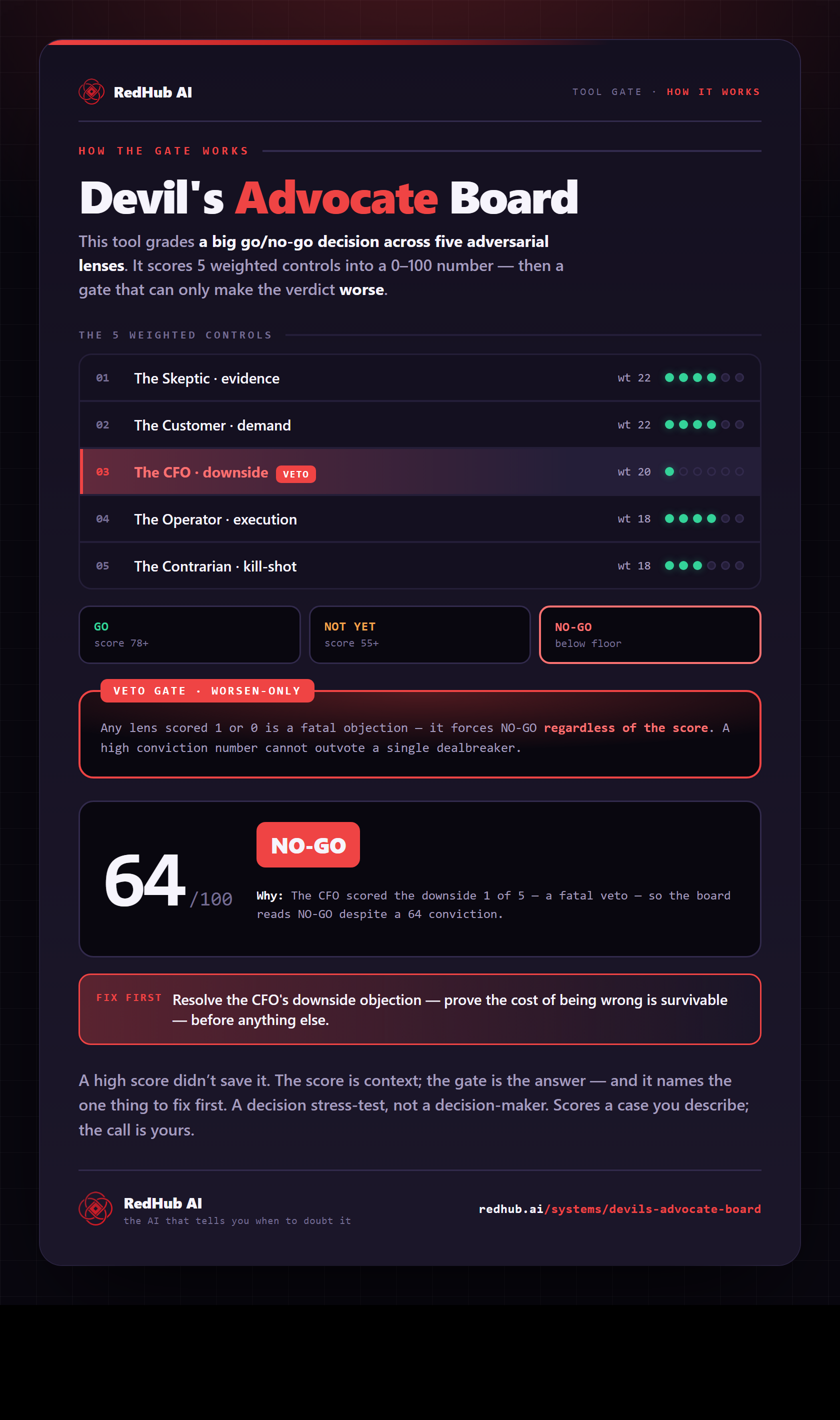
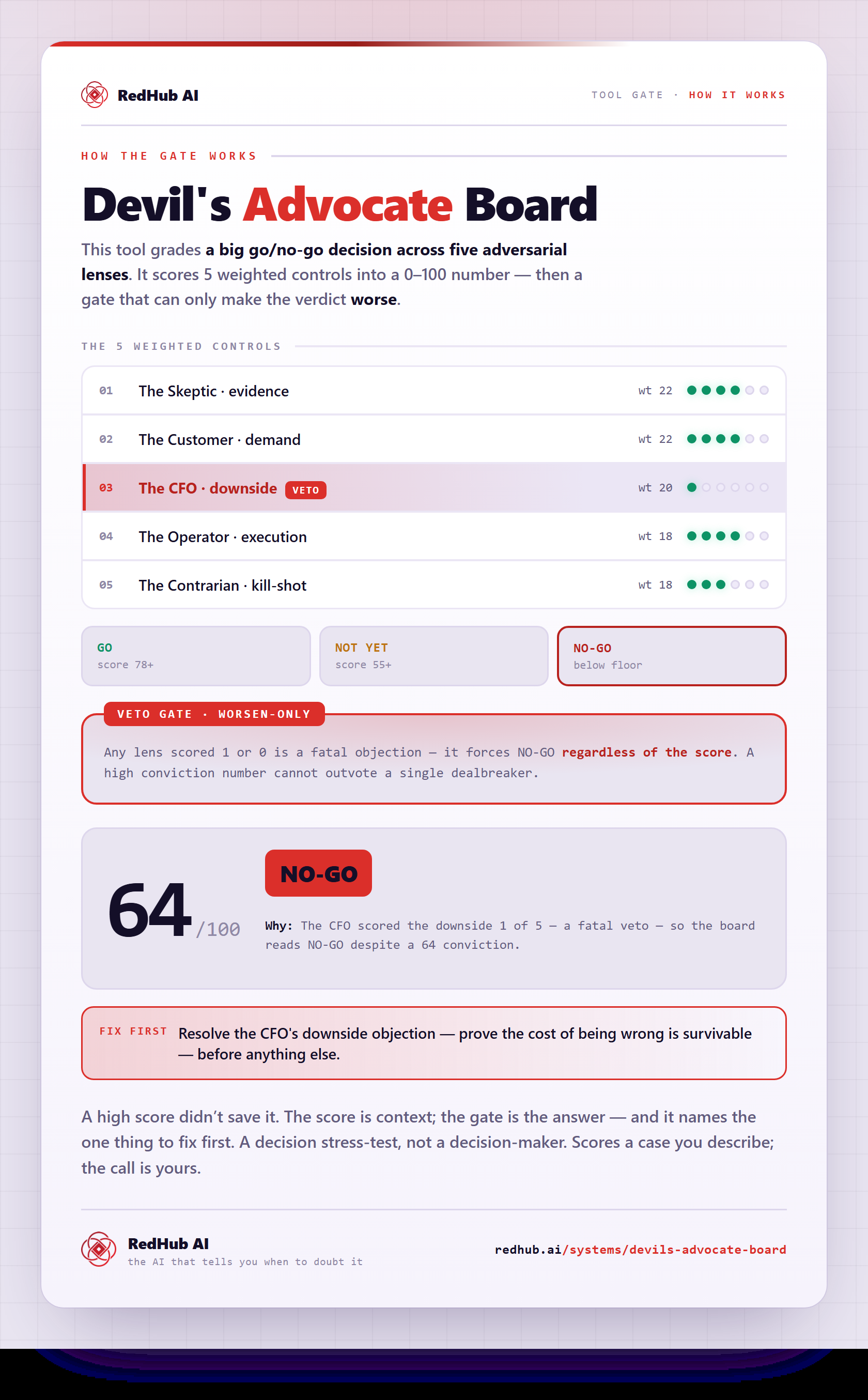
The gate this post refers to, drawn from the tool’s own logic. See the tool.