Are AI Backlinks Worth It? The 2,000-Link Question
RedHub AI Editorialupdated October 30, 202611 min read

Jump to a section10
TL;DR
- The pitch: an agent builds 2,000 backlinks while you sleep, your Domain Rating climbs, and the pages are "indexed overnight." Each of those three claims has a published document that answers it.
- Google: its spam policy lists "Using automated programs or services to create links to your site" and "Low-quality directory or bookmark site links" as examples of link spam. Volume by automation is the method it names.
- Ahrefs: Domain Rating "shows the strength of a website's backlink profile compared to the others in our database on a 100-point scale." It is Ahrefs' own relative metric, computed by Ahrefs, not by Google.
- Indexing: Google's Indexing API "can only be used to crawl pages with either JobPosting or BroadcastEvent embedded in a VideoObject". Nobody can sell you a guaranteed index of a directory listing.
- What is worth having: a small number of links from places that cover your field and your town, earned by something worth citing, and verified as live at recheck.
Are AI backlinks worth it?
AI backlinks, meaning links an agent creates at scale by submitting your business to directories and publishing posts that point at you, are the activity Google's spam policy names by method, and their count tells you nothing about whether any of them exists, is relevant, or will still be there in a month. A link from a page a real customer or a real search engine would read is worth having. Two thousand links from pages that exist to hold links are worth what they cost to clean up. The honest version of link building is slower, smaller, and verifiable, and this post is about why that is the version to pay for.
Best for: owners and marketing leads who have been quoted a link count and want to know what they would be buying. The read-only check for the AI-answer surface, where links are not the question at all, is the AI Search Brand-Presence Diagnostic.
The number in the pitch is always large. Two thousand targets. Links built around the clock. A rating that climbs. Pages indexed by morning. We have seen versions of these claims from vendors and have verified none of them, and the exact figures are not the point. Suppose the agent does exactly what the pitch says. The question that remains is whether what it did is worth anything, and three published documents answer it: Google's spam policy, Ahrefs' own definition of Domain Rating, and Google's Indexing API documentation.
RedHub is not affiliated with Google or Ahrefs. This post describes their published documentation. It is not a promise about rankings.
This is the second post in our guide to AI SEO agents: what to automate and what to avoid. The first, the business listing audit, covered the read-only work an agent should do first. This one is about the work a vendor most wants to sell: AI backlinks by the thousand.
The arithmetic of volume against relevance
Start with what a link is for, in the plainest terms. A link is a page saying your business exists and is worth pointing at. A link's value to a reader is whether the page is one a reader would be on. A link's value to a search engine is whatever the search engine decides, and Google does not publish that formula. What Google does publish is which kinds of links it treats as spam, and the published list is the only thing anyone outside Google can read.
Now the arithmetic. Here is a hypothetical example, labeled as one. A regional roofing company gets 2,000 links from an agent. The agent found them by searching for directories that accept submissions, which means every one of them is a page whose purpose is to hold submissions. Nobody looking for a roofer reads them. Against that, the same company gets five links: the county builders' association member page, the regional newspaper's story about a storm-repair program, a supplier's dealer locator, the chamber of commerce, and a neighborhood blog that reviewed the work. Five pages a person might open. Five pages a search engine would find in the ordinary course of crawling things people read.
The 2,000 cost almost nothing per link, which is the problem. Google's spam policy defines link spam as "the practice of creating links to or from a site primarily for the purpose of manipulating search rankings." Its list of examples (opens in a new tab) includes "Using automated programs or services to create links to your site" and "Low-quality directory or bookmark site links". Those two lines describe the 2,000 exactly: created by an automated service, on low-quality directories, for ranking purposes. The five are not on the list. Nobody automated them, nobody paid for them, and each one exists because the page had a reason to mention a roofer.
This post makes no claim about what Google will do with either set. The policy page says only that "Sites that violate our policies may rank lower in results or not appear in results at all." What this post claims is narrower and checkable: the 2,000 are the thing the policy describes, and the five are not. If you are paying for links, you are paying for one or the other.
What Domain Rating is, and what it is not
The second claim in the pitch is about a number going up. The number is almost always Ahrefs' Domain Rating, and the pitch treats it as a score Google keeps. It is not. Ahrefs' own help page (opens in a new tab) defines it: "Domain Rating (DR) shows the strength of a website's backlink profile compared to the others in our database on a 100-point scale." Ahrefs computes it, from Ahrefs' crawl, relative to the other sites in Ahrefs' database. Google does not use it, publish it, or see it. It is one company's estimate of one thing.
Ahrefs is careful about what the number means, and the care is worth quoting. The page says that "while DR correlates with Google rankings pretty well, it doesn't do this as well as our URL Rating (UR)", and recommends DR instead as "a great metric for selecting websites to build links from." So Ahrefs' own position is that DR is a tool for choosing where to seek a link, not a score of your site that Google reads. The page also says "Domain Rating is a relative metric by definition", and explains that your DR can drop when you lose nothing, because "Most likely, other websites gained a lot of backlinks." A number that moves when other people act is not a measure of your work.
Two more things from the same page undercut the volume pitch directly. Ahrefs' calculation splits a linking site's rating across every site it links to, so a page that links to thousands of businesses passes almost nothing to each. A directory that lists 2,000 companies is that page. And Ahrefs' list of questions to ask before taking a link from a site includes whether it publishes high-quality content, whether it gets any organic traffic, and whether it is "topically-relevant to yours". Those are the five-link questions, asked by the company that invented the number the 2,000-link vendor is quoting.
Why "indexed overnight" cannot be bought
The third claim is that the new links or pages will be indexed by morning, sometimes through "the indexing API." Google's own Indexing API documentation (opens in a new tab) settles that in one sentence: "The Indexing API can only be used to crawl pages with either JobPosting or BroadcastEvent embedded in a VideoObject". Job postings and livestream videos. Not directory listings, not blog posts, not your location pages. The same page adds that "All submissions through the Indexing API undergo rigorous spam detection." and that abuse "may result in access being revoked." A vendor who promises to push a directory listing through Google's Indexing API is describing something the API does not do, and if the vendor is doing something else to force a crawl, ask what, in writing.
Indexing is Google's decision. So is ranking. Google's Business Profile help page on local ranking (opens in a new tab) puts it as plainly as a company can: "There's no way to request or pay for a better local ranking on Google." What the same page says you can do is keep your information complete and accurate, which is the subject of the listing audit, and build the kind of prominence it describes as "also based on info like how many websites link to your business and how many reviews you have." Note what that sentence counts: websites that link to you, and reviews. Not links created by a program.
The honest alternative
What the five links in the example have in common is that each one was earned by something. Membership in an association. A program the newspaper found worth covering. A dealer relationship. A neighbor who had the work done. None of them can be automated into existence, and that is why they are worth having. The way to get more of them is the oldest way: do something in your field or your town that a page would have a reason to mention, and then ask, with a person's name on the request.
An agent helps with the part before the ask. It can find every association, publisher, supplier, and local organization that covers your field, read what they have mentioned before, and draft a note for each one. Then a person sends the note. That split, research by the agent and the outward action by a named person, is the line the next post draws in Google's own words: AI link building vs. link spam: where the line is.
- Associations and trade groups you belong to or could join, each with a member page.
- Local organizations the business already supports: a league you sponsor, a charity you donate to, a school program you supply. Most have a page listing supporters.
- Suppliers and partners with dealer, installer, or partner locators.
- Regional press and local publishers that cover your trade, pitched with something they would print anyway.
- Editorial mentions earned by publishing something worth citing: a price guide, a local data set, a how-to that answers what your customers ask.
Every link on that list can be verified the same way a listing is: opened at a published URL, read, captured with a date, and rechecked later. A link that is live at recheck is evidence. A link count is activity. The difference is the whole of SEO vendor accountability: pay for evidence, not activity.
The surface where links are not the question
There is a second reason to stop counting links, and it has nothing to do with Google's spam policy. A growing share of buyers now ask an AI assistant which business to call, and the answer either names you or it does not. No position, no click, and no link count changes it directly. What changes it is whether your pages are the kind an answer engine can read and cite, which is a separate discipline from link building. SEO vs GEO: why rankings don't get you cited explains the split, and AI Overviews SEO: what changes when Google answers covers what Google's own AI answers do to it.
The read-only check for that surface is the AI Search Brand-Presence Diagnostic: you run a fixed prompt battery across ChatGPT, Perplexity, Gemini, Google AI Mode, and Claude, mark presence, accuracy, and sentiment per engine from what you observe, and it scores PRESENT, PARTIAL, or ABSENT, with a presence gate that reads ABSENT when an engine never mentions you. Your observations, no API. It builds nothing. Citation on that surface means an AI engine naming your business in an answer, not a directory listing, which local SEO also calls a citation and this series calls a business listing.
Find out whether the AI engines name you at all
The AI Search Brand-Presence Diagnostic scores PRESENT, PARTIAL, or ABSENT per engine from a fixed prompt battery you run yourself across ChatGPT, Perplexity, Gemini, Google AI Mode, and Claude, with a presence gate: no mention means ABSENT regardless of accuracy or sentiment. Deterministic, offline, your observations and no API.
Get the Brand-Presence Diagnostic →Pairs well with
The AEO Citation Audit and Optimizer Kit scores how citable your pages are to AI answer engines on a 100-point Citation Index and works a 30-day playbook to a re-audit. The AI Visibility Bundle pairs that kit with the GEO / AI Visibility Playbook as one 90-day audit-and-fix loop, and its page is plain that there are no guaranteed citations. The Google Business Profile Suspension-Risk Gate grades the one profile a bad listing program can get suspended, GUIDELINE-READY, GUIDELINE GAPS, or HIGH SUSPENSION RISK.
Keep going: the full set starts at AI SEO agents: what to automate and what to avoid. The previous post is business listing audit with AI: 8 read-only steps, and the next draws the line in Google's words in AI link building vs. link spam.
Decision Guide
Walk away if: the offer is a link count, a Domain Rating target, or indexing by morning. Each of those is answered by a document quoted above, and none of the answers favors the offer.
Consider it if: the vendor proposes a short list of named, relevant targets, drafts outreach a person on your side sends, and reports each link as a published URL verified at recheck.
Best first step: list the five pages in your field or your town that would have a reason to mention you, and check whether they do. That is a morning's work, and it is the list an agent should be researching, not the directory list.
FAQ
Are AI backlinks worth it?
Links created at scale by an automated service on directories are the method Google's spam policy names as link spam, and a count of them says nothing about whether any one of them exists, is relevant, or is still live. A small number of links from pages that cover your field and your town, earned and verified, is what is worth having.
What does Google's spam policy say about automated links?
Its list of link spam examples includes "Using automated programs or services to create links to your site" and "Low-quality directory or bookmark site links", and it defines link spam as creating links "primarily for the purpose of manipulating search rankings." That is Google's published wording. This post makes no prediction about any particular site.
Is Domain Rating a Google score?
No. Ahrefs defines Domain Rating as showing "the strength of a website's backlink profile compared to the others in our database on a 100-point scale." Ahrefs computes it from its own database. Ahrefs also says DR correlates with rankings less well than its page-level URL Rating, and recommends DR as a metric for choosing where to seek links.
Can a vendor get my pages indexed overnight through Google's Indexing API?
Google's documentation says the Indexing API "can only be used to crawl pages with either JobPosting or BroadcastEvent embedded in a VideoObject". Directory listings and ordinary pages are not those. Indexing is Google's decision, and the same documentation says submissions undergo spam detection.
What should I ask for instead of a link count?
A short list of named targets that cover your field or your town, outreach drafted by the agent and sent by a person, and each resulting link reported as a published URL, captured with a date, and rechecked thirty days later. Links live at recheck are evidence. A count is activity.
Does the AEO Citation Audit and Optimizer Kit build links or get me cited?
Neither. It scores how citable your own pages are to AI answer engines on a 100-point Citation Index from queries you run, and works a 30-day playbook to a re-audit. Its page says it does not promise a citation. Citation there means an AI engine naming you in an answer, not a directory listing.
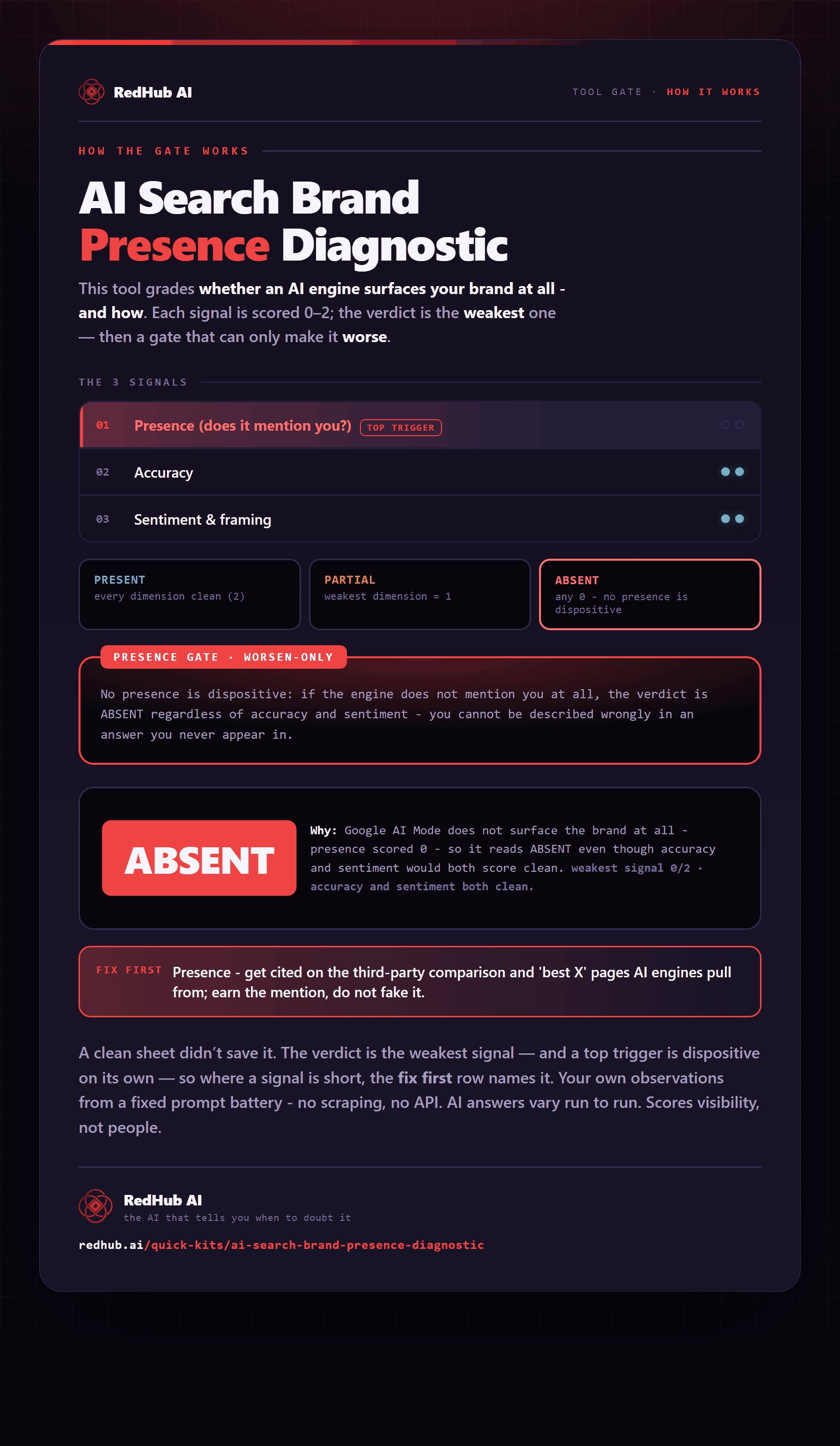
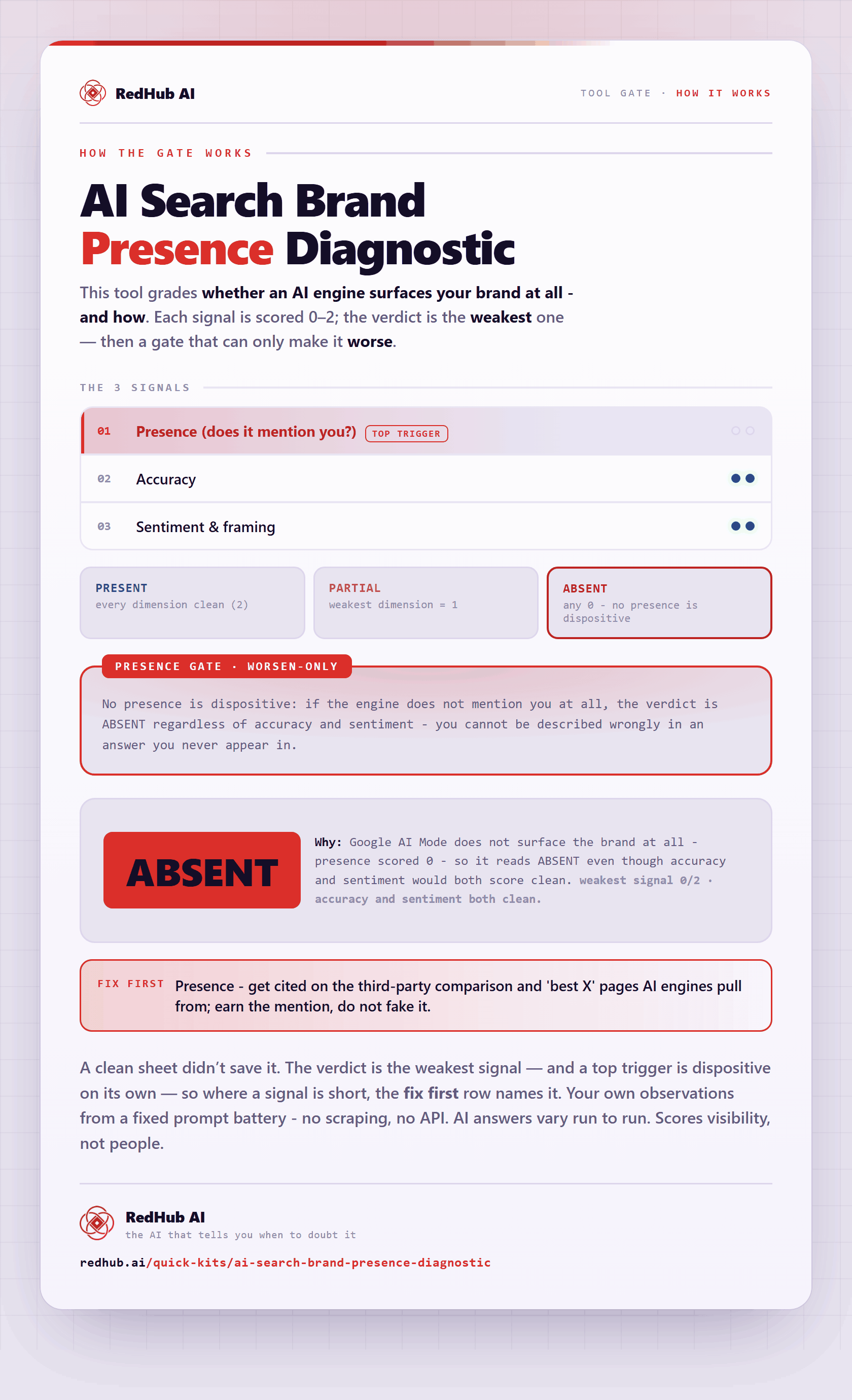
The gate this post refers to, drawn from the tool’s own logic. See the tool.