SEO Vendor Accountability: Pay for Evidence, Not Activity
RedHub AI Editorialupdated October 30, 202611 min read

Jump to a section10
TL;DR
- The problem: an SEO vendor's monthly report counts what the vendor did. Links built, listings submitted, posts published. Now that an agent can do all of that for pennies, the count is a count of nothing.
- What to pay for instead: evidence. Each listing as a published URL, fields matching your identity record, link resolving to your site, a dated capture, and still live at recheck. A submission that was never published is not delivered.
- The hidden cost of cheap listing services: unverified submissions you cannot find, wrong records you will spend a year correcting, and maintenance nobody budgeted for.
- Ten questions to ask before you renew, with the answer that counts as evidence and the answer that is reassurance. Get the free SEO Agent and Listing Audit Checklist.
What does SEO vendor accountability mean?
SEO vendor accountability means paying for results you can verify instead of activity you have to take on trust. A verifiable result is a listing or a link that a second person can open at a published URL, read, compare to your identity record, and find again thirty days later. An activity is a submission, a request, a post, or a count. AI agents have made activity nearly free, so a report built on activity no longer tells you anything about what you got. The ten questions below turn a vendor report into evidence or show that it cannot be.
Best for: owners and marketing leads with a renewal in front of them, and agencies that want to report in a way a client can check. The profile a careless vendor puts at risk is graded by the Google Business Profile Suspension-Risk Gate.
The report arrives on the first of the month. It says 500 links built, 180 listings submitted, 40 posts published, and a rating that went up two points. It has a chart. What it does not have is a single URL you could open to see one of the 500 links, and if you asked for the list, you would get a spreadsheet with 500 rows and no way to know how many of them exist. That report was written to be reassuring. It was not written to be checked.
RedHub is not affiliated with Google or Ahrefs. This post describes their published documentation. It is not a promise about rankings.
This is the last post in our guide to AI SEO agents: what to automate and what to avoid, and the sharpest, because it is the one with a renewal attached. The three before it explained the business listing audit, whether AI backlinks are worth it, and where link building ends and link spam begins. This one is about SEO vendor accountability: how to read the report, what the cheap version costs, and ten questions to ask before you pay again.
How to read a vendor report
Every line in an SEO report is one of two kinds of sentence, and you can sort them with a pencil. An activity sentence describes something the vendor did: submitted, built, published, requested, optimized, sent. An evidence sentence describes something that exists and can be checked: this URL, showing these fields, captured on this date, still live on this later date. Draw a line down the report. Count the sentences on each side.
The reason the sort matters now, and did not matter as much five years ago, is that automation has broken the link between activity and work. When a person had to submit each listing, 180 submissions meant a week of someone's time, and a count of them was a rough proxy for effort. An agent submits 180 in an afternoon. Google's spam policy (opens in a new tab) names the result, "Using automated programs or services to create links to your site", as an example of link spam. So the count is no longer evidence of work, and it was never evidence of a result. It is a count of an action that is both cheap and, in Google's published wording, named.
What Google says does help is on its Business Profile help page on local ranking (opens in a new tab): "Businesses with complete and accurate info are more likely to show up in local search results." Complete and accurate everywhere you are listed is a result. It can be checked by opening the listings. It is what the vendor should be reporting, and what the ten questions below ask for.
The hidden cost of a cheap listing service
Local SEO calls a directory listing of your name, address, and phone a local citation, and sells them in packages: so many listings for so many dollars. This series calls them business listings, to keep them apart from an AI engine citing your business in an answer, and the cheap package has three costs that are not on the invoice.
Those are the three costs. Unverified submissions you paid for and cannot find, which the vendor counted as delivered. Wrong records that went out at scale from a bad default, which you now correct at the rate of one person's afternoons. And maintenance, because listings drift, and a package has no line for the recheck that would catch it. The cheap price was the price of submitting. The real price is the price of finding out.
The ten questions
Each question has the answer that counts as evidence and the answer that is reassurance. There is no score. Ten evidence answers do not certify a vendor, and three reassurance answers do not fail one. What the list produces is a written record of what the vendor could show you, which is the thing most renewals do not have.
1. What identity record was every listing checked against, and who signed it off?
Evidence: a one-page record of name as it appears on signage, address, phone under the business's control, hours, category, and website, with an owner and a date, and the vendor has a copy. Reassurance: "We use the details you gave us at onboarding." Ask to see them.
2. For each listing reported as delivered, what is the published URL?
Evidence: a URL per listing, which you open, and which shows the business. Reassurance: a count, a percentage, or a dashboard status of "live" with no address behind it.
3. Do the name, address, and phone on each published listing match the record exactly?
Evidence: a field-by-field comparison per listing, with the mismatches named. Reassurance: "NAP consistency is part of our process."
4. Does each listing's website link resolve to our site, to the page we specified?
Evidence: the destination URL per listing, with no redirect through a third party and no link to a vendor-owned page. Reassurance: "All listings link back to you."
5. What evidence exists per listing, and can we have it?
Evidence: a dated capture of each listing as it was read, delivered to you, not held in the vendor's portal. Reassurance: "It's all tracked in our system."
6. How many listings were submitted but never published, and are they in the total?
Evidence: a number, and a total that excludes it. Reassurance: a total that is the submission count. This is the question that most often ends the conversation, and it is the one the Listing Delivery Verification Gate is built around: you mark each listing your vendor delivered on published URL found, identity fields match, link resolves, evidence captured, and still live at recheck. It grades each listing and rolls them up, and a listing that was submitted but never published never counts as delivered.
7. Which actions were taken in our name, and who approved each one?
Evidence: a log of every account created, form submitted, message sent, and payment made on the business's behalf, with the approving person named per action. Reassurance: "You approved the campaign." A campaign is not an action.
8. Were any links or placements paid for, and are they marked rel="sponsored"?
Evidence: the list of paid placements and the attribute on each. Google's documentation (opens in a new tab) says to mark "links that are advertisements or paid placements" with the sponsored value. Reassurance: "We don't buy links," from a vendor whose report counts hundreds of them a month.
9. How many of last quarter's delivered listings are still live and still correct today?
Evidence: a recheck, with the number and the list of what changed. Reassurance: the original delivery number, restated. Listings drift, and a vendor that never rechecks does not know what it delivered.
10. What does the invoice count: submissions, or verified listings?
Evidence: verified listings, defined as questions two through six all answered yes. Reassurance: anything else. This is the question that changes the contract, and it is the one to ask first at the next renewal.
The same ten questions are the free one-page checklist, with a blank column for the vendor's answer, below this post: Get the free SEO Agent and Listing Audit Checklist.
What a good report looks like
A vendor who reports evidence sends something shorter and harder to argue with. Listings in the inventory, and how many are correct on every field at this month's recheck. Corrections made, each shown by the corrected page, not the request. Links claimed, and how many resolved to your site on the day claimed and again thirty days later. Actions taken in your name, each with the approver. And the number that pays for all of it: calls, forms, and direction requests from people who could become customers, counted in your systems, not the vendor's.
A vendor who cannot report that way is not necessarily dishonest. Many report activity because activity is what their tools count. But the report is yours to specify, and a vendor who will not change it when asked is telling you which kind of vendor they are. The same standard applies on the AI-answer surface: the AEO Citation Audit and Optimizer Kit scores your own pages on a 100-point Citation Index, re-audits at day 30, and its page says it does not promise a citation. That is the kind of promise a vendor should be making.
The one profile a bad program can cost you
A listing program run on bad defaults does one more thing the invoice does not mention. The inconsistency it creates is also a guideline condition on your Google Business Profile. The Google Business Profile Suspension-Risk Gate scores one profile GUIDELINE-READY, GUIDELINE GAPS, or HIGH SUSPENSION RISK against seven guideline conditions the gate checks, from your own description, and NAP consistency across your profile, site, and directories is one of its two gate signals: a mark of 1 or 0 on it produces HIGH SUSPENSION RISK regardless of the other marks. It is not affiliated with Google and grades the profile, never a person. If a vendor has been submitting your business with a tracking number for six months, run it before the renewal call. The background is in Google Business Profile suspended: the reasons and how to avoid Google Business Profile suspension.
Take the ten questions into the renewal call
The SEO Agent and Listing Audit Checklist is one page: the ten questions above, the evidence answer for each, and a blank column for the vendor's reply. Free, behind a short email signup, and built to be sent ahead of the call and filled in during it.
Get the free SEO Agent and Listing Audit ChecklistPairs well with
The Google Business Profile Suspension-Risk Gate grades one profile GUIDELINE-READY, GUIDELINE GAPS, or HIGH SUSPENSION RISK, with NAP consistency as one of its two gate signals. The AEO Citation Audit and Optimizer Kit scores how citable your pages are to AI answer engines and re-audits at day 30. The AI Visibility Bundle runs that audit and the GEO / AI Visibility Playbook as one 90-day loop.
Keep going: the full set starts at AI SEO agents: what to automate and what to avoid. The audit the ten questions are built on is business listing audit with AI: 8 read-only steps. The arithmetic behind question ten is in are AI backlinks worth it, and the policy behind question eight is in AI link building vs. link spam.
Decision Guide
Ask the ten questions now if: a renewal is within ninety days, or the last report you received had counts and no URLs. That is most vendor reports.
Renew without them if: the vendor already reports published URLs, field matches, dated captures, rechecks, and approvers per action. Then the questions are answered and the list is a formality.
Best first step: ask question six today, by email, in writing. How many listings were submitted but never published, and are they in the total. The answer, or the silence, tells you how the other nine will go.
FAQ
What is SEO vendor accountability?
Paying for results a second person can verify: a listing or link opened at a published URL, matched to your identity record, captured with a date, and found again at recheck. Activity (submissions, requests, posts, counts) is not a result, and automation has made it nearly free.
Why is a submitted listing not a delivered listing?
Because directories reject, hold, and never process submissions, and a vendor that counts submissions counts all of those as done. Delivered means a published URL that shows the business, with the fields correct, and still live when rechecked.
What is the most important of the ten questions?
Question six: how many listings were submitted but never published, and are they in the total. It separates a report of what exists from a report of what was attempted, and it is the question the Listing Delivery Verification Gate is built around.
Is a cheap listing package a bad deal?
The price covers submitting. It does not cover finding out which submissions were published, correcting the ones that went out with a wrong default, or rechecking them later. Those costs fall on you, and in the hypothetical example above they outweighed the package several times over.
What should a good SEO report contain?
Listings correct on every field at this month's recheck, corrections shown by the corrected page, links live at claim and again thirty days later, every action taken in your name with its approver, and qualified leads counted in your own systems.
Where is the checklist?
Below this post, behind a short email signup, at Get the free SEO Agent and Listing Audit Checklist. It is one page, with the ten questions and a blank column for the vendor's answers.
Does the Listing Delivery Verification Gate check the listings for me?
No. You mark each listing your vendor delivered on five points (published URL found, identity fields match, link resolves, evidence captured, still live at recheck), it grades each listing and rolls them up, and a submitted-but-never-published listing never counts as delivered. It grades your marks and scans nothing.
Free: The SEO Agent and Listing Audit Checklist
Ten questions to put to any SEO vendor or agent before you pay for listing or link work. One page, printable.
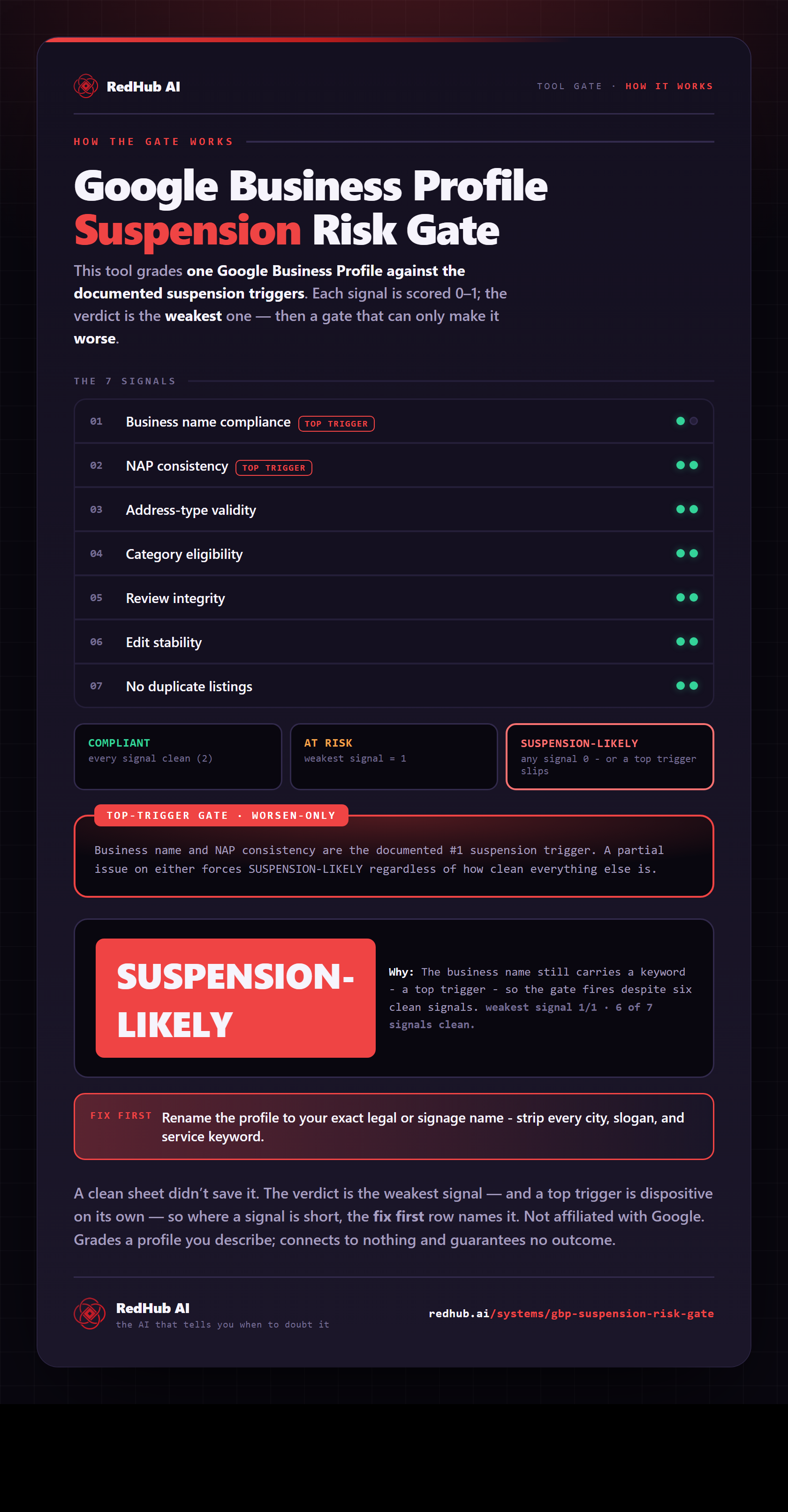
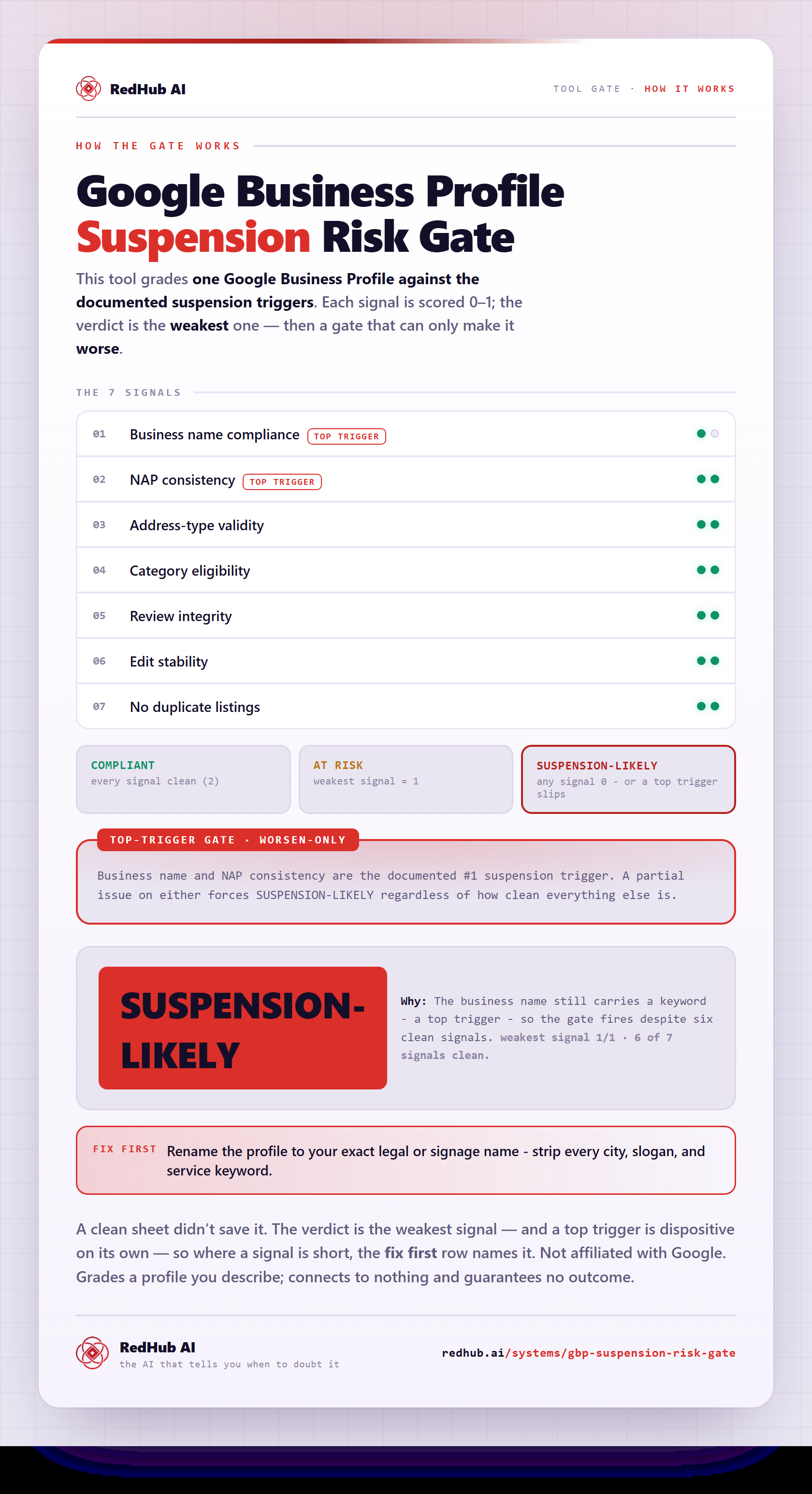
The gate this post refers to, drawn from the tool’s own logic. See the tool.