AI Link Building vs. Link Spam: Where the Line Is
RedHub AI Editorialupdated October 30, 202610 min read

Jump to a section11
TL;DR
- The line, in Google's words: link spam is "the practice of creating links to or from a site primarily for the purpose of manipulating search rankings." The examples include "Using automated programs or services to create links to your site" and buying links "for ranking purposes."
- What is not on the list: research. Finding who covers your field, reading what they publish, and drafting a note for a person to send. Nothing in the policy names that.
- Paid placement: Google says buying and selling links "is a normal part of the economy of the web for advertising and sponsorship purposes", as long as the link is qualified. Its documentation says to mark paid links with the sponsored value.
- The decision table: research (agent, read-only), outreach drafted for a human (agent drafts, person sends), submission to a relevant directory (person, one at a time, named approval), bulk automated placement (the named example, do not).
Where is the line between link building and link spam?
Link building vs link spam comes down to one question Google's spam policy answers in its own words: was the link created "primarily for the purpose of manipulating search rankings"? Automating the research, finding relevant publishers and drafting outreach for a person to send, is nowhere on Google's list of examples. Automating the placement, using "automated programs or services to create links to your site", is the first thing on it after paid links. Paid placements are allowed when qualified with rel="sponsored". The line is not AI versus human. It is read-and-draft versus place-at-scale, and which side of it an agent is on is a permissions decision you make before it runs.
Best for: anyone configuring an SEO agent, or buying one, who needs to know what it may do on its own and what needs a person's name. The gate that scores an agent's guardrails before it touches a public account is the AI Agent Go-Live Readiness Gate.
Every vendor selling AI link building says it is white hat. Every vendor selling the same thing five years ago said so too. The word has no definition, and arguing about it goes nowhere. What has a definition is link spam, because Google published one, with examples, and the examples are specific enough to sort almost any workflow an agent can run into one of two piles. This post does the sorting.
RedHub is not affiliated with Google or Ahrefs. This post describes their published documentation. It is not a promise about rankings.
This is the third post in our guide to AI SEO agents: what to automate and what to avoid. The previous one, are AI backlinks worth it, did the arithmetic on volume. This one is about link building vs link spam as a permissions question: given that an agent can do any of these things, which ones should it be allowed to do without asking.
The definition and the examples
Google's spam policies page (opens in a new tab) defines the term in one sentence: "Link spam is the practice of creating links to or from a site primarily for the purpose of manipulating search rankings." Then it lists examples. The ones that matter for an agent, quoted as written:
- "Buying or selling links for ranking purposes. This includes: Exchanging money for links, or posts that contain links"
- "Excessive link exchanges" and partner pages that exist only to cross-link
- "Using automated programs or services to create links to your site"
- "Advertorials or native advertising where payment is received for articles that include links that pass ranking credit"
- "Low-quality directory or bookmark site links"
- "Creating low-value content primarily for the purposes of manipulating linking and ranking signals"
Read the list as an engineer would. Every item is an action that creates a link, taken for ranking. Not one item is about reading. Nothing on the page names researching publishers, reading what they cover, finding out who runs them, or drafting a message. The policy is about placement, payment, and exchange. That is the whole basis for the split this post makes, and it is Google's wording, not ours.
What automating research looks like
An agent on the research side does four things and then stops. It finds the publishers, associations, suppliers, and local organizations that cover your field or your town. It reads what each one has published and whether they have mentioned businesses like yours before. It finds the right contact and how they prefer to be reached. And it drafts a note, specific to that one target, that a person on your side will read, edit, and send under their own name.
Nothing in that workflow creates a link. The agent has no account anywhere, no password, and no ability to post. Its output is a document: a target list with reasons, and a draft per target. If the research is bad, the person reads a bad draft and does not send it. The failure mode is wasted time, which is the right failure mode for an agent to have. This is the same read-only discipline as the business listing audit, applied to a different list.
What automating placement looks like
An agent on the placement side creates accounts, fills forms, posts content, and leaves links, at a rate no person could match and with no person reading each one. The vendor pitch calls it scale. Google's list calls it "Using automated programs or services to create links to your site". Whether the agent uses a language model to write the posts does not move it off the list. Neither does calling the directories "high quality". The example is about the method, and the method is automated placement for ranking.
There is a second line on the same page that catches the content half of this workflow. Under scaled content abuse, the first example is "Using generative AI tools or other similar tools to generate many pages without adding value for users". An agent that writes 200 posts on 200 sites so that each can hold a link is doing that and the link example at once.
And one more, because the placement agents often come bundled with it. Under machine-generated traffic, Google says the practice "includes scraping results for rank-checking purposes or other types of automated access to Google Search conducted without express permission." A dashboard that shows your rank by scraping Google is doing the thing that sentence names. Rank data has a permitted source, Search Console, and an agent should read that instead.
Paid placement, and the attribute that makes it legitimate
Paid links are not banned. They are regulated by an attribute. The spam page says: "Google does understand that buying and selling links is a normal part of the economy of the web for advertising and sponsorship purposes." The condition is that the link is qualified so it does not pass ranking credit, and Google's page on qualifying outbound links (opens in a new tab) says how: "Mark links that are advertisements or paid placements" with the sponsored value, and it calls those links "commonly called paid links". The same page notes that "The nofollow attribute was previously recommended for these types of links and is still an acceptable way to flag them, though sponsored is preferred."
So a sponsorship of the local league, with a link on the supporters page, is fine. A paid listing in a trade directory, marked as such, is fine. What makes either one spam is paying for the link to count toward ranking and leaving it unmarked so that it does. If a vendor is placing paid links for you, the one question that settles the matter is whether each one carries rel="sponsored", and a vendor who hesitates has answered.
The decision table
Four workflows, one row each. The permission column is the part to copy into your agent's configuration.
| Workflow | Who does it | Permission | Where Google's policy puts it |
|---|---|---|---|
| Research: find relevant publishers, associations, local organizations, and what they cover | Agent | Read-only, standing | Not named anywhere on the spam page |
| Outreach drafted for a human: one note per target, edited and sent by a named person | Agent drafts, person sends | Draft only, no send | Not named. The person's judgment is the control |
| Submission to a relevant directory: an association, a supplier locator, a trade body your customers use | Person, one at a time | Named approval per submission | Fine if the directory is one people use. "Low-quality directory or bookmark site links" is the example to stay away from |
| Bulk automated placement: accounts, forms, posts, and links created at scale by the agent | Nobody | Denied | "Using automated programs or services to create links to your site" |
The third row is the one that takes judgment. A directory can be a page people use, like a trade association's member list, or a page that exists to sell listings. Google's example names the low-quality kind. The test we use is the relevance gate from the listing audit: would a customer or a search engine plausibly read this page. If the answer is no, the listing is activity, and if the answer is yes, it is a listing worth a person's five minutes.
Making the table hold
A table is a policy. What makes it hold is the permission design around the agent, and that is a build decision, not a prompt. An agent told not to post can still post if it has the credentials. The controls that matter are the ones the agent cannot talk its way past: no standing credentials on any third-party platform, a named approval step in front of every outward action, a log of every tool call, a tested way to undo what it did, and a person it can hand off to when it is unsure. The general case is covered in AI agent permissions: enough access to help, not to harm, and the stop that has to work is in AI agent kill switch: what to build before you grant access.
The AI Agent Go-Live Readiness Gate scores exactly those five controls from your own marks (a human approval gate on destructive actions, full tool-call logging, a tested rollback path, bounded scope, and a human escalation path) and returns READY, FIX, or DO NOT DEPLOY per agent. Its hard gate is the one this post is about: a destructive action with no human approval step is DO NOT DEPLOY no matter how high the rest scores. An agent that can create accounts and place links in your name has that capability, because a link it places is public, in your name, and on the list above.
For the question one step earlier, whether a given task should be done by code, a model, or a person at all, the free Decision Fit Check runs in your browser, asks eight questions about one task, and has two gates that only ever move a task toward human judgment. Submitting a listing in your name is a task its irreversibility gate is built for.
Score the guardrails before the agent touches a public account
The AI Agent Go-Live Readiness Gate grades five operational controls and returns READY, FIX, or DO NOT DEPLOY, with a hard gate: a destructive action without a human approval step is DO NOT DEPLOY whatever the rest scores. Deterministic, offline. Scores the agent's guardrails, not people.
Get the Go-Live Readiness Gate →Pairs well with
The free Decision Fit Check places one task on a ladder from deterministic code to a person, with an irreversibility gate that routes any unreviewed, un-undoable task to human judgment. The Google Business Profile Suspension-Risk Gate grades the profile a careless placement program puts at risk, GUIDELINE-READY, GUIDELINE GAPS, or HIGH SUSPENSION RISK, with NAP consistency as one of its two gate signals. The AI Search Brand-Presence Diagnostic scores PRESENT, PARTIAL, or ABSENT per AI engine, for the surface where links are not the question.
Keep going: the full set starts at AI SEO agents: what to automate and what to avoid. The previous post is are AI backlinks worth it, and the last turns all of this into questions for a vendor in SEO vendor accountability: pay for evidence, not activity.
Decision Guide
Let the agent run if: its only outputs are target lists and drafts, it holds no credentials on any third-party platform, and a named person sends every note and makes every submission.
Stop it if: it can create accounts, post, or submit on its own, at any volume. That is the example Google's policy names, whatever the vendor calls it.
Best first step: list every credential the agent holds. If the list is longer than "none", the permission design is the problem to fix before the link strategy.
FAQ
Where is the line between link building and link spam?
Google's spam policy defines link spam as creating links "primarily for the purpose of manipulating search rankings" and lists examples, including "Using automated programs or services to create links to your site". Research and drafting are not on the list. Automated placement at scale is.
Is it against Google's rules to use AI for link building?
Google's policy names methods, not tools. An AI agent that researches targets and drafts outreach a person sends is doing nothing the policy lists. An AI agent that creates accounts and places links at scale is doing the thing the policy's example describes. The same model can run either workflow, and the permissions decide which.
Are paid links always spam?
No. Google's spam page says buying and selling links "is a normal part of the economy of the web for advertising and sponsorship purposes", as long as the link is qualified. Its documentation says to mark paid placements with the sponsored value, and that nofollow is still acceptable though sponsored is preferred. An unmarked paid link that passes ranking credit is the problem.
Can an agent submit my business to directories?
It can prepare the submission. A person should make it, one directory at a time, with a named approval, and only to directories a customer or a search engine would plausibly read. "Low-quality directory or bookmark site links" is on Google's list of link spam examples.
Can an agent check my rankings by searching Google?
Google's spam policy describes machine-generated traffic as including "scraping results for rank-checking purposes". Search Console is the permitted source for that data, and an agent should read it there.
Does the Go-Live Readiness Gate configure my agent's permissions?
No. It grades five operational controls from your own marks and returns READY, FIX, or DO NOT DEPLOY, with a hard gate on a destructive action that has no human approval step. The permission design is yours to build. The gate tells you whether it is in place.
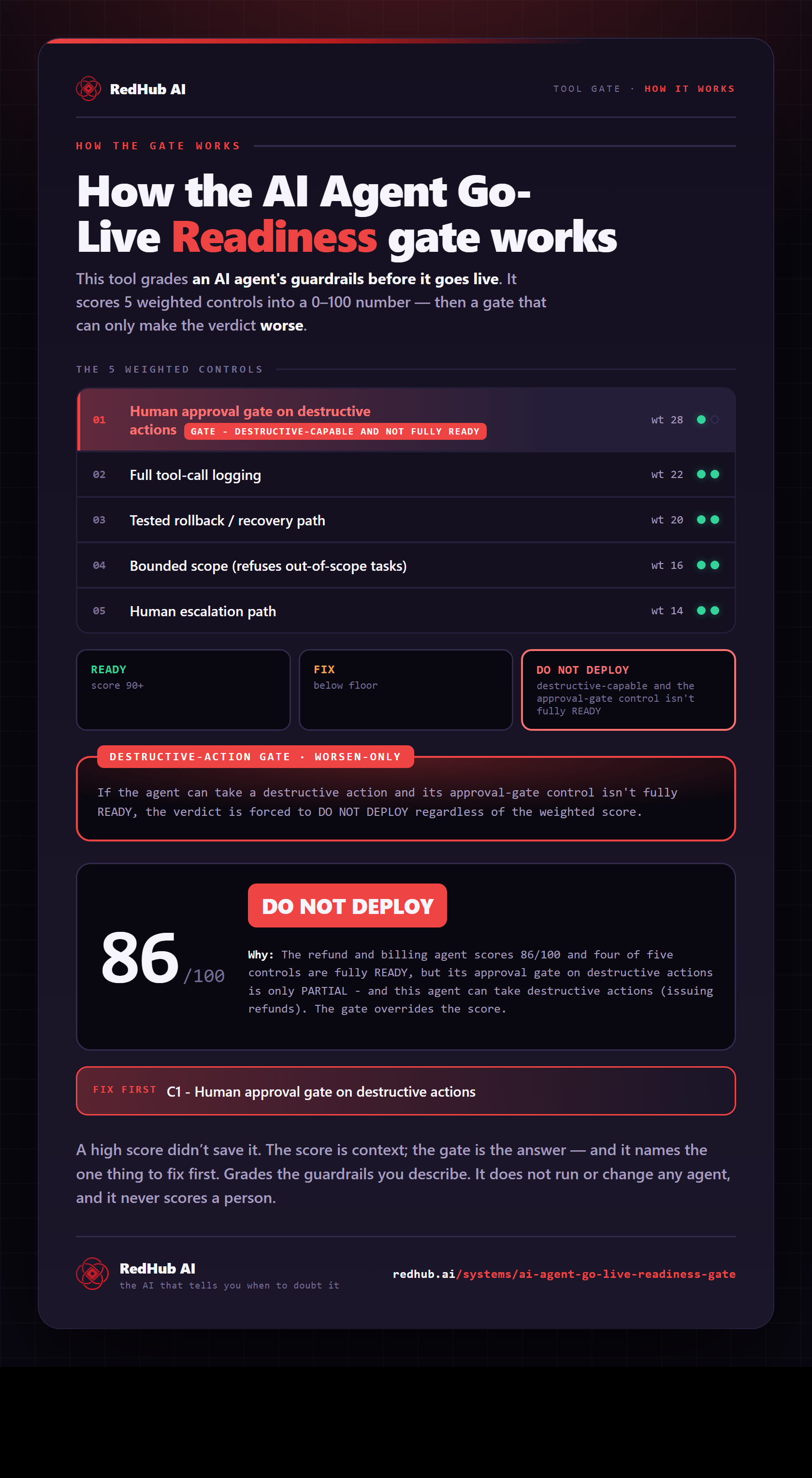
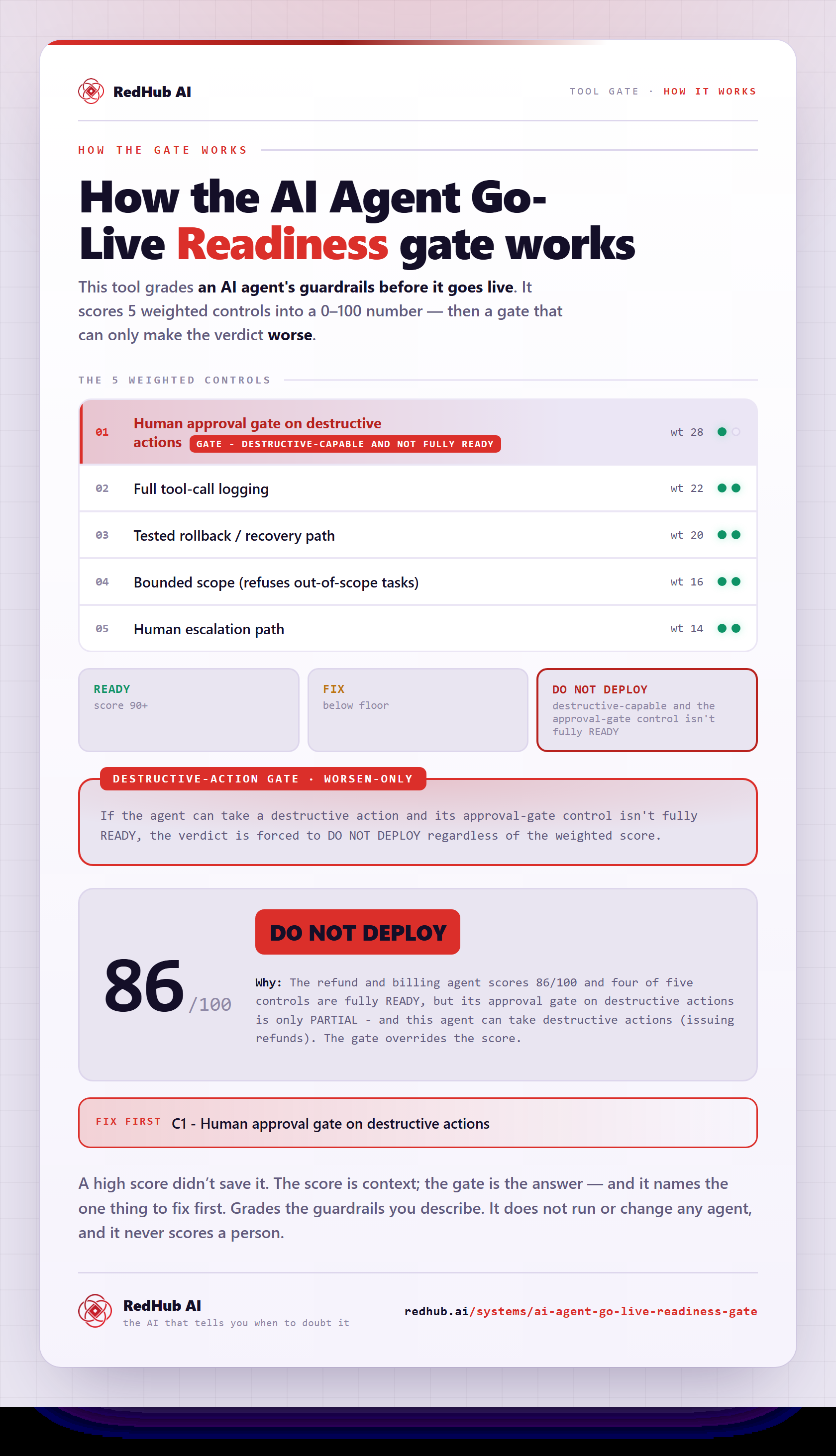
The gate this post refers to, drawn from the tool’s own logic. See the tool.