Authority Video: How Experts Use Video to Build Trust and Get Known
RedHub AI Editorialupdated September 20, 20266 min read
Jump to a section8
Authority video is video where your judgment — not just your information — is the thing people are watching for. It works when you say something a viewer couldn't get from a summary of your notes, and it fails when it's just you reading your knowledge out loud. Production value doesn't fix that. A real point of view does.
TL;DR: Authority video isn't about better lighting or a bigger camera — it's about having a real point of view, backing it with something you actually know firsthand, and showing up on it consistently. The fastest way to fail is picking a topic because it sounds smart instead of because real people are searching for it. Research the topic, find your actual opinion on it, then record — in roughly that order.
What "Authority Video" Actually Means
Most experts think "making video content" means turning their expertise into a script and reading it well. That's information video, and there's a lot of it — most of it forgettable. Authority video is different: it's built around a stance. It answers a question the way only you would answer it, with the specific experience, disagreement, or hard-won opinion that makes you the person to listen to on that topic.
The test is simple: could a competent generalist with access to the same facts have made this video? If yes, it's information content. If the video falls apart without your specific judgment in it, it's authority content.
Why Most Expert Video Doesn't Build Authority
Three failure modes show up over and over:
- Information without opinion. "Here's what X is and how it works" is a definition, not a stance. It doesn't tell anyone why they should trust your judgment over anyone else's.
- Topics chosen by guess, not demand. Recording a video on what you feel like talking about, instead of what your audience is actually searching for, means the video exists but nobody finds it.
- No consistency. One great video and then silence doesn't build authority — it builds a single data point. Authority compounds from a pattern, not an event.
The Three Ingredients of Authority Video
Every piece of video that actually builds trust has three things in common:
- A point of view. Not "here are five ways to think about pricing" — "here's why I think most consultants underprice, and the specific mistake I see them make." Opinions are memorable; lists of options are not.
- Evidence tied to real experience. Your POV has to be backed by something — a client story, a mistake you made, a pattern you've seen repeat. Borrowed opinions read as hollow on camera.
- Consistency on a topic lane. Authority is built by being the person who keeps showing up on the same handful of questions, not by covering everything once.
How to Know What to Say
The most common reason experts stall out isn't lack of knowledge — it's not knowing which of the twenty things they could say is actually worth saying on video. Guessing wastes the one resource you can't get back: the time it takes to record. The fix is choosing topics from real demand signals — what people are actually searching for and asking — rather than from what sounds impressive in your own head. We go deeper on exactly how to do that in how to choose video topics that prove your expertise using real demand.
The ~70-Minute Process Behind a Recorded Authority Video
Once you know your topic and your point of view, the actual production doesn't need to be a project. The Authority Video Engine is a $199 MCP-driven workflow that walks an expert from a real search-demand topic to a recorded, on-camera video in about 70 minutes. Four Claude Skills handle the parts that usually eat a week: one researches the topic against live search and competition data (never invented numbers — if the demand isn't there, it says so), one interviews you to pull out your actual opinion instead of a generic summary, one builds an animated outline deck from that interview, and one runs a teleprompter so you can just talk. It doesn't invent your point of view for you — it removes the friction between having one and getting it recorded.
What Happens After You Hit Record
A recorded video isn't a finished asset — it's raw material for two different jobs. Getting it found and watched on YouTube is a packaging problem (title, thumbnail, the first 15 seconds), and getting it in front of people on Instagram, TikTok, or Reels is a clipping problem. Both are worth doing well, and neither is what this post is about — see our companion post on turning expertise into content people actually watch for more on the substance side, and treat packaging and clipping as the next two steps after the point of view is locked.
A Realistic Path, Not a Shortcut
None of this replaces having something worth saying. If you don't have a real opinion on your topic yet, no tool — including this one — will manufacture one for you. What it can do is remove the excuses that keep a real point of view stuck in your head: not knowing what to say, not having a process to say it in, and not having 6 hours to spend on a single video. Authority is still built one honest, specific video at a time.
Pairs well with: before you record a single video, your point of view needs a foundation to stand on — that's what The Founder's Positioning Forge ($59) is for. Once your video is recorded, package it for search and discovery with the YouTube Packaging & Retention Engine ($99), and clip it down for social with the Organic Social & Short-Form Video System ($79).
More in this guide
What makes a video "authority video" instead of just expert content?
A real point of view. Authority video is built around a stance a viewer couldn't get from a generic summary of the topic — information alone, no matter how accurate, doesn't build trust the same way an opinion backed by real experience does.
Do I need expensive production equipment to build authority through video?
No. Production quality helps a video look professional, but it doesn't create trust by itself. A clear point of view recorded simply outperforms a beautifully shot video that says nothing specific.
How do I know if I actually have a point of view on a topic?
Ask whether a reasonable, informed person could disagree with what you're about to say. If your take is just a neutral summary everyone would agree with, it's information, not a point of view — you need to dig for the opinion underneath it.
How long does it take to go from topic to a recorded authority video?
With a structured process — research, interview, outline, teleprompter — the Authority Video Engine takes an expert from a real search-demand topic to a recorded video in about 70 minutes. Without a process, the same video can take days because most of the time gets lost deciding what to say.
Should I pick video topics based on what I want to say or what people are searching for?
Both, at the same time. A topic that's only what you want to say may have no audience; a topic that's only high-demand with no point of view attached is forgettable. The strongest videos sit where real search demand and your genuine opinion overlap.
What should I do with an authority video after it's recorded?
Package it properly for the platform it lives on (title, thumbnail, opening hook) and consider clipping it into shorter pieces for social distribution. Those are separate, specialized jobs from the recording itself — worth doing, but downstream of having a real point of view on tape.
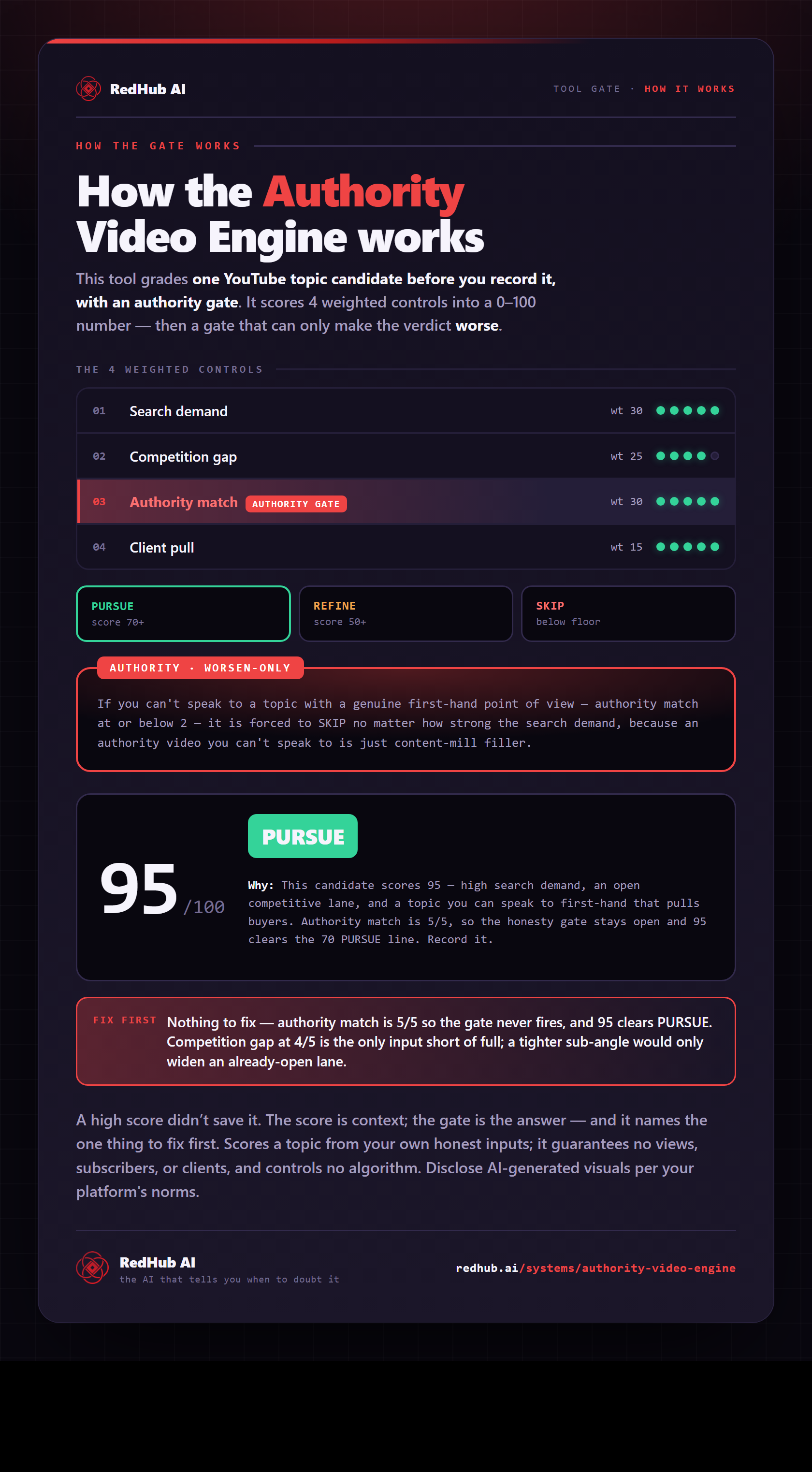
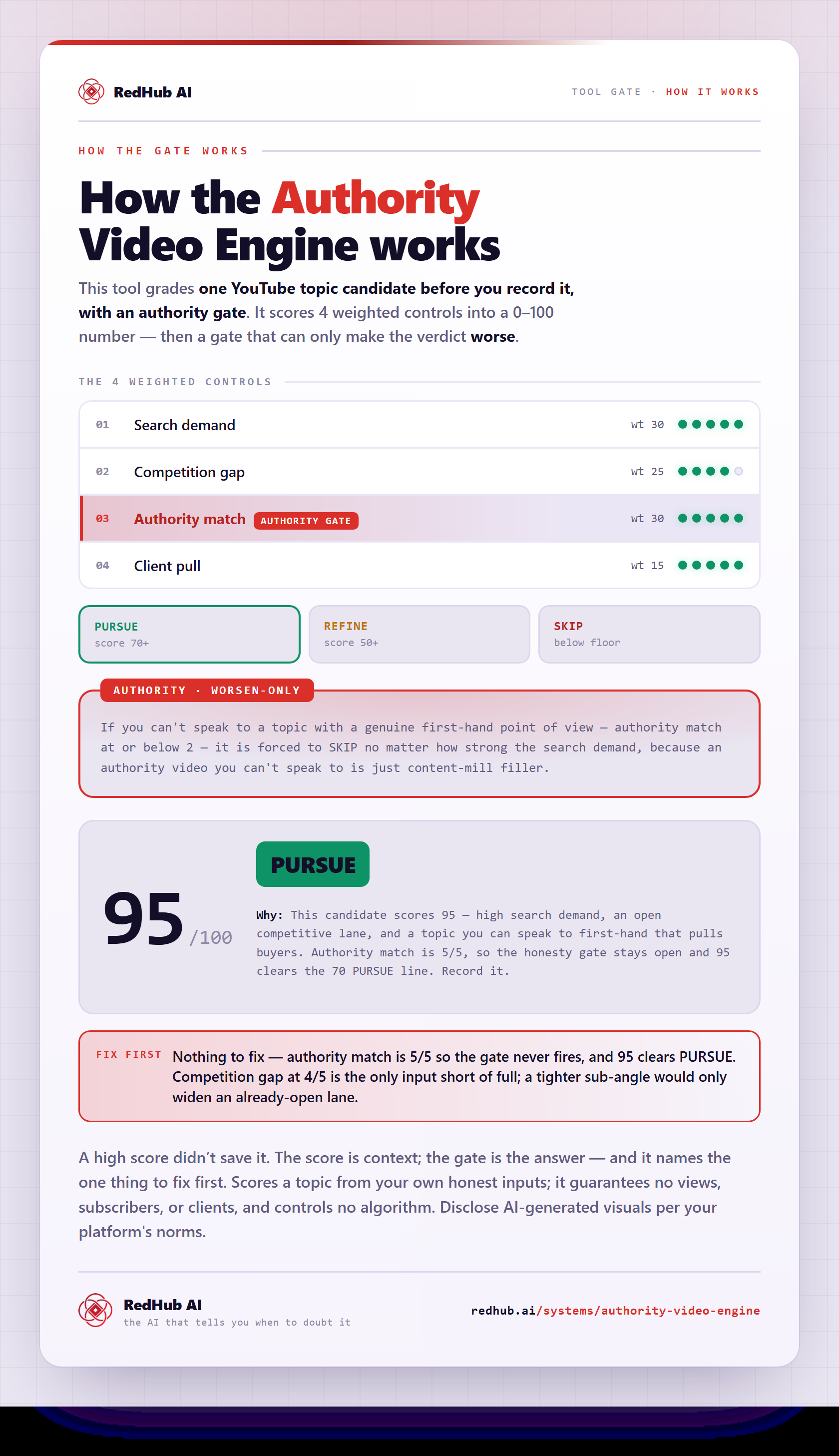
The gate this post refers to, drawn from the tool’s own logic. See the tool.