Video Content for Coaches and Consultants: What Actually Builds Authority
RedHub AI Editorialupdated September 20, 20264 min read

Jump to a section7
- Why Coaches and Consultants Need a Different Video Approach
- The Trap of "Value" Content
- What Actually Builds Authority for This Audience
- Choosing Topics That Convert, Not Just Vanity Topics
- Build the Foundation Before You Build the Video
- From Point of View to Recorded Video Without the Week-Long Detour
- More in this guide
For coaches and consultants, video's job isn't views — it's shortening the trust gap between a stranger finding you and a stranger paying you. That means the video that matters most is the one that proves you understand a prospect's exact problem better than they do, not the one with the most generic tips.
TL;DR: High-ticket sales cycles are trust-limited, not information-limited — prospects can find generic tips anywhere. Video that actually converts for coaches and consultants demonstrates a specific, opinionated read on the prospect's problem, backed by real client experience, on a consistent topic lane tied to what you sell. Generic "value" content rarely closes deals; specific point-of-view content does.
Why Coaches and Consultants Need a Different Video Approach
Most product businesses sell on video by demonstrating the product. Coaches and consultants can't do that — the "product" is judgment, applied to a specific person's situation, which is hard to show in a 90-second clip. What you can show is how you think. A prospect who watches you work through a real problem on camera is getting the closest thing to a sample session you can offer before they've paid you.
The Trap of "Value" Content
A huge amount of coach and consultant video content is generic tips — "5 ways to improve your sales calls," "3 mistakes founders make with pricing." It feels productive to make and it's easy to script, but it rarely moves a prospect closer to booking a call, because it doesn't require you specifically. Anyone with the same list of tips could have made it. The prospects most likely to buy aren't looking for more tips — they're looking for evidence that you'll understand their specific situation.
What Actually Builds Authority for This Audience
- A specific, arguable take on a problem your buyers actually have. Not "how to improve retention" — "why most coaches lose clients in month two because of how they structure the first session, and what I do differently."
- A real client pattern, told honestly. Without naming names, the specific situation that shaped your opinion is what makes it credible instead of generic advice.
- Consistency on a narrow lane. Prospects buy from the person who's clearly thought hardest about their exact problem, not the person who's covered the widest range of topics.
Choosing Topics That Convert, Not Just Vanity Topics
It's tempting to make video about the parts of your work you're proudest of — but the topics that actually move a prospect toward booking are the ones addressing the specific fear or confusion that's stopping them from hiring someone right now. That usually means recording on the objections you hear in sales calls, not the achievements you'd put on a slide. If you're not sure which of your topics real people are actually searching for, ground the decision in real demand data rather than a guess — see our post on choosing video topics using real demand.
Build the Foundation Before You Build the Video
A point-of-view video only lands if the positioning underneath it is already clear — who you're for, what you believe about their problem, and why your approach is different. Recording strong opinion-driven video on top of fuzzy positioning tends to produce videos that sound confident but don't clearly connect to what you sell. If that foundation still feels shaky, that's worth fixing first with the Founder's Positioning Forge ($59) before scripting your next video.
From Point of View to Recorded Video Without the Week-Long Detour
The reason many coaches and consultants stop making video isn't lack of expertise — it's that turning a real opinion into a script, deck, and recorded video takes time most solo practitioners don't have between client sessions. The Authority Video Engine ($199) compresses that into roughly 70 minutes: it researches your topic against real search and competition demand, interviews you into an opinionated outline instead of a generic one, builds an animated deck, and runs a teleprompter so you can record without the usual production overhead.
Pairs well with: start with the Founder's Positioning Forge ($59) to lock your positioning, then once your authority video is recorded, clip the strongest moments for social with the Organic Social & Short-Form Video System ($79).
More in this guide
What kind of video content actually builds authority for coaches and consultants?
Video with a specific, arguable point of view about a problem your buyers actually have — backed by real client experience — outperforms generic tips content because it's the closest thing to a sample of your judgment a prospect can get before hiring you.
Why doesn't "value" content like tip lists convert as well as expected?
Tip lists are easy to make but easy to replace — a prospect can find similar tips from dozens of other sources. They rarely prove you understand a prospect's exact situation, which is what actually moves a high-ticket sale forward.
How should coaches and consultants pick video topics?
Start from the objections and confusion you hear on real sales calls, and ground the choice in real search-demand data rather than which topics feel impressive to talk about — the goal is proving relevance to a specific buyer, not showcasing range.
Should I fix my positioning before I start making authority video?
If your positioning still feels unclear, yes — opinion-driven video works best when it's built on a clear sense of who you're for and what you believe about their problem. Video on top of fuzzy positioning tends to sound confident without converting.
How consistent do I need to be with video as a coach or consultant?
Consistency on a narrow, related set of topics tied to what you sell matters more than volume across many unrelated topics. Prospects trust the person who's clearly thought hardest about their specific problem.
Can I make authority video without a large production budget?
Yes — the core requirement is a real point of view and a repeatable process to get it recorded, not expensive equipment. A structured workflow that handles research, interview, and outline can cut the production overhead significantly.
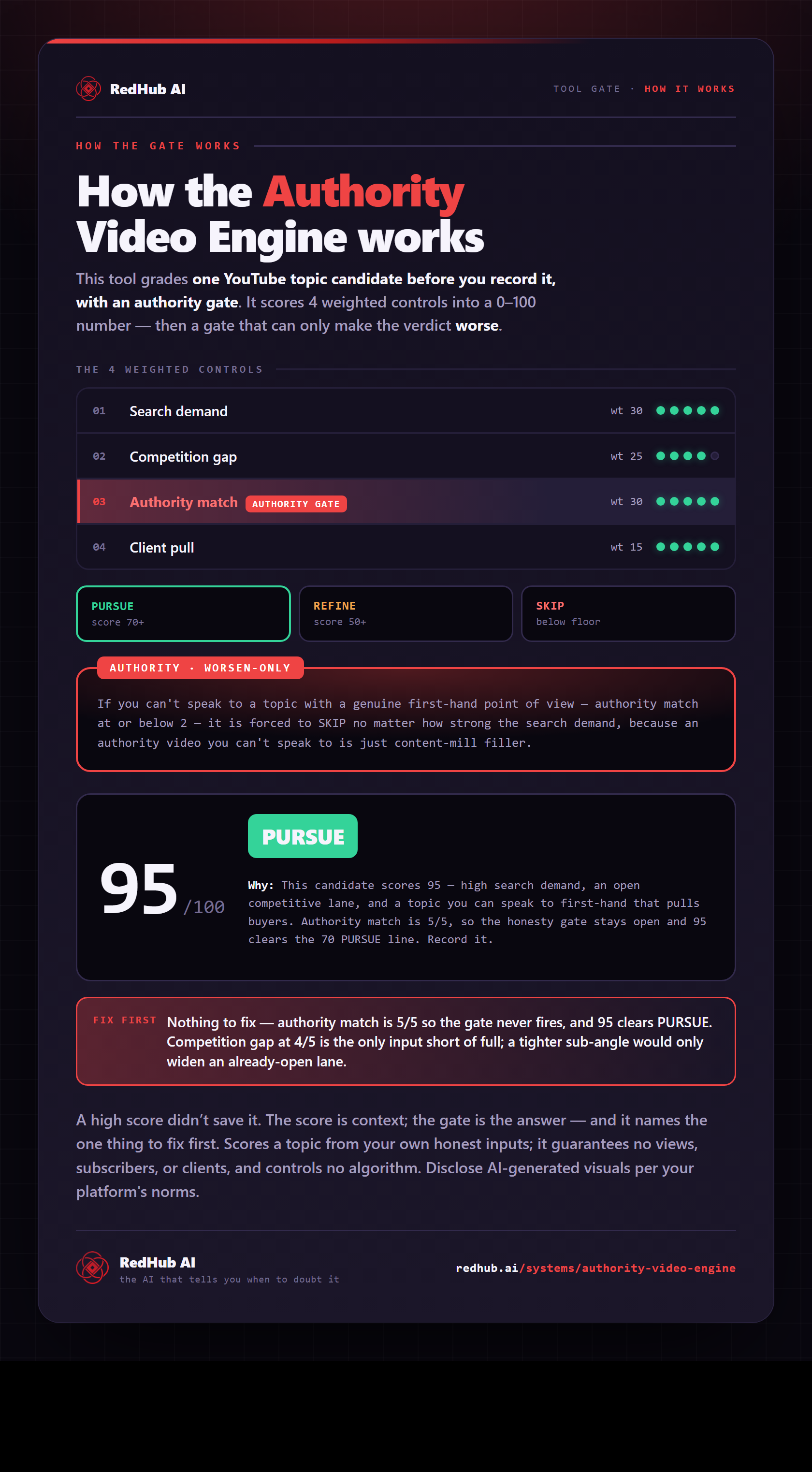
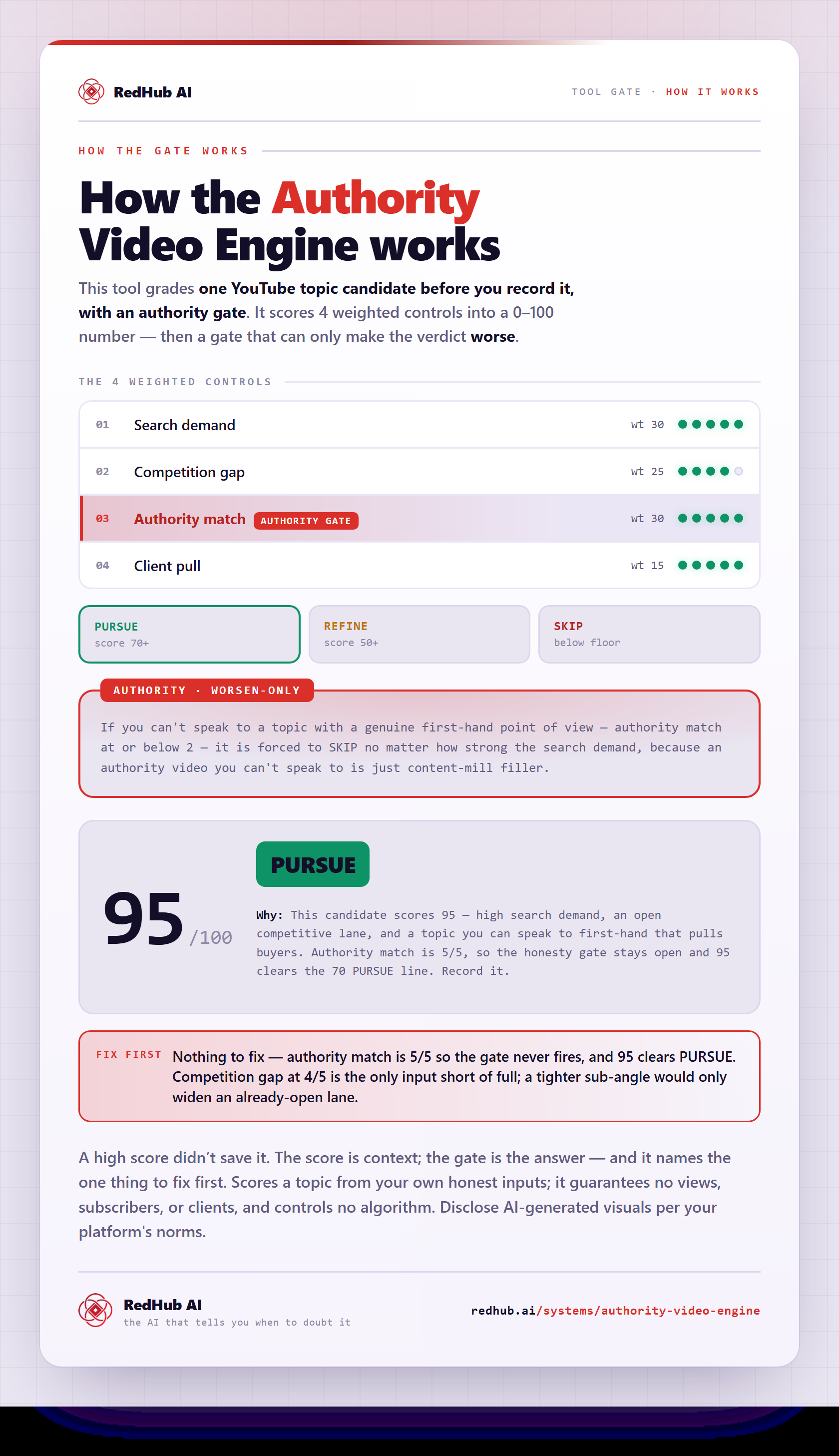
The gate this post refers to, drawn from the tool’s own logic. See the tool.