How to Choose Video Topics That Prove Your Expertise (Using Real Demand)
RedHub AI Editorialupdated September 20, 20264 min read

Jump to a section7
The fastest way to waste a good point of view is recording it on a topic nobody is searching for. Topic selection isn't a formality before the "real work" of scripting and filming — it's the decision that determines whether any of that work gets found. Choose from real demand, not from what sounds impressive to say.
TL;DR: Most experts pick video topics by guessing what sounds smart or on-brand, which is a coin flip on whether anyone's actually searching for it. The reliable approach is checking real search and competition data first, then finding your genuine point of view on whichever demand-backed topic fits your expertise — demand and opinion have to overlap, not just one or the other.
Why Topic Choice Matters More Than Most Experts Think
Two experts with the same production quality and the same speaking ability can get wildly different results from video, and the difference is usually the topic, not the delivery. A brilliantly delivered video on a topic nobody searches for reaches almost nobody. A mediocre video on a topic with real, active demand at least gets found — and a strong point of view on top of real demand is what actually compounds.
The Guessing Trap
Left to instinct, most experts pick topics one of two ways: what they feel like talking about that week, or what sounds impressive on a landing page. Neither is a reliable signal of what real people are actually typing into a search bar. It's an easy trap because it feels productive — you're making a decision and moving forward — but it's a coin flip on whether the resulting video ever gets in front of the people who'd actually search for it.
Using Real Demand Data Instead of a Guess
The alternative is checking actual search and competition data before committing to a topic — what people are genuinely searching for, how much competition already exists on that exact phrase, and whether there's a gap your specific point of view could fill. This isn't about chasing whatever's trending; it's about confirming the topic you're considering has a real audience before you spend an afternoon making a video for it.
Where Demand and Point of View Have to Overlap
The right topic sits at the intersection of two things, not either one alone:
- Real demand: people are actually searching for this, and the competition gap suggests there's room for another strong answer.
- Your genuine opinion: you have a specific, defensible take on it drawn from real experience, not just a summary of common knowledge.
High demand with no real opinion produces a forgettable, generic video. A strong opinion with no demand produces a great video nobody finds. Neither alone is enough — the overlap is the topic worth recording.
Red Flags of a Bad Topic Choice
- You picked it because it sounds smart, not because you checked demand. Impressive-sounding topics and searched-for topics are frequently not the same list.
- You can't state an opinion on it, only a summary. If your outline reads like a definition, you haven't found the angle yet.
- It doesn't connect to what you're actually known for. A demand-backed topic outside your real expertise still won't build authority — it'll just be accurate and unremarkable.
How This Actually Gets Checked, Not Just Estimated
Guessing at demand from a search bar's autocomplete or a hunch about what's "probably popular" isn't the same as checking real data — and inflated or invented numbers are worse than no numbers at all, because they send you into production on a topic that was never actually in demand. The Authority Video Engine ($199) starts its process by researching your candidate topic against live search and competition data — real numbers, never invented ones — so you know before you script anything whether the topic is actually worth the 70 minutes it takes to record. From there, its interview step pulls your genuine opinion into an outline, and it builds the animated deck and teleprompter you record from.
Pairs well with: once you've recorded a demand-checked, opinionated video, package it for discovery with the YouTube Packaging & Retention Engine ($99), and clip the sharpest moments for social with the Organic Social & Short-Form Video System ($79).
More in this guide
Why does video topic choice matter more than production quality?
A well-produced video on a topic nobody searches for still reaches almost nobody. Topic choice determines whether the video has an audience at all — production quality only matters once people are actually watching.
How do I know if a video topic has real demand?
Check actual search and competition data for the topic rather than guessing from instinct or what sounds impressive. Real search volume and a genuine gap in the existing competition are the two things worth confirming before you script.
Is it enough to just pick a high-demand topic?
No — high demand without a real, specific point of view produces a generic video that gets found but doesn't build authority. The topic needs both real demand and a genuine opinion you can back with experience.
What if my area of expertise has low search demand?
Look for the specific angle within your broader expertise that does have demand, rather than assuming your whole field is low-demand. Most fields have narrower, more searched-for questions inside them.
Can I trust made-up or estimated demand numbers to plan video topics?
No — inflated or invented numbers are worse than having no data, because they send you into production on a topic that was never actually in demand. Real search and competition data should come from an actual source, not a guess.
How long should researching a topic take before I record?
It shouldn't be the bottleneck. A structured process that checks real demand data automatically can confirm a topic is worth making before you invest the time to script and record it, rather than researching from scratch each time.
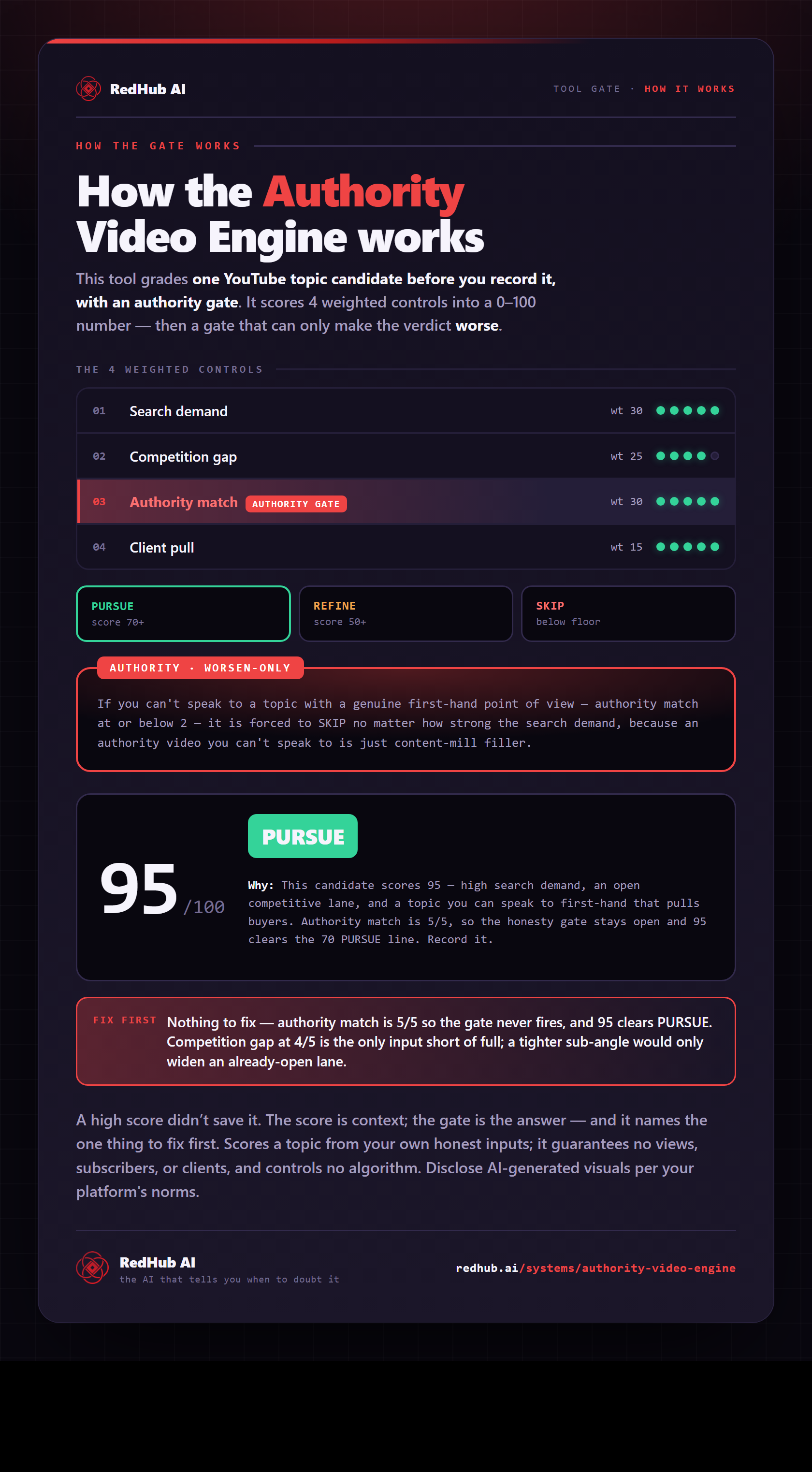
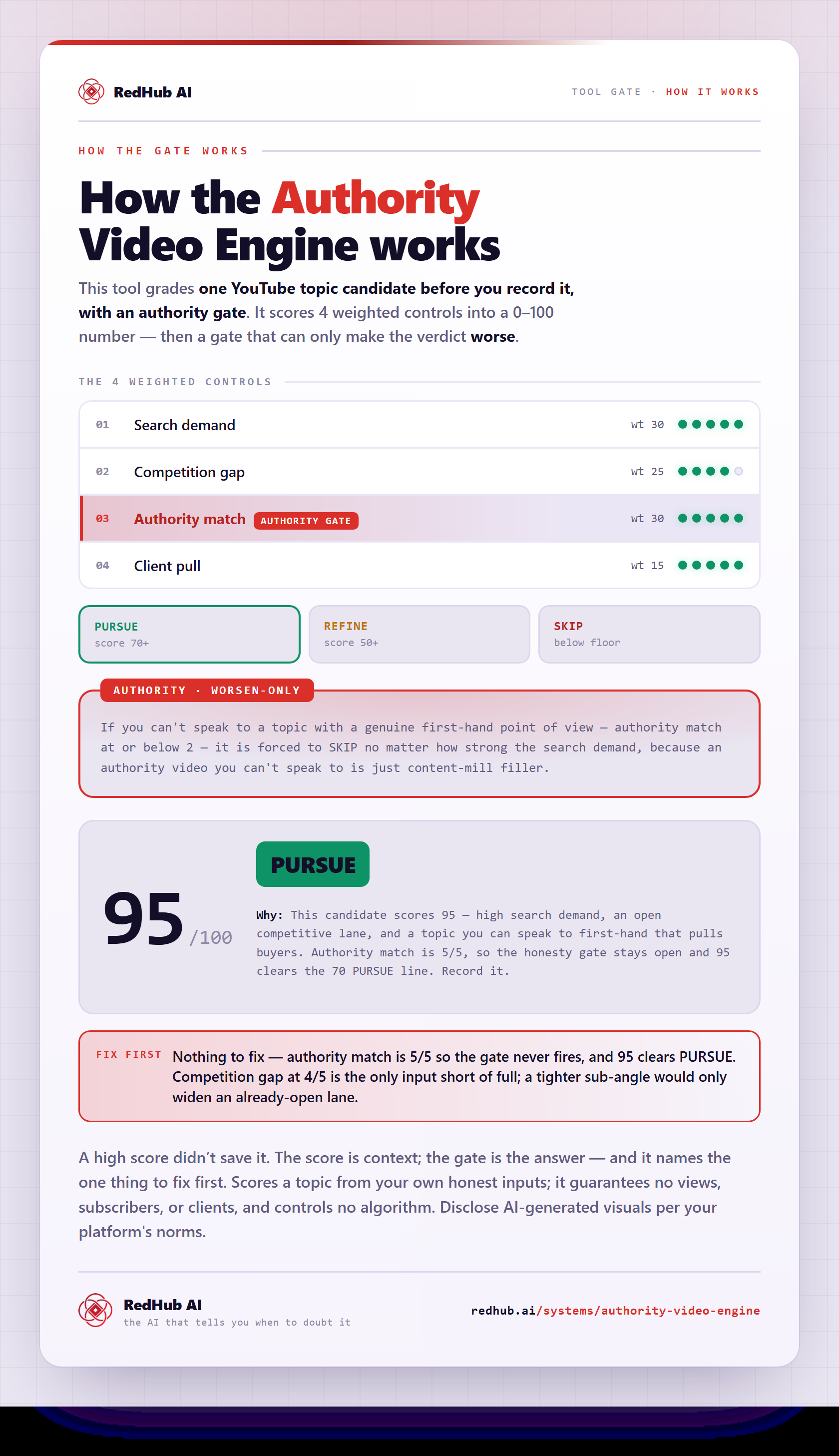
The gate this post refers to, drawn from the tool’s own logic. See the tool.