Thought Leadership Video: How to Turn Your Expertise Into Content People Watch
RedHub AI Editorialupdated September 20, 20264 min read

Jump to a section7
Thought leadership video works when it turns your expertise into an opinion people can react to — not when it turns your expertise into a lecture. The difference between a video people watch to the end and one they scroll past isn't polish. It's whether you took a stance.
TL;DR: "Sharing your knowledge" on camera isn't the same as thought leadership. Thought leadership video requires a specific, arguable opinion, backed by something you've actually lived through, delivered on a repeatable cadence. Skip any of the three and the video reads as filler, no matter how accurate the information is.
What Thought Leadership Video Actually Is
Thought leadership means having a position other qualified people in your field might reasonably disagree with — and being willing to defend it on camera. It is not a synonym for "expert content." A tutorial on how a tool works is useful, but it isn't thought leadership; it doesn't require you specifically. Thought leadership video is the subset of your expertise that only sounds right coming from you.
Why "Just Sharing Knowledge" Doesn't Work
Most experts default to explaining rather than arguing, because explaining feels safer — it's hard to be wrong about a definition. But safe content is also forgettable content. If your video could have been written by anyone with access to the same Wikipedia page, it won't build the kind of trust that turns a viewer into a client. The videos that get remembered are the ones where the expert clearly picked a side.
Opinion vs. Information — The Line That Matters
Here's a simple filter to run every topic through before you record:
- Information: "Here's how cash-flow forecasting works." Accurate, useful, and interchangeable with a hundred other explainers.
- Thought leadership: "Most founders forecast cash flow wrong because they're modeling revenue instead of collections — here's the mistake I see constantly." Specific, arguable, and clearly yours.
If you can't finish the sentence "most people in my field get this wrong because…", you don't have thought leadership content yet — you have a topic that needs more digging before it's ready to record.
Structuring a Thought Leadership Video
- Open with the stance, not the setup. Lead with your opinion in the first line, not three minutes of throat-clearing context.
- Back it with one real example. A client story, a mistake, a pattern from your own work — something a generic AI summary couldn't produce.
- Name the counterargument. Acknowledging the obvious objection and explaining why you still hold your position is what separates confidence from arrogance on camera.
- Close with the specific action. Not "think about this differently" — the actual next step a viewer should take.
Consistency Is the Part Everyone Skips
One strong thought leadership video is a data point. Ten of them on a related set of questions is a reputation. The single biggest reason experts stall out isn't a bad first video — it's that the second, third, and tenth video never get made, usually because deciding what to talk about and turning it into a script both take too long. A repeatable process for topic selection and outline-building is what actually makes a cadence sustainable, not motivation.
Getting From Opinion to Recorded Video Without Losing a Week
The gap between "I have a strong opinion on this" and "I have a recorded video" is usually where thought leadership content dies — not from lack of expertise, but from the friction of turning a raw opinion into a structured, on-camera video. The Authority Video Engine ($199) is built for exactly this gap: it interviews you to pull out your actual point of view (not a generic summary), researches the topic against real search and competition data so you know it's worth making, builds an animated outline deck from what you said, and runs a teleprompter so recording takes about 70 minutes instead of an afternoon.
Pairs well with: once your video is recorded, don't stop at the point of view — package the video for discovery with the YouTube Packaging & Retention Engine ($99), and clip the strongest moments into short-form content with the Organic Social & Short-Form Video System ($79).
More in this guide
What's the difference between thought leadership video and expert content?
Thought leadership requires an arguable opinion specific to you; expert content is often just accurate information anyone with the same knowledge could have shared. The test is whether a reasonable expert in your field could disagree with what you said.
How do I find my opinion if I've never thought of my expertise that way?
Look for the moment you correct someone, or the mistake you see repeated in your field. Those reactions are usually your real point of view — it's often already there, just never stated out loud on camera.
Does thought leadership video need to be controversial?
No — arguable is not the same as controversial. It just needs to be specific enough that a reasonable person could push back, which is what makes it memorable instead of generic.
How often should I publish thought leadership video?
Consistency matters more than frequency — a steady, sustainable cadence on a related set of topics builds more trust than one strong video followed by silence. Pick a pace you can actually keep up.
Can a tool write my opinion for me?
No, and it shouldn't try to. A structured process can interview the opinion out of you and help you turn it into a script faster, but the point of view has to come from your real experience — that part can't be manufactured.
What should I do after recording a thought leadership video?
Package it properly so it's found (title, thumbnail, opening hook) and consider clipping the strongest lines for social. Both are separate, worthwhile jobs once the substance of the video is locked.
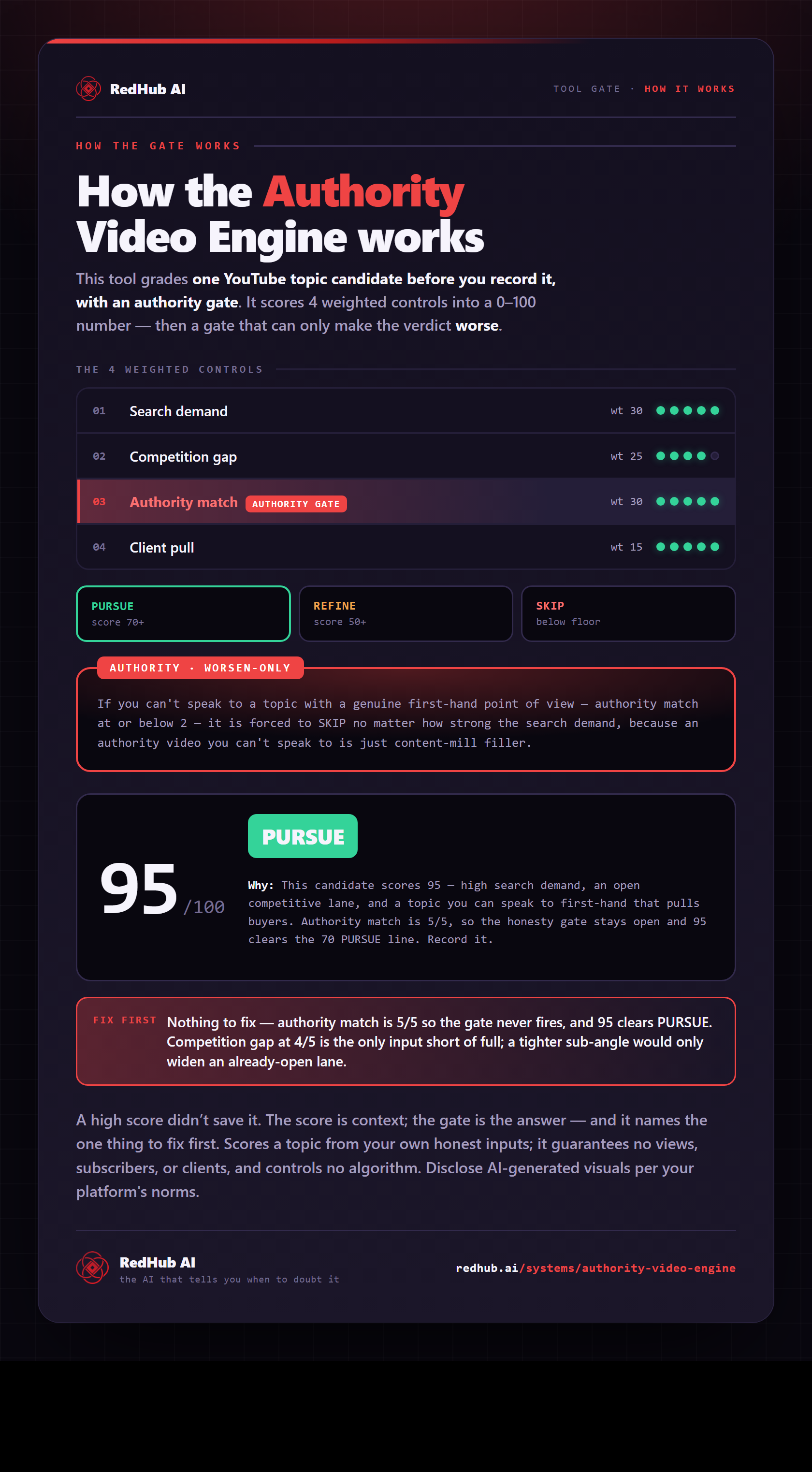
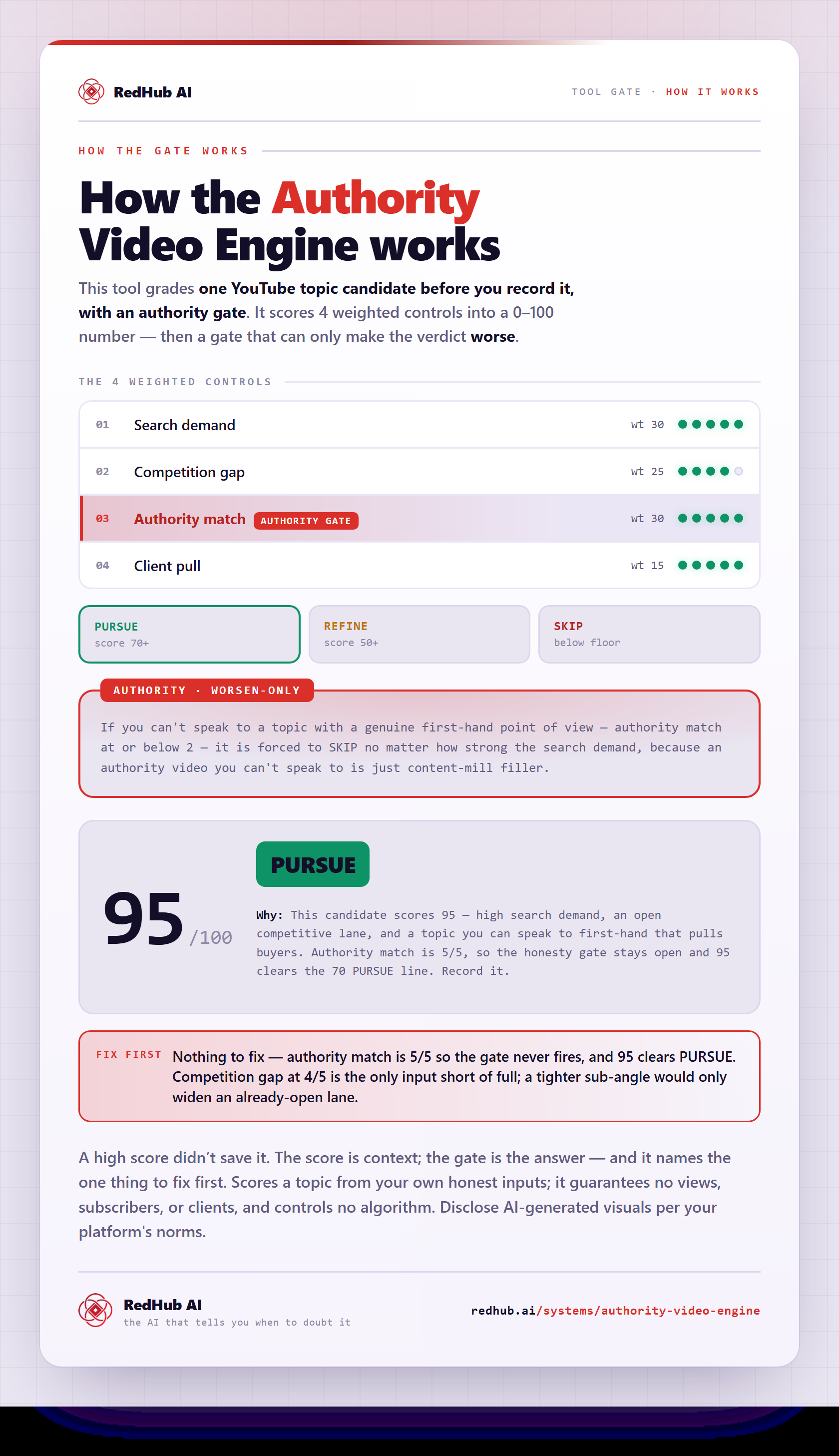
The gate this post refers to, drawn from the tool’s own logic. See the tool.