EOS vs Vistage: Which Buys You Operating Discipline?
RedHub AI Editorial6 min read

Jump to a section7
TL;DR
- What it is: The honest comparison of EOS vs Vistage — an implementer-led operating system vs a CEO peer group — plus the self-serve third path most comparisons skip.
- Who it's for: Founders deciding where to spend five figures on discipline — see the RedHub Operating System ($990/yr).
- How it works: EOS installs a company-wide rhythm (commonly reported $36K–$52K year one); Vistage sharpens the CEO through peers (roughly $13K–$22K/yr). They fix different problems.
- Bottom line: If your company lacks a rhythm, a peer group won't install one. If you lack challenge, a rhythm won't provide it. Name your gap before you spend.
What's the difference between EOS and Vistage?
EOS is a company operating system installed by a paid implementer: it gives your whole leadership team a shared meeting rhythm, measurables, and priorities. Vistage is a CEO peer advisory group: a monthly room of fellow CEOs plus a chair, built to challenge your thinking — it doesn't install anything inside your company. Commonly reported costs: EOS runs $36,000–$52,000 in year one with an implementer; Vistage CEO programs run roughly $13,000–$22,000 per year plus an initiation fee. A third path — a self-serve operating system — delivers the rhythm without the room, at $990 per year.
Best for: founders weighing both quotes — part of our EOS alternative guide.
The EOS vs Vistage question comes up because both get recommended by the same people at the same moment: a founder somewhere between $1M and $20M whose company has outgrown improvisation. But they're not two brands of the same thing. One is plumbing for your company. The other is a gym for you. Comparing them on price alone misses the point — and both prices are big enough to deserve the real comparison.
What each one actually is
| EOS (with an implementer) | Vistage | Self-serve OS (RedHub) | |
|---|---|---|---|
| What it is | A company-wide operating system, installed by a facilitator | A CEO peer advisory group with a chair | A membership that runs your executive systems on a rhythm |
| Who it changes | The whole leadership team | Mostly you | You first, then the company through the cadence |
| What forces discipline | The implementer on your calendar | A room of peers you don't want to face unprepared | A Command Deck that counts whether you actually ran each cadence |
| Frequency | Session days plus your own weekly rhythm | Monthly meetings plus one-to-ones | Weekly briefing, monthly review, quarterly reset |
| Commonly reported cost | $36K–$52K year one | Roughly $13K–$22K/yr plus initiation, per independent reviews (opens in a new tab) | $990/yr (actual price) |
| Commitment | Engagements often run ~2 years | Annual membership | Monthly or annual, cancel anytime |
Where each one wins
EOS wins when the company is the problem
If your leadership team has no shared rhythm, no agreed numbers, and meetings that wander — that's a company-level problem, and EOS attacks it at the company level. The implementer's superpower isn't the toolset; it's making six busy executives sit in a room and do the work. If your team can't do that alone, the fee buys something real. (What it costs, line by line, is in how much does EOS cost.)
Vistage wins when the CEO is the bottleneck
If the company runs fine but you're making big calls alone — pricing, firing a partner, an acquisition — a peer room is the product. Twelve CEOs who've seen your movie before will challenge you in ways employees can't. That's genuinely valuable and no software replaces the relationships. What it doesn't do is install anything: you drive home from the meeting to the same company with the same missing rhythm.
The third path wins when the gap is enforcement
Most founders comparing these two don't lack facilitation or peers. They lack follow-through — the rhythm exists in January and is gone by March. That's the gap the RedHub Operating System is built for: it includes five executive systems (operations, challenge, pipeline, cash, and the synthesis harness) and a Command Deck that counts days from the last time you actually ran the weekly briefing, monthly review, and quarterly reset. Miss the weekly once and the deck reads DRIFTING. It's the peer room's social pressure, rebuilt as instrumentation — at about 7% of the low-end Vistage figure.
Honest boundary: a system doesn't give you twelve CEOs' pattern-matching or a chair's coaching. What it can give you is structured challenge on demand — the Devil's-Advocate Board ($199, included in the membership) stress-tests a decision the way a hostile boardroom would, any night you need it, without waiting for next month's meeting. Different product than a peer room. Sometimes the better one at 11pm before a signing.
The two-question decision
- Is the gap in the company or in you? Company gap (no rhythm, no shared numbers) points to EOS or a self-serve OS. Personal gap (isolation, untested decisions) points to a peer group or structured challenge.
- Is the gap facilitation or follow-through? If your team can't do the work without an outsider, pay a human. If your team can but doesn't sustain it, buy enforcement — that's instrumentation, and it doesn't cost five figures.
Plenty of founders eventually do both: a self-serve rhythm for the company and a peer group for themselves. At $990 against $13K+, the rhythm is the cheaper experiment to run first. And if you got here from the book rather than a quote, read the Traction alternative — the decay problem it covers is the same one the peer room never solves.
EOS® is a registered trademark of EOS Worldwide, LLC, and Vistage® of Vistage Worldwide, Inc. RedHub is not affiliated with, endorsed by, or connected to either. Third-party pricing reflects publicly discussed ranges, not quotes.
Decision Guide
Choose EOS (implementer) if: the whole leadership team needs a rhythm installed and won't build one without a facilitator in the room.
Choose Vistage if: the company runs but you're deciding alone — you need peers and a coach, not plumbing.
Choose self-serve if: you can hold the meeting; what dies is the follow-through. Buy the enforcement, not the room.
FAQ
Is Vistage an EOS alternative?
Only partially. Vistage substitutes for the challenge and accountability an implementer brings to you personally, but it doesn't install an operating rhythm in your company. If the rhythm is the gap, Vistage won't fill it.
Which costs more, EOS or Vistage?
EOS with an implementer, by commonly reported figures: $36K–$52K in year one versus roughly $13K–$22K per year for Vistage CEO programs plus a one-time initiation fee. Both vary by implementer, chapter, and region.
Can I do both EOS and Vistage?
Yes, and some CEOs do — one fixes the company, the other sharpens the CEO. The combined bill commonly lands near $50K–$70K in year one, which is exactly why many founders test a self-serve rhythm first.
What does a self-serve operating system replace?
The enforcement layer: the scheduled rhythm, the honest status, and the "you skipped it" signal. It doesn't replace human facilitation of a conflicted team or the relationships of a peer group.
How does the Devil's-Advocate Board compare to a peer group?
A peer group challenges you monthly with human experience. The Devil's-Advocate Board challenges a specific decision on demand with structured adversarial review. It's included in the RedHub Operating System membership and available standalone for $199.
Does the RedHub Operating System run my meetings?
No. It schedules the three cadences, tracks whether you ran them, and reports each system's findings. You run the briefings and make the decisions. It is not financial, legal, or investment advice.
What's the cheapest way to test operating discipline?
Run the membership for a month at $99. If four weekly briefings in a row change how you see the company, you've learned more than any quote could tell you — and you can cancel anytime.
The rhythm, without the room or the retainer
The RedHub Operating System: five executive systems, a weekly/monthly/quarterly cadence, and a Command Deck that grades whether you actually ran it — ON RHYTHM, DRIFTING, or OFF. $99/month or $990/year, cancel anytime.
Get the RedHub Operating System →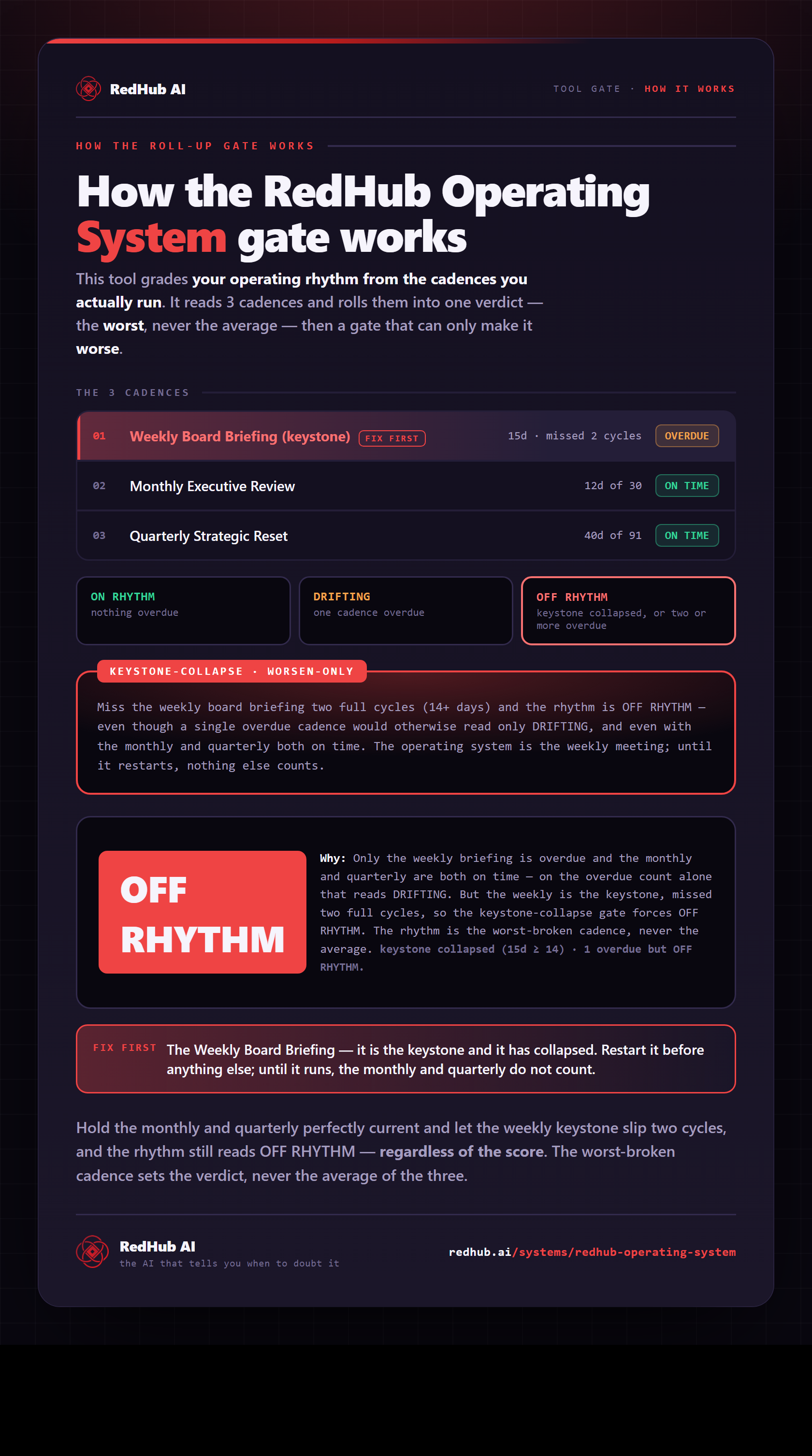
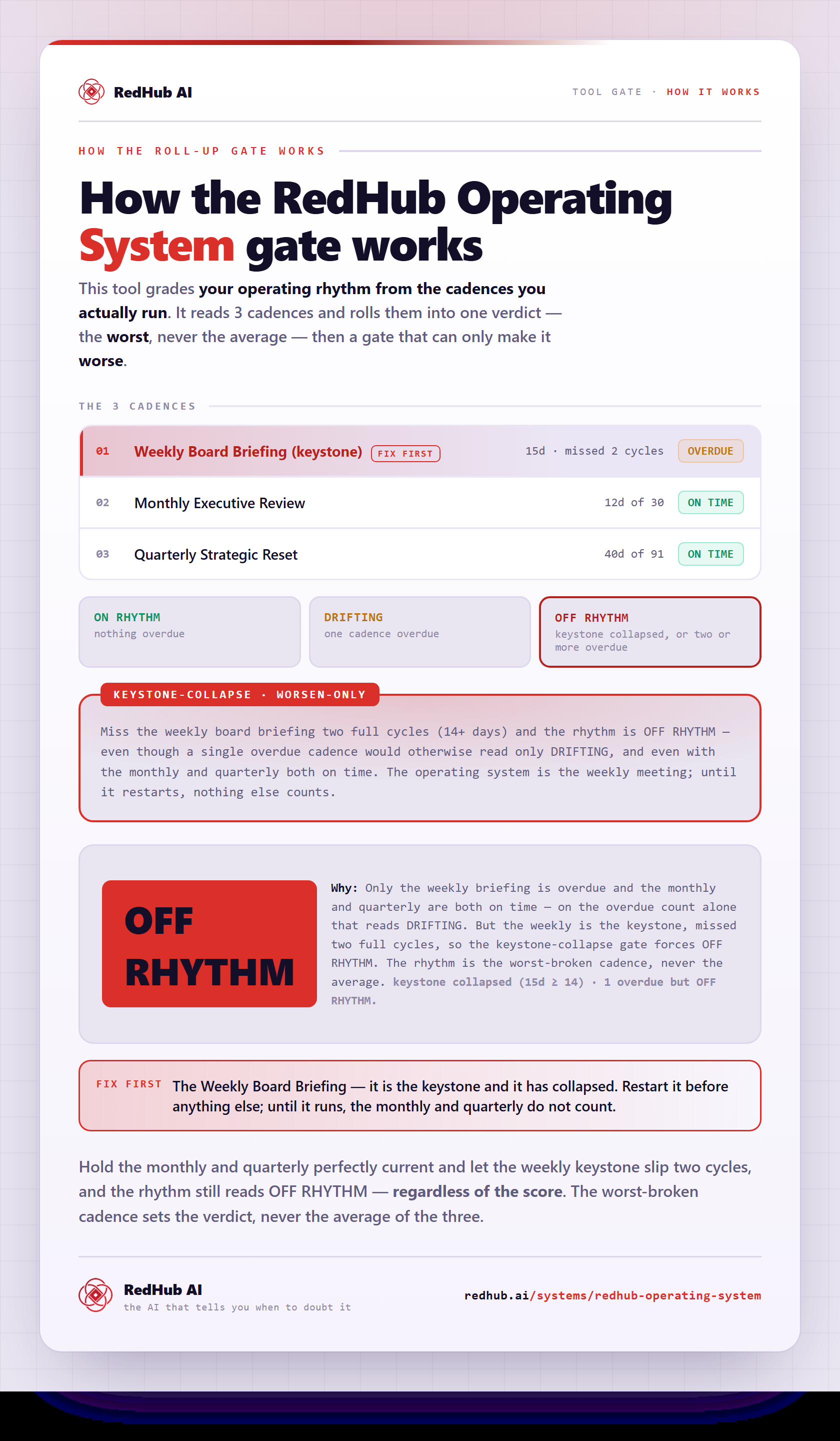
The gate this post refers to, drawn from the tool’s own logic. See the tool.