Traction Alternative: When the Book Isn't Enough
RedHub AI Editorial6 min read

Jump to a section8
TL;DR
- What it is: A Traction alternative for the founder who read the book, ran the tools for a quarter, and watched the whole thing fade.
- Who it's for: Book-implementers who won't hire a $30K+ coach — see the RedHub Operating System ($990/yr).
- How it works: The book gives you tools; it can't run them. The alternative is a system where the rhythm is instrumented, the grading is worst-signal-first, and skipping is visible.
- Bottom line: Your problem was never the framework. It was that nothing noticed when you stopped.
What's the alternative to Traction?
If Traction's ideas worked for you but the practice didn't stick, the alternative isn't another framework book — the frameworks are broadly similar and equally shelf-able. The real alternatives are the ones that add enforcement: hire an implementer (commonly reported at $36K–$52K in year one), join a CEO peer group, or run a self-serve operating system that instruments the rhythm — one that counts days since you actually ran each cadence, grades your company by its worst signal, and names one next action. That last path costs $990 a year.
Best for: founders whose binder is on the shelf — part of our EOS alternative guide.
Every founder searching for a Traction alternative has roughly the same story. The book landed. The diagnosis fit. You rolled out the meetings, the numbers, the quarterly priorities — and for about ten weeks it genuinely worked. Then the busy season hit, the rhythm slipped, and the operating system became a binder with a good spine. Now you're looking for the thing that's like the book, but sticks.
Here's the uncomfortable truth that saves you money: the next book won't stick either, and for the same reason.
What the book gives you — and the one thing it can't
What the book delivers
- A clear diagnosis of why growing companies wobble
- Simple, genuinely useful tools: a rhythm, a short number set, a few real priorities
- A shared vocabulary for your leadership team
- All of it for about twenty dollars
What no book can deliver
- Enforcement — nothing happens when you skip a week
- Honest grading — you score your own homework
- Synthesis — no one condenses five domains into one status
- A next action — the binder never says "do this one thing"
That right-hand column is precisely what the $30K+ implementer engagement sells (the arithmetic is in how much does EOS cost), and it's what a peer group approximates through social pressure (weighed in EOS vs Vistage). If neither of those is happening, the question becomes: can you buy the right-hand column without the human? That's the design brief for a real Traction alternative.
The four tests of an alternative that will actually stick
- It counts actual runs, not intentions. A calendar invite is an intention. The system should measure days since each cadence was genuinely run — and treat "we meant to" as overdue.
- It grades by the worst signal. Averages flatter. If cash is red and everything else is green, your company status is red. An honest system refuses to let a strong quarter in sales hide a weak one in runway.
- It makes skipping visible the week it happens. Book-implementations die in week 9 and get discovered in week 15. The gap between those two numbers is where the damage lives.
- It names one next action. Not a dashboard of forty metrics — one thing: the most overdue cadence, the binding constraint, the top item. Discipline survives on smallness.
What passing all four looks like
The RedHub Operating System was built against exactly those tests. It's a membership, not a book: you get five executive systems — an operations read, an adversarial challenge board, a pipeline grader, a cash grader, and the harness that synthesizes them into one company status — plus the rhythm that convenes them: a weekly board briefing (the keystone), a monthly executive review, and a quarterly strategic reset.
The enforcement is the Command Deck. It counts from your last actual run of each cadence and grades the rhythm: ON RHYTHM, DRIFTING the first time the weekly slips, OFF RHYTHM when the keystone misses two cycles. Week 9 can still happen — but it happens in daylight, with the deck naming the one cadence to run to get back on. And the weekly synthesis grades the company by its worst domain, never a flattering average.
The honest line: it schedules and reports. It doesn't run your meetings, make your decisions, or move your money — you do. If you want the domain graders standalone instead of the membership, the Cash-Flow Sentinel ($249) grades cash on runway and trajectory, and the Pipeline Commander ($249) does the same for revenue — both are among the five included in the membership.
Book vs. book-plus-system
| Moment | Book alone | Instrumented system |
|---|---|---|
| Week 1 | Enthusiastic kickoff | First board briefing; first honest company status |
| Week 9 (the loud week) | Meeting skipped, "just this once" | Deck reads DRIFTING the same week |
| Week 11 | Rhythm quietly dead | One named action: run the keystone |
| Week 15 | "Whatever happened to that system?" | Back ON RHYTHM — or OFF RHYTHM and you know it |
Same founder, same company, same loud week. The difference isn't willpower. It's whether anything in the building had the job of telling the truth about the rhythm. If you want to go one level deeper on running the whole thing without a coach, that's self-implementing EOS.
Traction is a book by Gino Wickman; EOS® is a registered trademark of EOS Worldwide, LLC. RedHub is not affiliated with, endorsed by, or connected to either. Third-party figures are publicly discussed ranges, not quotes.
Decision Guide
Get a Traction alternative if: the ideas worked, the practice decayed, and you're not going to spend $30K+ on a facilitator.
Skip it if: you never actually ran the book's tools — try four honest weeks first; you may only need the twenty dollars.
Best first step: pick the day and hour for a weekly board briefing, run it this week, and put something in place that notices if you don't run the next one.
FAQ
What is the best alternative to Traction?
For most book-implementers, a self-serve operating system with real instrumentation — because the book's gap was enforcement, not ideas. If your team needs facilitation, an implementer; if you need peers, a CEO group. The RedHub Operating System is the self-serve path at $990/yr.
Why did my book implementation fail?
Almost certainly drift, not misunderstanding. The rhythm lost individual collisions with urgent weeks until it stopped, and nothing flagged it. That's the failure mode instrumentation exists to catch.
Is the RedHub Operating System based on Traction or EOS?
No. It's an independent system with its own design: three cadences, five executive systems, a worst-signal-first company grade, and a Command Deck that counts actual runs. It aims at the same goal — operating discipline — by a different route.
Do I have to abandon the book's tools to use it?
No. Keep any vocabulary and habits that work for your team. The membership adds what the book couldn't: graded systems, a synthesized company status, and a rhythm that's enforced by instrumentation instead of intention.
What does "graded by the worst signal" mean?
The weekly briefing synthesizes all five systems into one company status equal to the weakest domain. Strong sales never averages away a cash problem — the thing that needs you this week is the thing you see.
How much does it cost compared to the coached path?
$99/month or $990/year, cancel anytime — against commonly reported implementer engagements of $36K–$52K in year one. They're different products: the coach facilitates; the system instruments. This one costs about what one session is commonly reported to cost.
Will it make decisions for me?
No. It schedules the cadences and reports what each system found and what's due. Every decision is yours. It is not financial, legal, or investment advice.
The book gave you the tools. This runs them.
The RedHub Operating System: five executive systems, a weekly/monthly/quarterly rhythm, and a Command Deck that counts your actual runs and grades the truth — ON RHYTHM, DRIFTING, or OFF. $99/month or $990/year, cancel anytime.
Get the RedHub Operating System →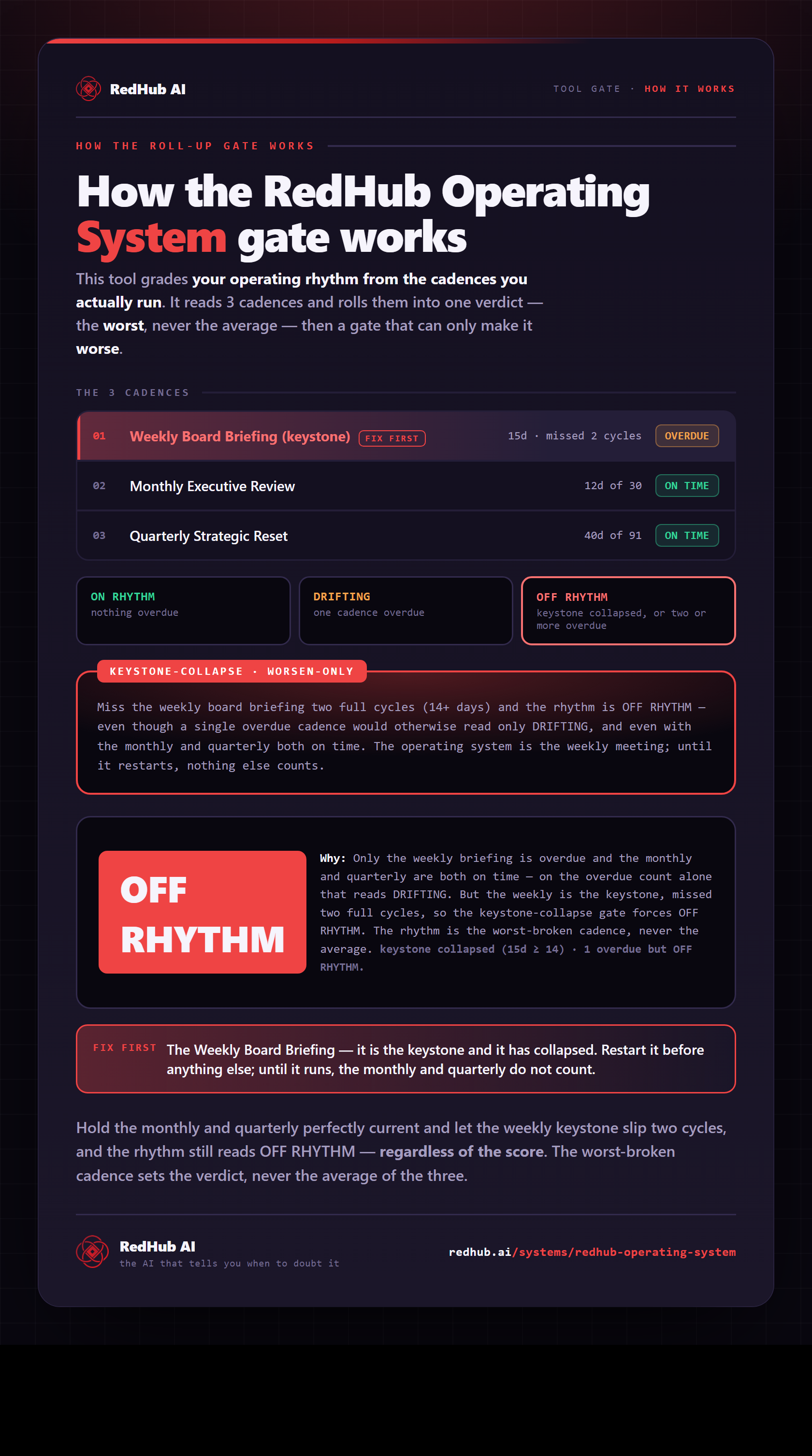
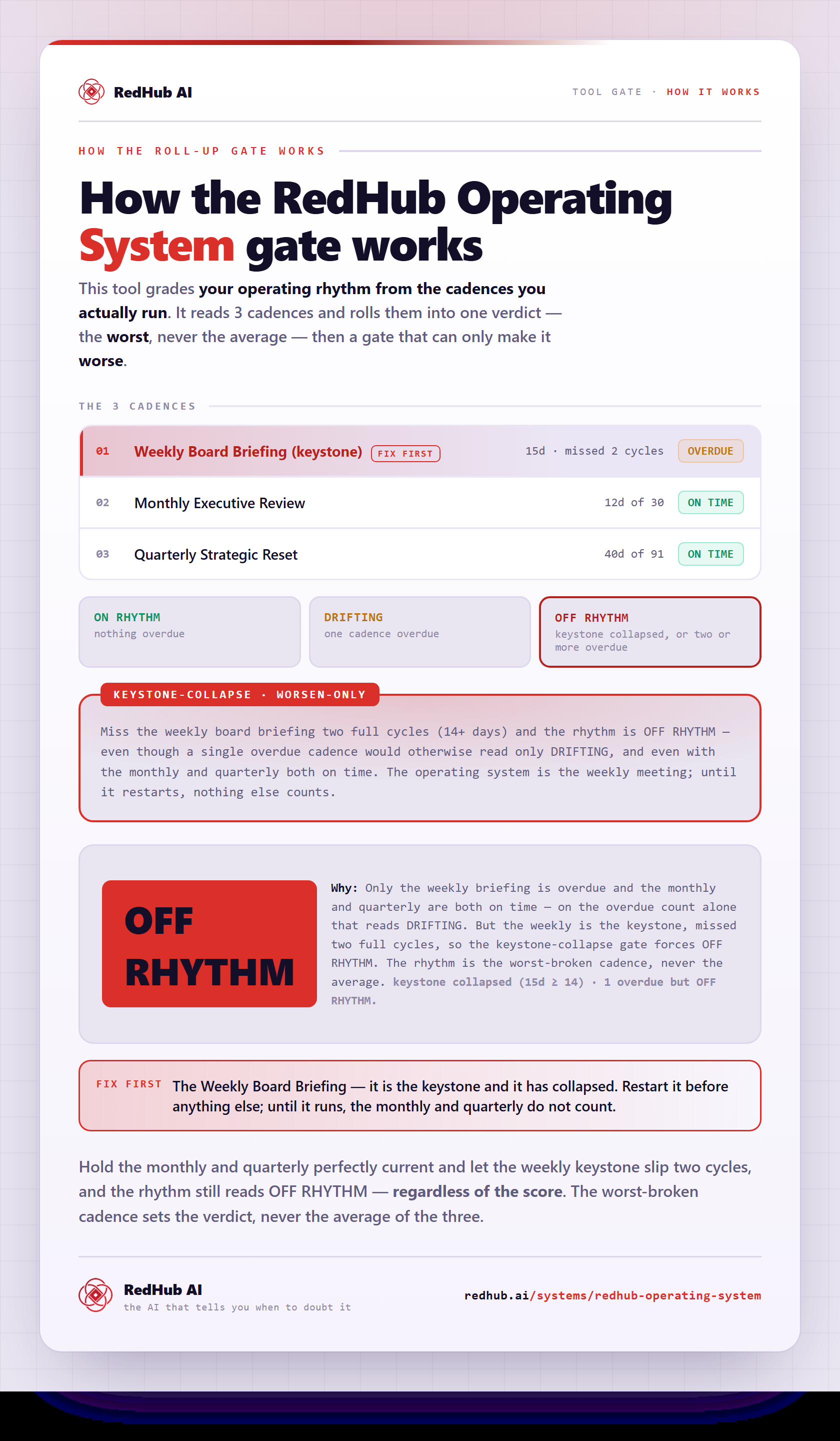
The gate this post refers to, drawn from the tool’s own logic. See the tool.