How Much Does EOS Cost? The Real Price Stack
RedHub AI Editorial5 min read

Jump to a section8
TL;DR
- What it is: The full answer to how much does EOS cost — not just the book, but the implementer sessions, the ongoing years, and the software seats.
- Who it's for: Founders quoting the implementer path before committing — see the self-serve alternative at RedHub Operating System.
- How it works: Commonly reported: $4,500–$6,600 per session, $36K–$52K year one, $58K–$86K over two years — before software seats.
- Bottom line: The ideas cost the price of a book. The enforcement is what costs five figures — and enforcement can be bought cheaper.
How much does EOS cost?
The EOS ideas themselves cost about the price of the book Traction. Running EOS with a professional implementer is what costs real money: implementers set their own fees, but publicly discussed figures commonly land at $4,500–$6,600 per full-day session, $36,000–$52,000 for the first year, and $58,000–$86,000 over a typical two-year engagement. Team software adds a per-seat monthly subscription on top. Self-implementing from the book is nearly free — but most self-implementations quietly decay without enforcement.
Best for: founders pricing their options — part of our EOS alternative guide.
Asking how much does EOS cost gets you a strangely wide range of answers, because "EOS" names three different purchases: a book, a coaching engagement, and a software subscription. Founders usually price the first, get quoted the second, and forget the third. Here's the whole stack, with every third-party number framed the honest way — as commonly reported ranges, not quotes. Implementers are independent and set their own fees.
The price stack, line by line
| Line item | Commonly reported cost | Notes |
|---|---|---|
| The book (Traction) | ~$20 | The ideas. Reading it is the cheap part. |
| Implementer sessions, year one | $4,500–$6,600 per session; roughly five sessions | A focus day, vision-building days, then quarterly sessions |
| Year-one total | $36,000–$52,000 | Per independent breakdowns (opens in a new tab) of implementer engagements |
| Ongoing years | $22,500–$33,000 per year | Quarterly and annual sessions continue |
| Two-year total | $58,000–$86,000 | The engagement length most companies report |
| Team software | Per seat, per month | Scorecard/meeting tools price per user; a ten-seat team adds a four-figure annual line |
The part nobody prices: your leadership team's time. Five full-day offsite sessions in year one is five days of your entire senior team not running the company. That's not an argument against doing the work — it's a reminder that the work, not the workbook, was always the product.
Year one, by path
Here's the same decision as a picture. The first two bars are the low end of commonly reported ranges; the third is an actual price.
The peer-group path has its own trade-offs — a room of real peers is a different product than a facilitator or a system. We compare them properly in EOS vs Vistage.
Price your own stack
You may already have a real quote in hand. Put your numbers in — this is arithmetic on your inputs, labeled as an estimate, not a quote or a savings claim:
Your year-one stack vs. self-serve
RedHub Operating System, annual: $990 · Difference: $0
The difference isn't automatically savings — an implementer facilitates and a system doesn't. But it's the honest size of the decision you're making, and for most growth-stage companies it's the size of a hire.
What the $990 buys instead
The RedHub Operating System is the self-serve path: a membership that includes all five RedHub Executive Suite systems and runs them on a fixed rhythm — a weekly board briefing (the keystone), a monthly executive review, and a quarterly strategic reset. A Command Deck counts days from the last time you actually ran each cadence and grades the rhythm honestly: ON RHYTHM, DRIFTING, or OFF RHYTHM. That deck is the enforcement you were pricing at five figures.
Two honest boundaries. First, it schedules and reports — it never runs the systems or makes a decision; you run the company. Second, it can't facilitate a leadership team that won't sit in a room together. If facilitation is your gap, the implementer fee is money well spent — the case for and against running it yourself is in self-implementing EOS.
EOS® is a registered trademark of EOS Worldwide, LLC. RedHub is not affiliated with, endorsed by, or connected to EOS Worldwide or Vistage Worldwide. Third-party figures are publicly discussed ranges, not quotes.
Decision Guide
Pay the implementer if: your leadership team needs a human in the room to have hard conversations, and the fee won't strain the budget.
Go self-serve if: your team can hold a meeting — what you lack is a rhythm that gets enforced when the quarter gets loud.
Best first step: get one real implementer quote and run it through the calculator above. Decide with the actual number, not the sticker shock.
FAQ
How much does EOS cost per session?
Implementers set their own fees. Publicly discussed figures commonly land between $4,500 and $6,600 per full-day session, varying with the implementer's experience and region.
How much does EOS cost in the first year?
Commonly reported first-year totals run $36,000–$52,000 with a professional implementer — roughly five sessions plus the engagement structure around them. Software seats are extra.
How long does an EOS engagement last?
Companies commonly report about two years to be fully running the system, with two-year totals discussed in the $58,000–$86,000 range. After that, many continue quarterly and annual sessions.
Is EOS free if I just use the book?
Nearly — the book and the freely shared tools cost very little. What the book can't include is enforcement. Most self-implementations run well for a quarter and then decay, which is why the implementer market exists.
What does the RedHub Operating System cost?
$99/month or $990/year — an actual price, not a range. It includes all five Executive Suite systems, the weekly/monthly/quarterly cadence, the Command Deck, and updates while subscribed. Cancel anytime.
Is $990 a year really comparable to a $40K engagement?
They're different products at the same goal. The implementer gives you facilitation plus a rhythm; the membership gives you the systems plus instrumentation that grades whether you ran the rhythm. If you need facilitation, pay for it. If you need enforcement, you don't have to pay $40K for it.
Does the membership make decisions or run meetings for me?
No. It schedules the cadences and reports each system's findings and what's overdue. You run the briefings and make every call. It is not financial, legal, or investment advice.
Enforcement for $990, not $40K
The RedHub Operating System: five executive systems, three cadences, and a Command Deck that counts from the last time you actually ran each one. $99/month or $990/year, cancel anytime. It schedules and reports — you run the company.
Get the RedHub Operating System →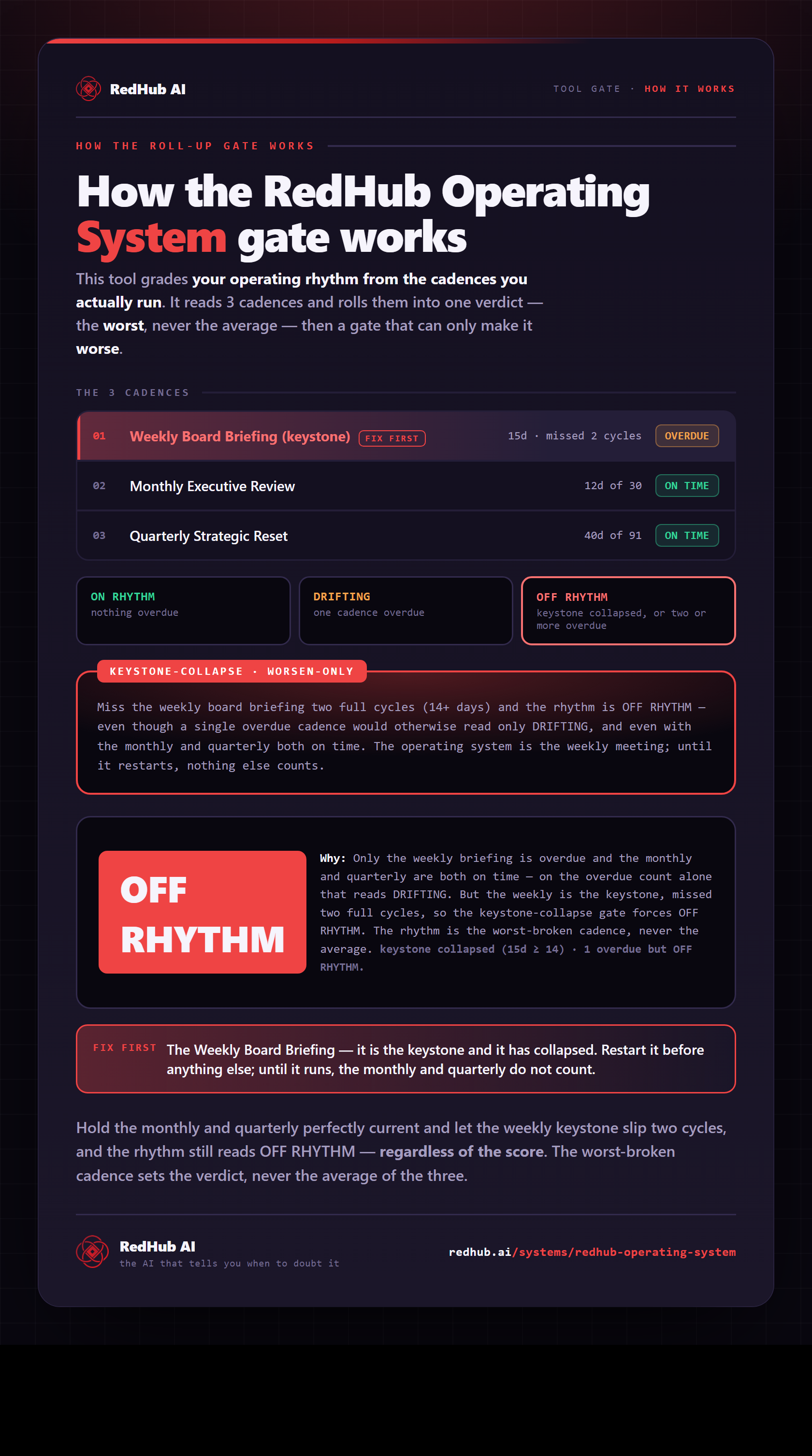
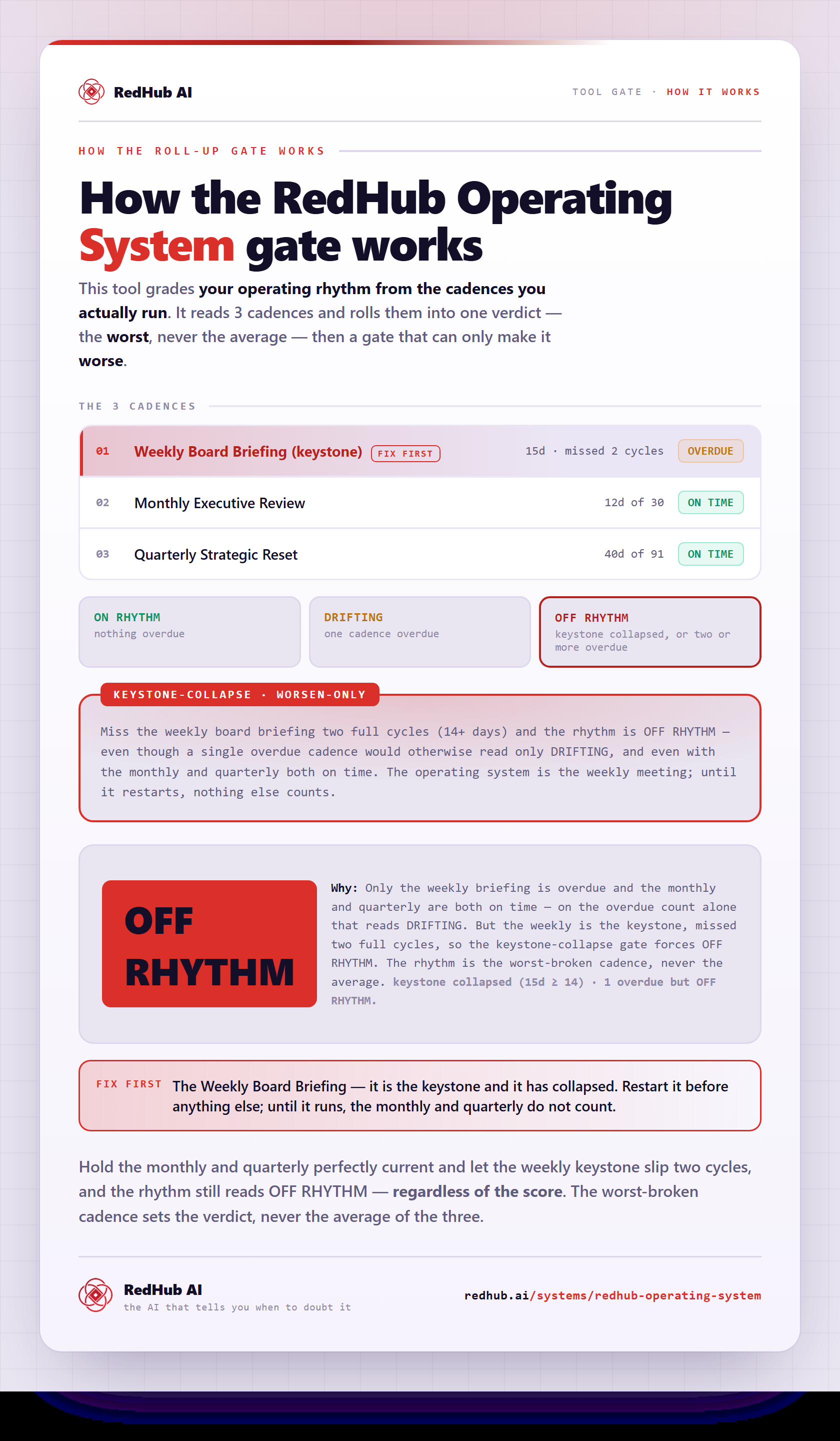
The gate this post refers to, drawn from the tool’s own logic. See the tool.