EOS Alternative: Operating Discipline Without the $30K Bill
RedHub AI Editorial8 min read

Jump to a section10
TL;DR
- What it is: An EOS alternative is any path to structured operating discipline that doesn't require hiring an EOS Implementer — peer groups, fractional executives, or a self-serve operating system.
- Who it's for: Founders running $1M–$20M companies who want the discipline but balked at the implementer quote — browse RedHub Systems.
- How it works: Separate what EOS actually sells (a cadence, honest numbers, a forcing function) from what it costs (commonly reported at $36K–$52K in year one with an implementer), then pick the cheapest path that still forces the rhythm.
- Bottom line: The discipline is the product. You can buy it with a coach, a peer room, or a system that tracks whether you actually ran your own rhythm — at very different prices.
What is an EOS alternative?
An EOS alternative is a way to get the operating discipline EOS promises — a fixed meeting rhythm, honest numbers, clear priorities, and accountability — without hiring an EOS Implementer or signing up for a multi-year coaching engagement. The main paths are CEO peer groups (like Vistage), fractional COOs, and self-serve operating systems you run yourself. Each one trades money for enforcement in a different way.
Best for: founders who want EOS-grade discipline at self-serve prices — see the RedHub Operating System ($99/mo or $990/yr).
Here's how the search for an EOS alternative usually starts. You read Traction, or a quarter got away from you, or you crossed ten hires and the company stopped fitting in your head. You decided the fix was an operating system. Then you got the quote: EOS Implementers commonly charge in the range of $4,500 to $6,600 per session, and publicly discussed year-one totals often land between $36,000 and $52,000 per independent breakdowns (opens in a new tab). Implementers set their own fees, so quotes vary — but the shape of the number is the same: five figures before the first quarter closes.
That number stops a lot of founders cold. It shouldn't stop the search for discipline. This guide breaks down what EOS actually sells, the four ways to buy it, and how a self-serve operating system delivers the rhythm at roughly the price of one implementer session per year.
What are you actually buying with EOS?
Strip the branding away and an implementer-led operating system delivers four things:
- A cadence. A fixed rhythm of weekly, quarterly, and annual meetings that happen whether or not this week feels busy.
- Honest numbers. A small set of measurables reviewed on schedule, so problems surface in days instead of quarters.
- Forced prioritization. A short list of real priorities instead of forty half-commitments.
- An outside forcing function. Someone external whose presence on the calendar makes the leadership team show up and do the work.
Notice what's not on the list: the decisions. Even with a $50K engagement, the implementer facilitates — your leadership team decides. The judgment was always yours. What you're paying for is structure and enforcement. That matters, because structure and enforcement can be bought several ways.
The four paths to operating discipline
| Path | What forces the discipline | Commonly reported cost | Commitment |
|---|---|---|---|
| EOS Implementer | A paid facilitator on your calendar | $36K–$52K year one; engagements often run ~2 years | Multi-year coaching relationship |
| CEO peer group (Vistage, YPO, EO) | A room of peers you don't want to disappoint | Roughly $13K–$22K/yr for CEO programs, plus initiation | Annual membership, monthly meetings |
| Fractional COO | A hired operator who owns the rhythm | A recurring monthly retainer — typically the most expensive path over a year | Ongoing contract |
| Self-serve operating system | Instrumentation — a deck that counts whether you actually ran each cadence | $990/yr (RedHub Operating System, actual price) | Monthly or annual, cancel anytime |
The first three columns are commonly reported ranges, not quotes — every implementer, chapter, and operator prices differently. The last row is an actual price. We break the full EOS price stack down line by line in how much does EOS cost, and compare the implementer path against the peer-group path in EOS vs Vistage.
Where self-serve wins — and where it honestly doesn't
Self-serve wins when
- You're disciplined enough to show up, but need the structure and the scorekeeping
- The implementer quote is a meaningful share of your operating budget
- You want a weekly instrumented rhythm, not a monthly meeting
- You'd rather own the system than rent the facilitator
Hire a human when
- Your leadership team is in open conflict — software doesn't facilitate a fight
- Nobody on the team will run a meeting without an outsider in the room
- You need a partner-level ownership conversation, not an operating rhythm
That right column is real. A skilled implementer earns their fee in rooms where the leadership team can't have hard conversations alone. If that's your situation, pay for the human. But most founders searching for an EOS alternative don't have a facilitation problem. They have a follow-through problem — and follow-through is exactly what instrumentation fixes. We cover the run-it-yourself decision in depth in self-implementing EOS.
What a self-serve operating system looks like
The RedHub Operating System is a membership that runs your executive systems on a rhythm. It includes all five RedHub Executive Suite systems — an operations read, an adversarial challenge board, a pipeline grader, a cash grader, and the harness that synthesizes them — plus the cadence that makes you actually convene them:
- Weekly board briefing — the keystone. Pull every system's current verdict and synthesize one company status: the worst signal, not a flattering average. Walk out with the binding constraint and one top item.
- Monthly executive review. Go domain by domain for the trend a weekly glance can't show — pipeline thinning over six weeks, burn creeping up, a bet stalling.
- Quarterly strategic reset. Re-challenge your direction, re-baseline your targets, and prune what isn't working — so a perfectly run rhythm doesn't aim at the wrong goal.
The enforcement layer is the Command Deck. It counts days from the last time you actually ran each cadence — not the last time you meant to. Each cadence reads ON TIME, DUE, or OVERDUE, and the whole rhythm gets one grade: ON RHYTHM, DRIFTING (one cadence overdue), or OFF RHYTHM (the weekly missed two cycles, or two cadences overdue at once). Miss the weekly once and you're DRIFTING. That's the implementer's calendar pressure, rebuilt as instrumentation.
The honest line: the RedHub Operating System schedules and reports. It never runs the systems, makes a decision, or takes an action — you run the cadences and you run the company. Anyone selling you an operating system that claims to make the decisions is selling something else.
EOS-grade discipline, self-serve price
The RedHub Operating System includes all five Executive Suite systems, the weekly/monthly/quarterly cadence, and the Command Deck that grades whether you actually ran it. $99/month or $990/year. Cancel anytime — no two-year engagement.
Start the membership — $99/mo →What if you already tried the book?
A lot of founders in this search aren't EOS-curious — they're EOS-veterans of the cheapest kind. They read the book, ran the tools for a quarter, and watched the whole thing quietly decay. That's not a character flaw; it's the predictable result of running a rhythm with no scorekeeping. If that's you, start with the Traction alternative — it's written for the founder whose binder is on the shelf.
Where to go deeper
This pillar is the map. Each decision on the path has its own guide:
- How much does EOS cost? — the real price stack: sessions, years, software seats.
- EOS vs Vistage — implementer vs peer group, and the third path.
- Self-implementing EOS — can you run it without a coach, and why most attempts drift.
- Traction alternative — when the book isn't enough.
EOS® is a registered trademark of EOS Worldwide, LLC, and Vistage® of Vistage Worldwide, Inc. RedHub is not affiliated with, endorsed by, or connected to either. Third-party pricing above reflects publicly discussed ranges, not quotes.
Decision Guide
Choose an EOS alternative if: you want the operating discipline, your leadership team can hold a meeting without a referee, and the implementer quote would fund a hire instead.
Hire the implementer if: your leadership team can't have hard conversations alone — facilitation is a human job, and a good one is worth the fee.
Best first step: run one honest weekly briefing this week — every domain, worst signal first, one top item out. If you can do that four weeks straight, you don't need the $30K; you need the instrumentation.
FAQ
What is the best EOS alternative?
It depends on what's missing. If your leadership team needs facilitation, a human implementer or fractional COO. If you need peer accountability and a network, a CEO peer group like Vistage. If you need the rhythm itself enforced, a self-serve operating system like the RedHub Operating System ($990/yr) is the least expensive path by a wide margin.
How much does an EOS Implementer cost?
Implementers set their own fees, but publicly discussed figures commonly land at $4,500–$6,600 per session and $36,000–$52,000 for the first year. Engagements often run around two years. See the full breakdown in how much does EOS cost.
Can I get EOS-style discipline without an implementer?
Yes. The discipline is a rhythm plus enforcement. A self-serve system replaces the implementer's calendar pressure with instrumentation: a deck that counts days since you actually ran each cadence and grades the rhythm honestly. What it can't replace is human facilitation of a dysfunctional team.
Is the RedHub Operating System a version of EOS?
No. It's not affiliated with EOS Worldwide and doesn't use the EOS toolset. It's a different path to the same underlying goal — operating discipline — built on a weekly board briefing, a monthly review, a quarterly reset, and a Command Deck that tracks whether you actually ran them.
Does it make decisions for me?
No, and that's deliberate. It schedules the cadences and reports what's due and what each system found. You run the meetings, you make the calls, you run the company. It is not financial, legal, or investment advice.
What's included in the $99/month?
All five Executive Suite systems (a $1,295 value bought separately), the cadence engine, four Claude Skills that operate the cadences, the Command Deck workbook, the operating-rhythm template, the Operating System Handbook, and a First 30 Days guide — plus updates while subscribed. Annual is $990 (about 17% less) and you can cancel anytime.
What if I already own some Executive Suite systems?
The membership includes all five, so nothing extra to buy. If you'd rather own individual systems outright, they're sold separately — start with the Operating Cadence Engine ($299) or the Cash-Flow Sentinel ($249).
Run the company. Don't just own the tools.
The RedHub Operating System: five executive systems, a weekly/monthly/quarterly rhythm, and a Command Deck that tells you the truth — on rhythm, drifting, or off. $99/month or $990/year. It schedules and reports; you run the company.
Get the RedHub Operating System →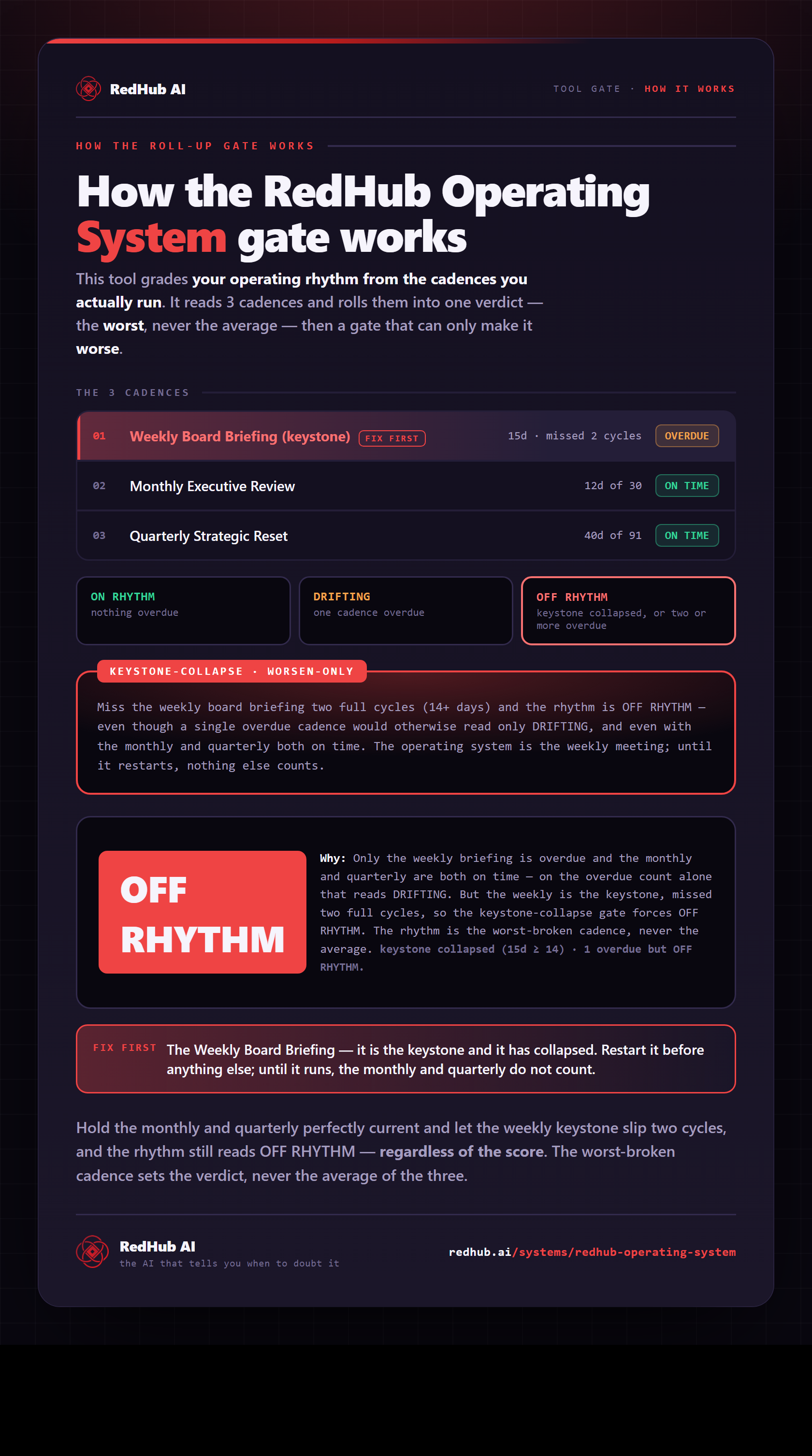
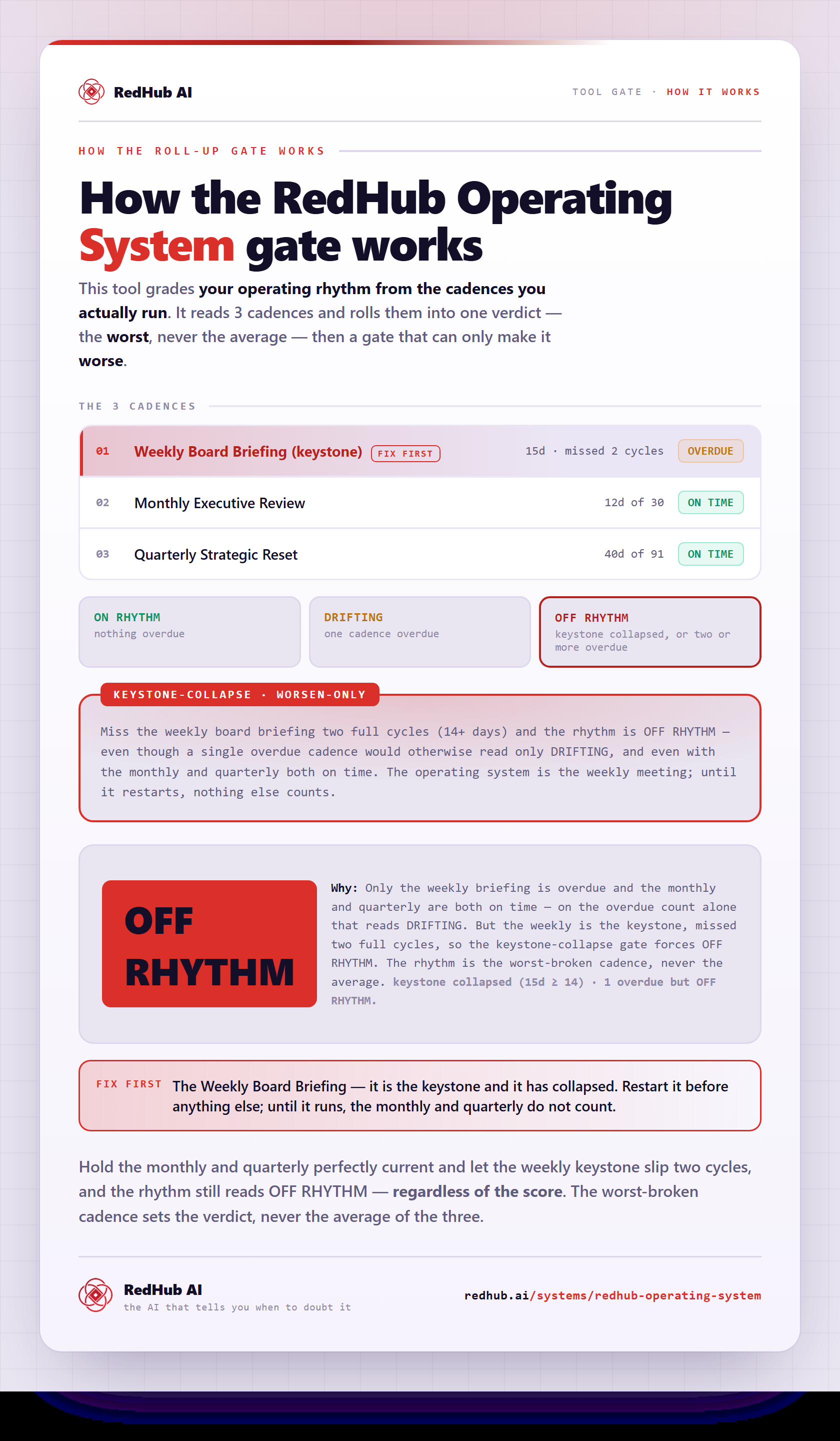
The gate this post refers to, drawn from the tool’s own logic. See the tool.