Self Implementing EOS: Can You Run It Without a Coach?
RedHub AI Editorial6 min read

Jump to a section8
TL;DR
- What it is: The honest answer on self implementing EOS — running the operating system from the book, without paying an implementer.
- Who it's for: Founders who can hold a meeting but keep watching the rhythm decay — see the RedHub Operating System.
- How it works: Self-implementation fails on drift, not difficulty. The fix is instrumentation: a system that counts days since you actually ran each cadence and grades the rhythm.
- Bottom line: You don't need a coach to run a rhythm. You need something that tells the truth when you stop.
Can you self-implement EOS without an implementer?
Yes — the tools are in the books, and plenty of companies start that way. But the commonly reported failure mode isn't misunderstanding the tools; it's drift. The rhythm runs for a quarter, a loud month arrives, meetings slip "just this once," and six weeks later the system exists only in a binder. The implementer's real product was never the toolset — it was enforcement. A self-serve operating system replaces that enforcement with instrumentation: a deck that counts days from the last time you actually ran each cadence and grades the whole rhythm honestly.
Best for: disciplined founders who need scorekeeping, not coaching — part of our EOS alternative guide.
Self implementing EOS is the path every cost-conscious founder considers first, and for good reason: the ideas are public, the book is cheap, and the implementer path commonly runs $36,000–$52,000 in the first year (the full stack is in how much does EOS cost). The question isn't whether you're allowed to run it yourself. It's whether it will still be running in June.
Why self-implementation actually fails
Talk to founders who tried and the story repeats. Not "the tools were too hard." The tools are meeting agendas and spreadsheets. The story is always some version of drift:
- Week 1–8: the rhythm runs. Meetings happen. Numbers get reviewed. It works.
- Week 9: a customer escalation lands on meeting day. Skipped, "just this once."
- Week 11: the meeting happens but nobody prepped. It takes twenty minutes and decides nothing.
- Week 15: someone asks whatever happened to the operating system.
Nothing broke. Nothing failed loudly. The rhythm just quietly lost every individual collision with urgency — because nothing in the building had the job of defending it. That's the implementer's actual role: a five-figure calendar commitment you won't no-show. Remove it and you've removed the enforcement, not the knowledge.
Key insight: discipline systems don't fail at the start, when motivation is high. They fail in the boring middle, when the only thing that keeps the rhythm alive is something that notices you stopped. A coach notices. A binder doesn't.
What to replace the coach with: instrumentation
If drift is the failure mode, the fix is a system that measures the rhythm itself — not your intentions. That's the design of the RedHub Operating System. It runs three cadences and one scoreboard:
| Cadence | Frequency | What it does |
|---|---|---|
| Board briefing (the keystone) | Every 7 days | Pull every system's verdict into one company status — the worst signal, not the average — and leave with the binding constraint and one top item |
| Executive review | Every ~30 days | Domain by domain, the trend a weekly glance can't show: the slope, not this week's point |
| Strategic reset | Every ~91 days | Re-challenge the direction, re-baseline the targets, prune what isn't working |
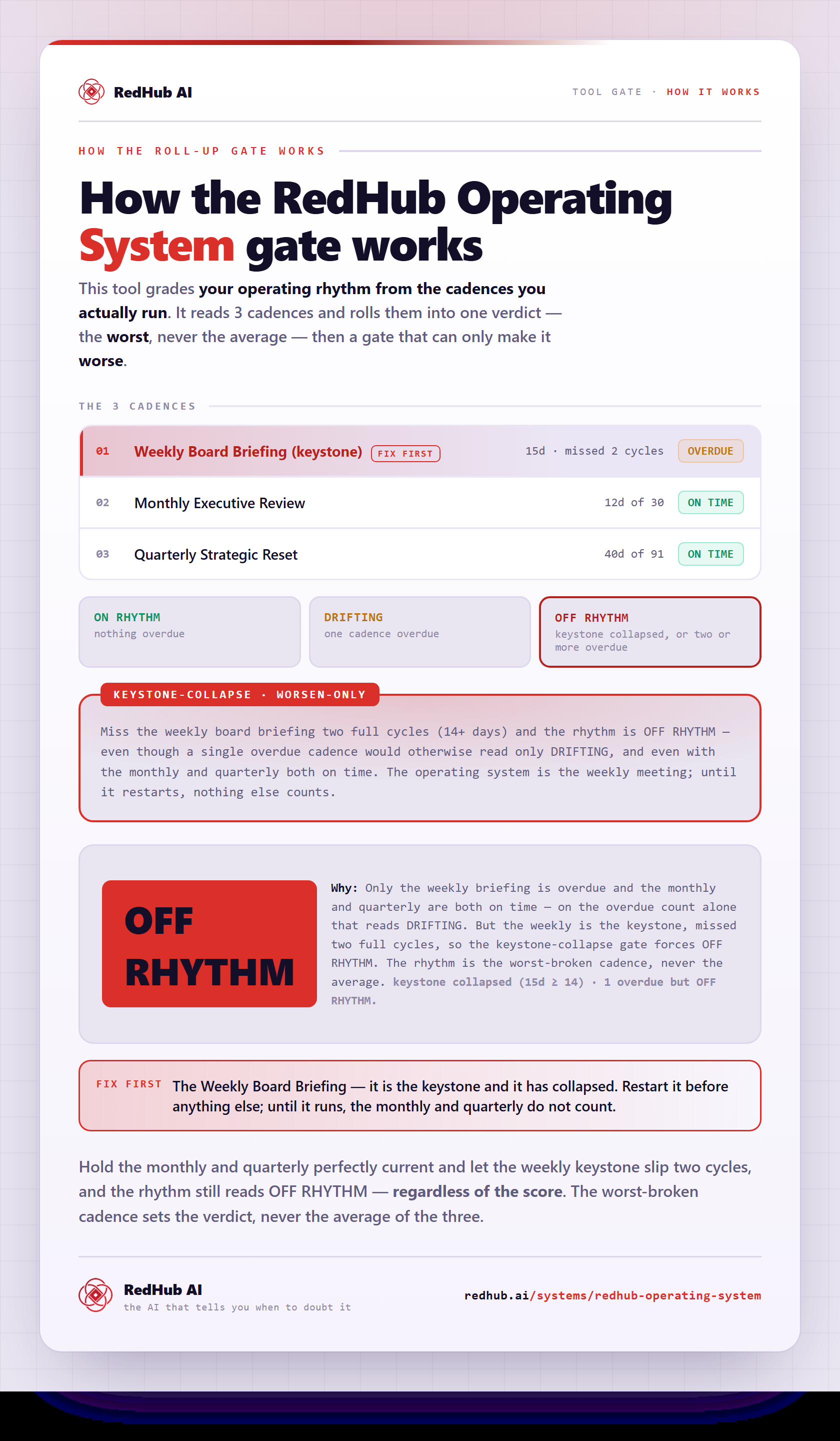
The scoreboard is the Command Deck, and it enforces the one rule a binder can't: it counts from the last time you actually ran each cadence, not the last time you scheduled it. Each cadence reads ON TIME, DUE, or OVERDUE. The whole rhythm gets one honest grade:
The weekly briefing is the keystone on purpose. Miss it once and you're DRIFTING — the same "just this once" that kills every self-implementation, made visible the week it happens instead of discovered in week 15. And the deck always names the single next action: the most overdue cadence, keystone first. No dashboard archaeology, one thing to do.
Your first 30 days, self-serve
The membership ships a First 30 Days guide; here's the shape of it:
- Week 1 — run the first board briefing. Don't configure. Convene. Pull each executive system's read on operations, pipeline, cash, and strategy, and write down the worst signal.
- Weeks 2–4 — defend the weekly. Three more briefings, same day, same hour. When the loud day collides with it, the deck is watching. This is the entire test.
- Day ~30 — first monthly review. Now you have four weeks of data. Look at slopes, not points. Carry anything serious into next week's briefing.
- Day ~91 — first strategic reset. Re-run the challenge on your direction and re-baseline. If you got here ON RHYTHM, you've done what most $40K engagements are hired to force.
The honest limits of running it yourself
Two things a self-serve system will not do. It won't facilitate: if your leadership team can't have hard conversations without a referee, hire the human — that's a real service worth real money (the comparison is in EOS vs Vistage). And it won't decide: the RedHub Operating System schedules and reports — it never runs the systems, makes a decision, or takes an action. You run the cadences and the company. Any tool that promises otherwise is overpromising.
If you've already lived the drift story — book read, tools tried, binder shelved — the follow-up is written for you: the Traction alternative.
EOS® is a registered trademark of EOS Worldwide, LLC. RedHub is not affiliated with, endorsed by, or connected to EOS Worldwide. Third-party figures are publicly discussed ranges, not quotes.
Decision Guide
Self-implement if: your team can hold a meeting without a referee and your past failures were drift, not conflict.
Hire an implementer if: the room itself is the problem — facilitation is a human job.
Best first step: schedule one weekly board briefing for this week and put a counter on it. If you can run four in a row, instrumentation is all you were missing.
FAQ
Is it legal to run EOS without an implementer?
Yes. The concepts are published in widely available books, and self-implementation is a recognized path. What you can't do is hire someone who calls themselves an EOS Implementer without EOS Worldwide's licensing — but running the ideas in your own company is yours to do.
Why do most self-implementations fail?
Drift. The tools are simple; the enforcement is what's missing. The rhythm loses one collision with urgency at a time until it quietly stops, usually within a couple of quarters.
What does "instrumented rhythm" mean?
A system that counts days from the last time each cadence was actually run and grades the whole rhythm — ON RHYTHM, DRIFTING, or OFF RHYTHM — so a skipped week is visible the week it happens, not a quarter later.
Why is the weekly briefing the keystone?
Because the weekly meeting is the operating system — it's where every domain's signal gets seen and one priority gets set. Miss it once and the deck reads DRIFTING; miss two cycles and the rhythm has broken, no matter how current the monthly and quarterly are.
What does "worst signal, not the average" mean?
The weekly synthesis grades the company by its weakest domain. A strong pipeline doesn't offset a cash problem — averaging them would hide the thing that needs you this week.
Do I need all five executive systems to start?
The membership includes all five, so there's nothing else to buy. If you'd rather start with one standalone, the Operating Cadence Engine ($299) is the operations read the weekly rhythm is anchored on.
What happens if I fall off the rhythm?
The deck tells you, plainly, and names the single next action — the most overdue cadence, keystone first. No shame spiral, no archaeology: run that one cadence and you're climbing back.
Run it yourself — with a scoreboard that won't flatter you
The RedHub Operating System: all five Executive Suite systems, the weekly/monthly/quarterly cadence, the Command Deck, and a First 30 Days guide. $99/month or $990/year, cancel anytime. It schedules and reports — you run the company.
Get the RedHub Operating System →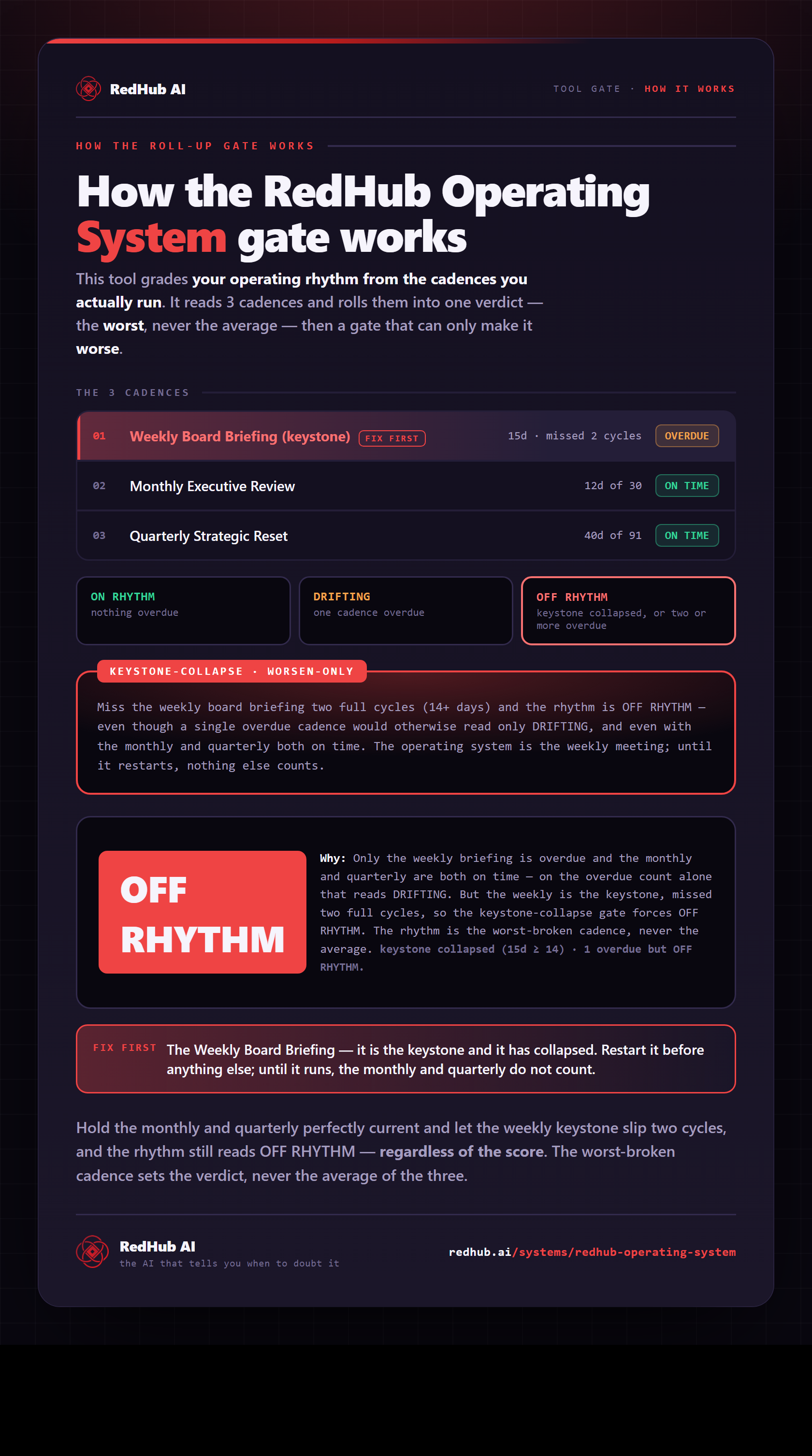
The gate this post refers to, drawn from the tool’s own logic. See the tool.