Does Page Speed Affect SEO and Conversions?
RedHub AI Editorialupdated October 5, 20265 min read

Jump to a section7
Google's own documentation settles most of the page speed SEO question in a few lines. "Core Web Vitals are used by our ranking systems," its Search Central page on page experience says, and then: "Google Search always seeks to show the most relevant content, even if the page experience is sub-par." So speed counts, but relevance comes first. Conversions are a different story. On your own site, speed acts on buyers directly, and the size of that effect is something you measure, not borrow.
TL;DR: For SEO, speed works like a tiebreaker. Google says good Core Web Vitals don't guarantee top rankings, and that chasing a perfect score just for SEO "may not be the best use of your time." For conversions, speed is a real lever, but the best-known study found different sizes, and even different directions, by industry. Fix poor scores, and don't chase 100. The full picture is in the Core Web Vitals revenue pillar guide.
Speed as a ranking factor: real, but limited
Google's page experience FAQ goes on: "for many queries, there is lots of helpful content available. Having a great page experience can contribute to success in Search, in such cases." Read plainly, speed helps most when several pages answer equally well. A slower page that answers the question better can still outrank a faster one that does not.
The same page adds a warning that every speed audit should quote. Good results in Search Console's Core Web Vitals report "doesn't guarantee that your pages will rank at the top of Google Search results." In a crowded category where several sites answer the query well, Core Web Vitals can plausibly tip a ranking. They are not the first lever when the content itself is thin.
Speed and conversions: more direct, less predictable
The link between speed and conversion is easier to picture. A visitor who waits, taps a button and gets nothing, or watches the page jump as they reach to click, feels friction. Friction loses sales. The hard part is the size of the effect, because it depends on how slow you are now, what you sell and where your traffic comes from.
The most-cited study shows both sides. Deloitte's 2020 report Milliseconds Make Millions (opens in a new tab), commissioned by Google, analyzed mobile data from 37 brands over four weeks. For retail it reported "an 8.4% increase in conversions" when its four speed metrics improved by 0.1 second. For the six lead-generation brands, it reported the opposite: "Conversion rates on both mobile and desktop decreased when site speed was seen to improve." The report describes itself as examining a correlation, with speed changes that "were natural and not artificially controlled."
So the evidence points one way for stores and the other way on conversions for lead-generation sites, and none of it was measured on your traffic. Treat any headline figure as a reason to test, not as a forecast. The way to get your own number is in How to Measure the Revenue Impact of a Slow Website.
Where speed and conversion actually collide
A slow Shopify product page is the cleanest case. A shopper on a phone with a weak signal taps through from an ad, and the hero image is still loading three seconds later. Some of those shoppers leave before the Add to Cart button is even visible. That is a lost sale that already had intent, and no ranking report will show it.
An image-heavy blog is different. There, speed mostly decides whether readers stay long enough to reach a sign-up form or an affiliate link, and whether the page shows as poor in Search Console's field data.
A WordPress site running a dozen marketing tools often shows the widest gap between looking fine and feeling fine. The page paints quickly, so LCP is decent, but every click lags because scripts are holding the main thread, so INP is poor. It passes a basic loading test and still fails a real visitor's patience.
Don't chase a perfect score
A 100 on PageSpeed Insights is not a business goal. Google's own page experience FAQ says that "trying to get a perfect score just for SEO reasons may not be the best use of your time." Once LCP, INP and CLS move from poor into good, squeezing a 90 into a 100 costs engineering time that usually earns more elsewhere: in content, offer clarity, or the parts of the page that persuade.
What to work on once speed is fixed
If your Core Web Vitals already pass and conversions still lag, speed is no longer your bottleneck. The problem has moved to copy and offer structure: headline clarity, proof, pricing and the call to action. Our post on landing page mistakes that quietly kill conversions covers the usual suspects. If organic traffic itself is falling, check whether AI Overviews are answering the query before anyone reaches your page, using the method in AI Overviews Traffic Loss: How To Measure It.
See which slow pages are worth fixing
The Core Web Vitals Revenue-Impact Gate grades each page against Google's thresholds by its worst metric, returns PASSING, NEEDS WORK or BLEEDING, and estimates revenue at risk from your own numbers. RedHub asserts no industry lift and guarantees no ranking change.
Get the Core Web Vitals Revenue-Impact Gate — $49Pairs well with
If speed checks out but conversions haven't moved, the AI Offer & Landing-Page Conversion Kit ($79) scores your landing copy on a Conversion-Ready Scorecard and flags overclaiming and missing proof. If organic clicks are sliding while impressions hold, the AI Overview Traffic-Loss Diagnostic ($79) grades each page from your own Search Console numbers. And the AEO Citation Audit & Optimizer Kit ($79) audits how citable your pages are to AI answer engines.
More in this guide
Is page speed a Google ranking factor?
Yes. Google's Search Central says Core Web Vitals are used by its ranking systems, but it also says it shows the most relevant content even when page experience is sub-par. Speed helps most among pages that answer a query equally well.
Will fixing my Core Web Vitals boost my rankings a lot?
Probably not on its own. Google says good Core Web Vitals results don't guarantee top rankings. If your content is thinner or less relevant than competitors', speed won't close that gap.
Does site speed affect conversion rate?
Often, but not always in the same direction. Deloitte's 2020 study for Google reported an 8.4% rise in retail conversions with a 0.1-second improvement, while its lead-generation brands saw conversion rates fall. Measure the effect on your own site.
Is there a reliable "each second costs X% of sales" figure?
No universal one. Published figures come from specific sites, industries and years, and the best-known study found different results by industry. Use your own before-and-after conversion data instead.
Should I aim for a perfect 100 PageSpeed score?
No. Google says chasing a perfect score just for SEO may not be the best use of your time. Moving each metric out of poor and into good captures most of the benefit.
How do I know if speed is my bottleneck?
Check your field Core Web Vitals in Search Console against Google's thresholds. If LCP, INP and CLS already read good, speed probably isn't what is holding conversions back.
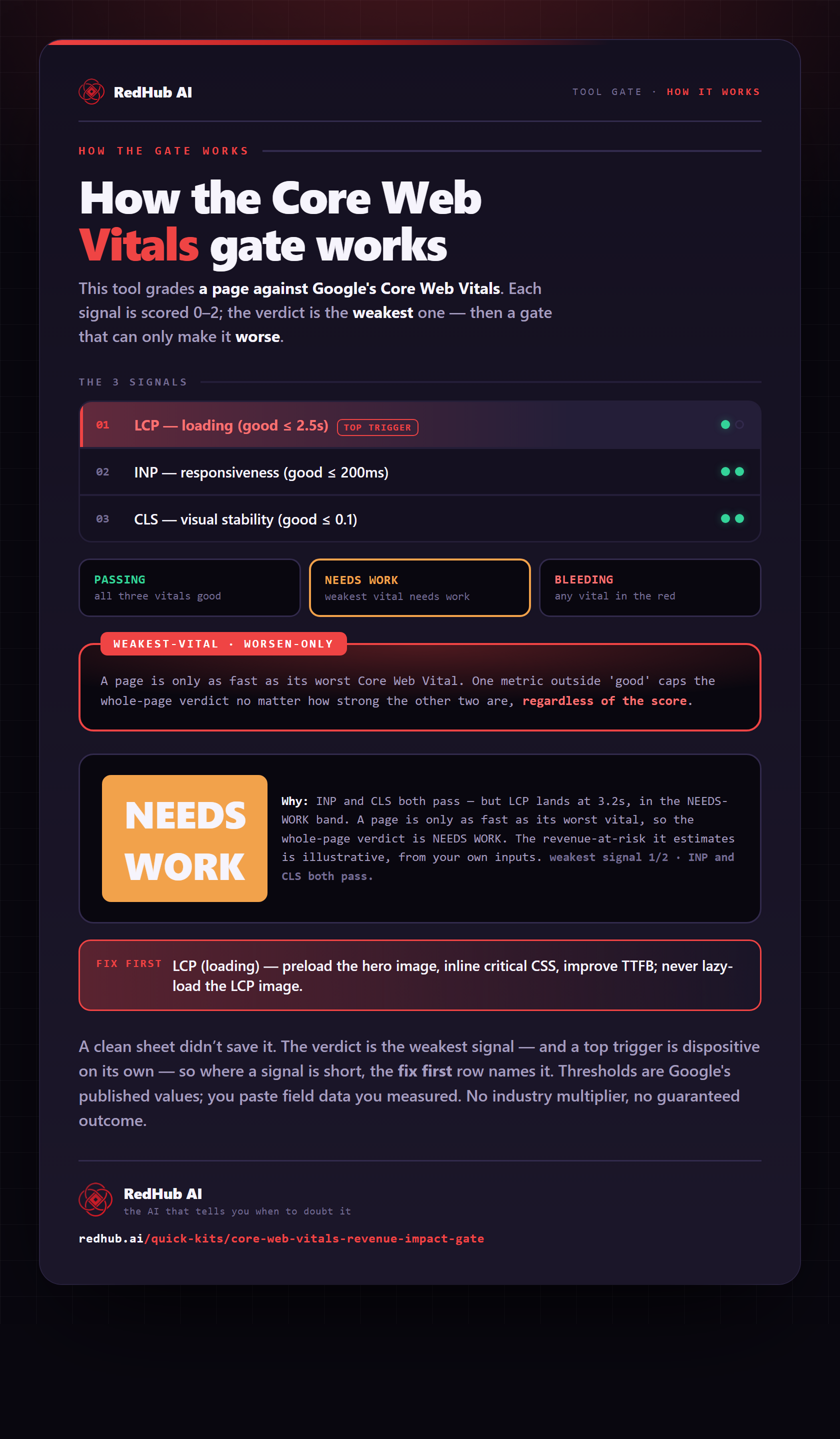
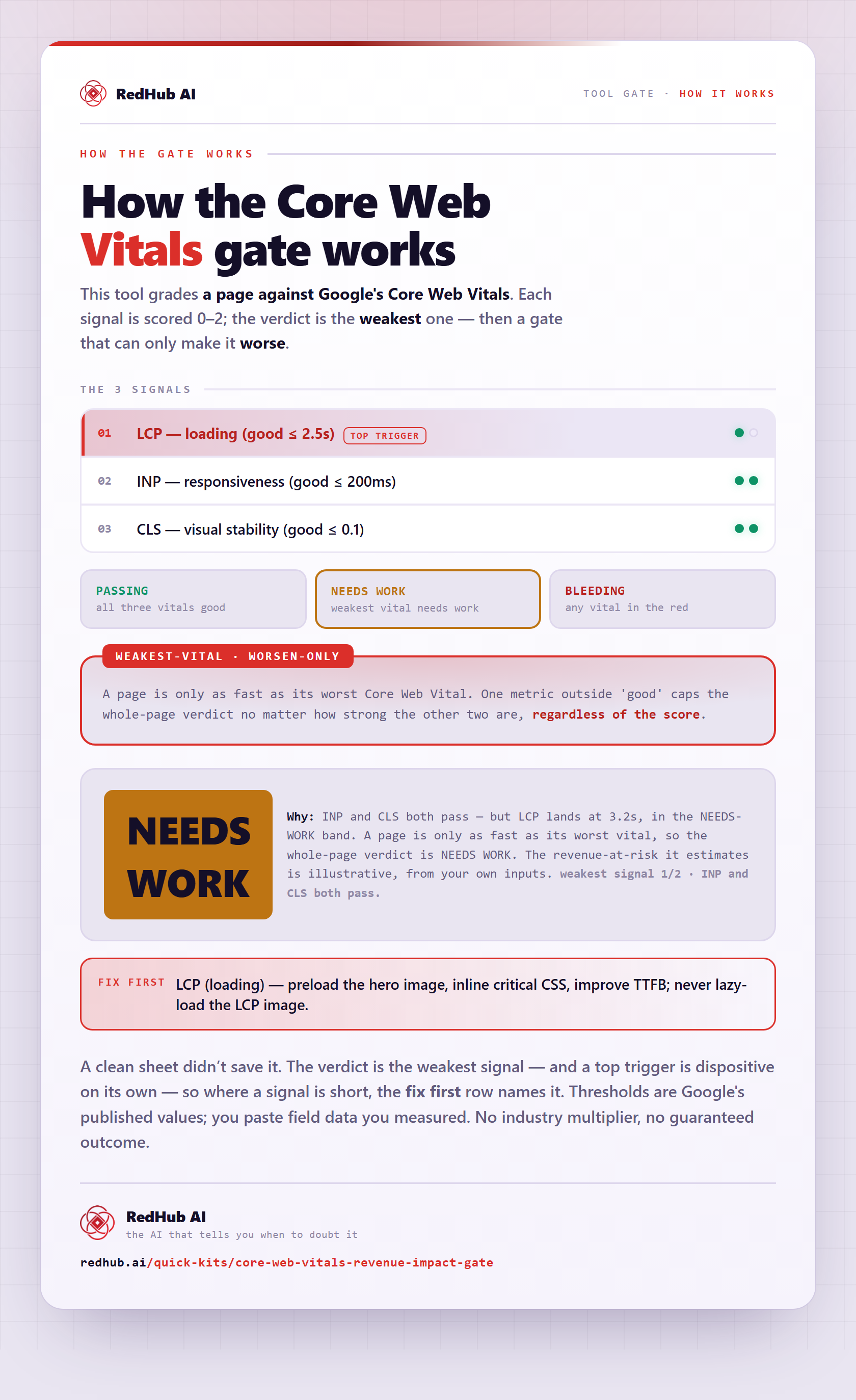
The gate this post refers to, drawn from the tool’s own logic. See the tool.