We Tested Our Own Skills Twice and Got Different Answers
RedHub AI Editorial8 min read
Jump to a section12
TL;DR
- What we did: ran a three-way skill ablation test (full skill, slim copy, no skill) on three of our own Claude skills, then ran the same test again the next day.
- What we found: the totals were identical both times. Two of the three verdicts underneath them swapped.
- What held: one skill matched its slim copy on all six checks in both runs, and one stage was never tested in either run.
- The lesson: compare results skill by skill, not total by total, and treat a single run as an indication.
Is one skill ablation test enough to cut a skill?
Usually not. A skill ablation test runs one task with the full skill, a slim copy and no skill, then compares the results. When we ran the same test twice on three of our own skills, two of the three got a different verdict the second time, though the totals matched. Treat one run as an indication. Repeat the test before you change a skill other people depend on.
Best for: anyone about to slim a skill on the strength of one test. The Skill Ablation Assay labels a single run as SINGLE RUN so nobody mistakes it for proof.
We built a tool that tells you whether a Claude skill still earns its place. Before we sold it, we pointed it at ourselves. Then, because one run felt thin, we ran the whole test again. The second run gave the same totals and different answers.
This post is what happened, what held across both runs, and what we changed because of it. If you are planning a skill ablation test of your own, the second run is the part worth copying. For the method itself, start with why you should ablate your CLAUDE.md instead of just deleting it.
The test
We picked three skills we use or sell:
- Drop authoring, an internal skill that writes new product pages for our storefront. Six pass or fail checks.
- Inventory ABC Analysis, a skill from our Ecommerce Skills Pack that sorts products by how much they matter to revenue. Six checks.
- Card Explainer, an internal skill that scripts and renders short product videos. It has two stages: authoring the script, then rendering it. Eight checks on authoring.
Each skill got one representative task, run three ways: A with the full skill, B with a slim copy that kept only the governance, preference and fact lines, and C with no skill at all. Each output was marked against its checklist, and the marks went into the Assay.
Run 1 was on November 24, 2026, one run per condition. It was graded by the same session that wrote the slim copies, which is a known source of bias. Run 2 was the next day: same tasks, same inputs, same skill files, fresh sessions, and a separate grader for each skill that saw the outputs under shuffled labels.
Same totals, different answers
Here is the summary line from both runs:
FLEET: EARNS ITS PLACE 1 CUT THE METHOD 2 RETIRE 0 NOT TESTED 0Identical. If we had only read the totals, we would have called the result stable. It was not. Here is what sat underneath.
| Skill | Run 1 (full / slim / none) | Run 2 (full / slim / none) | Verdict |
|---|---|---|---|
| Drop authoring | 6 / 6 / 5 of 6 | 6 / 5 / 5 of 6 | CUT THE METHOD, then EARNS ITS PLACE |
| Inventory ABC | 6 / 6 / 4 of 6 | 6 / 6 / 3 of 6 | CUT THE METHOD both times |
| Card Explainer (authoring) | 8 / 7 / 1 of 8 | 7 / 7 / 1 of 8 | EARNS ITS PLACE, then CUT THE METHOD |
Two of three verdicts flipped. The fleet line stayed the same only because the two flips cancelled each other out.
Why each one moved
Drop authoring: the slim copy missed something it caught before
In run 1, the slim copy passed all six checks. In run 2, it missed one: spotting that the new product overlapped with one we already sell. One missed check is enough. The Assay is strict on purpose, so a single miss by the slim run means the full skill earns its place. Same skill file, same task, different day, different verdict.
Card Explainer: the full skill had a bad day
In run 1, the slim copy missed one check that the full skill passed, a required label on a redrawn sample report. That made it EARNS ITS PLACE. In run 2, the full skill missed the same check. With both missing it, the slim copy matched, and the verdict became CUT THE METHOD. The method lines did not get less useful overnight. The output changed, and so did the grader: run 2 used a blind one. Either can move a strict verdict.
Inventory ABC: the one that held
Full and slim both passed six of six checks, both times. The no-skill run fell short both times, at four of six and then three of six. That is the only result we would act on: two runs in a row say the step-by-step method is not adding anything, while the skill's rules and facts still are.
The stage nobody tested
Card Explainer has a second stage, rendering, narration and sync. Our test never exercised it, in either run. So the Assay never let the verdict reach past authoring. Here is that part of its real output from run 2:
Card Explainer
  VERDICT: CUT THE METHOD   [SINGLE RUN]
  SCOPE: the cut applies to tested stages only.
    - Authoring: CUT THE METHOD   passed A 7 / B 7 / C 1 of 8
    - Render, narration and sync: NOT TESTED (not exercised by the test)
This is the gap in the popular "delete it and add back what breaks" approach. A week of writing scripts would never touch the render stage. Its instructions would look unused, and they would get deleted with no evidence either way. Untested is not the same as unneeded.
What else did not repeat
Run 1 also flagged that on two skills the full version made more errors than the slim one, the kind of finding that makes a good headline. In run 2, full and slim made the same number of errors on both. We had been ready to quote it. We are glad we checked first.
The blind grading was also only partly blind. Two of the no-skill outputs looked different enough, in file layout and format, that a grader could guess which condition they came from. Blinding still removed the bigger bias, which was the session that wrote the slim copies grading them. It just was not complete, and we would rather say so.
What we changed
Our product page first quoted run 1. After run 2, we rewrote those numbers to state only what held in both runs, naming the skill each one held for. One stat from run 1 did not recur at all, so it came off the page.
The bigger change is a habit. Before quoting any result from a test like this, we re-run it and compare it item by item. A count across items can stay the same while the items it counts swap places, so the total cannot tell you whether a result repeated.
How to run yours
- Write the checks first. Five to eight pass or fail checks for one real task. If you cannot write them, you are not ready to cut.
- Run full, slim and none. Use fresh sessions for each. Strip anything from the outputs that names the condition before grading.
- Have someone else grade. Not the person who wrote the slim copy.
- Run it twice. With repeated runs, mark a check as passed only if it passed every time.
- List the stages you did not test. Those keep every instruction, whatever the rest shows.
- Keep the old version. Every cut should be one step from a rollback.
For more on building checks that mean something, see how to evaluate prompts.
Read your test results the strict way
The Skill Ablation Assay takes your full, slim and no-skill marks and returns EARNS ITS PLACE, CUT THE METHOD, RETIRE or NOT TESTED per skill. It labels a single run as SINGLE RUN, holds any skill with an untested stage short of RETIRE, and never lets a good score remove a safety, permission or approval rule. It is an offline engine and workbook. It does not run your skill or call a model.
See the Skill Ablation Assay →Pairs well with
The Prompt Regression Lab locks in a slim version as the new baseline and fails any later change that regresses it. The Agent Reliability Harness produces pass and fail marks at the level of tool calls and steps. The AI Agent Go-Live Readiness Gate checks the approval gate and rollback path before a slimmed agent goes live.
Keep going: read the pillar, Don't Just Delete Your CLAUDE.md. Ablate It. For the step-by-step method, see how to test a Claude skill, and for the stage we never tested, what "add back what breaks" cannot see. For the cost of skipping tests on a model switch, see why AI model upgrades break production workflows.
Decision Guide
Run a second test if: your first run says CUT THE METHOD or RETIRE on a skill that customers or colleagues rely on.
One run is fine if: the skill is yours alone, short, and easy to restore from a backup.
Best first step: list every stage in the skill and mark which ones your test task actually touches.
FAQ
What is a skill ablation test?
You run one representative task three ways: with the full skill, with a slim copy that keeps only its governance, preference and fact lines, and with no skill. Comparing the three shows which instructions still change the result.
Why did the same test give different verdicts?
Model output varies from run to run, and our two runs also used different graders. In our test, a slim copy missed one check it had passed the day before, and a full skill missed one it had passed. Either is enough to change a strict verdict.
How many runs do I need?
At least two before changing a skill other people depend on. With repeated runs, count a check as passed only if it passed every time.
Can I trust the totals if they match across runs?
No. Our totals matched exactly while two of three verdicts swapped. Compare each skill's result, not the summary.
What happens to a stage I did not test?
It keeps every instruction. A test that never ran a stage says nothing about whether that stage's instructions are needed.
Did any of your skills get retired?
No. The no-skill run never matched the full skill, and all three skills carry governance and fact lines, which the Assay never retires.
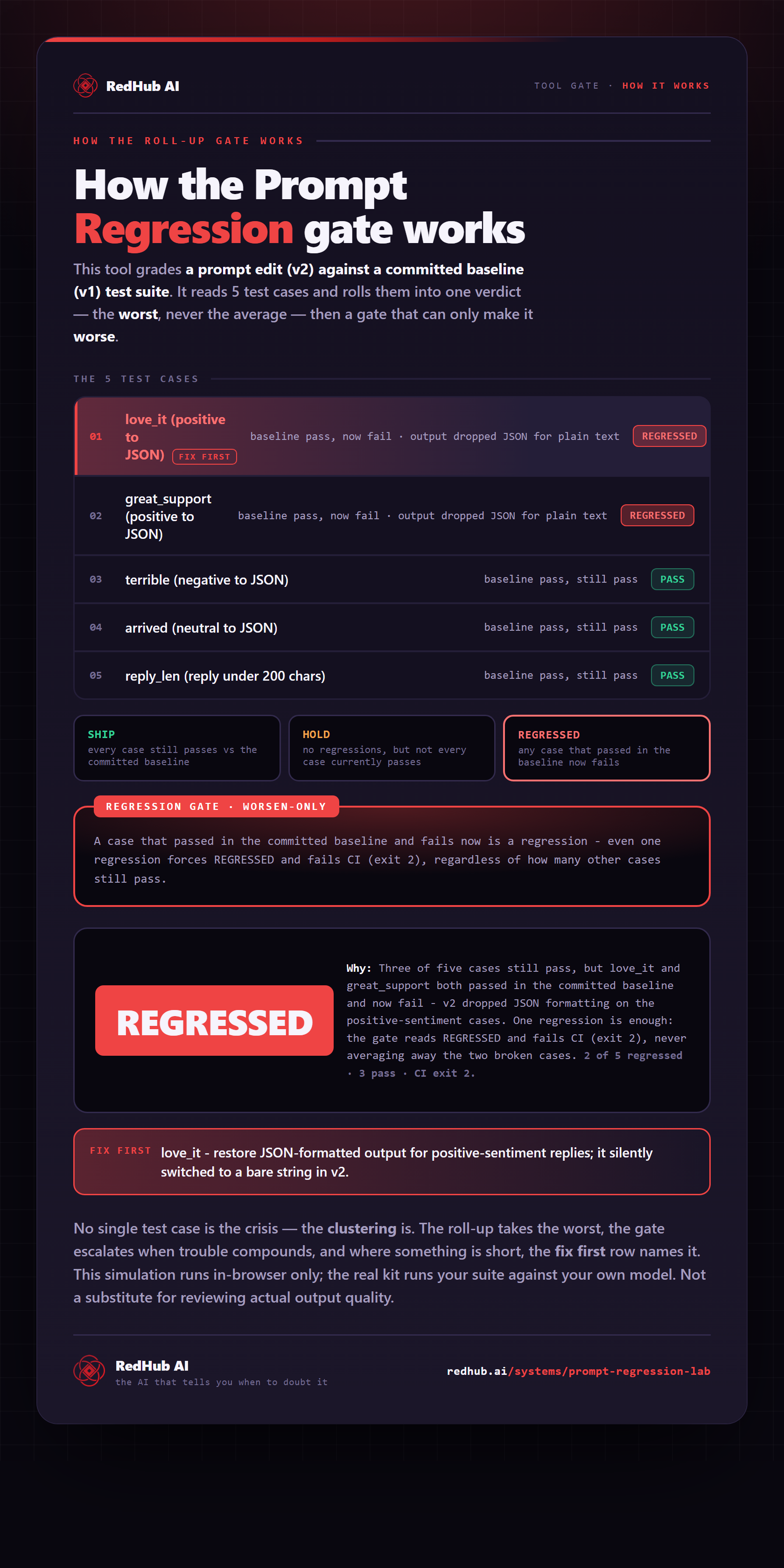
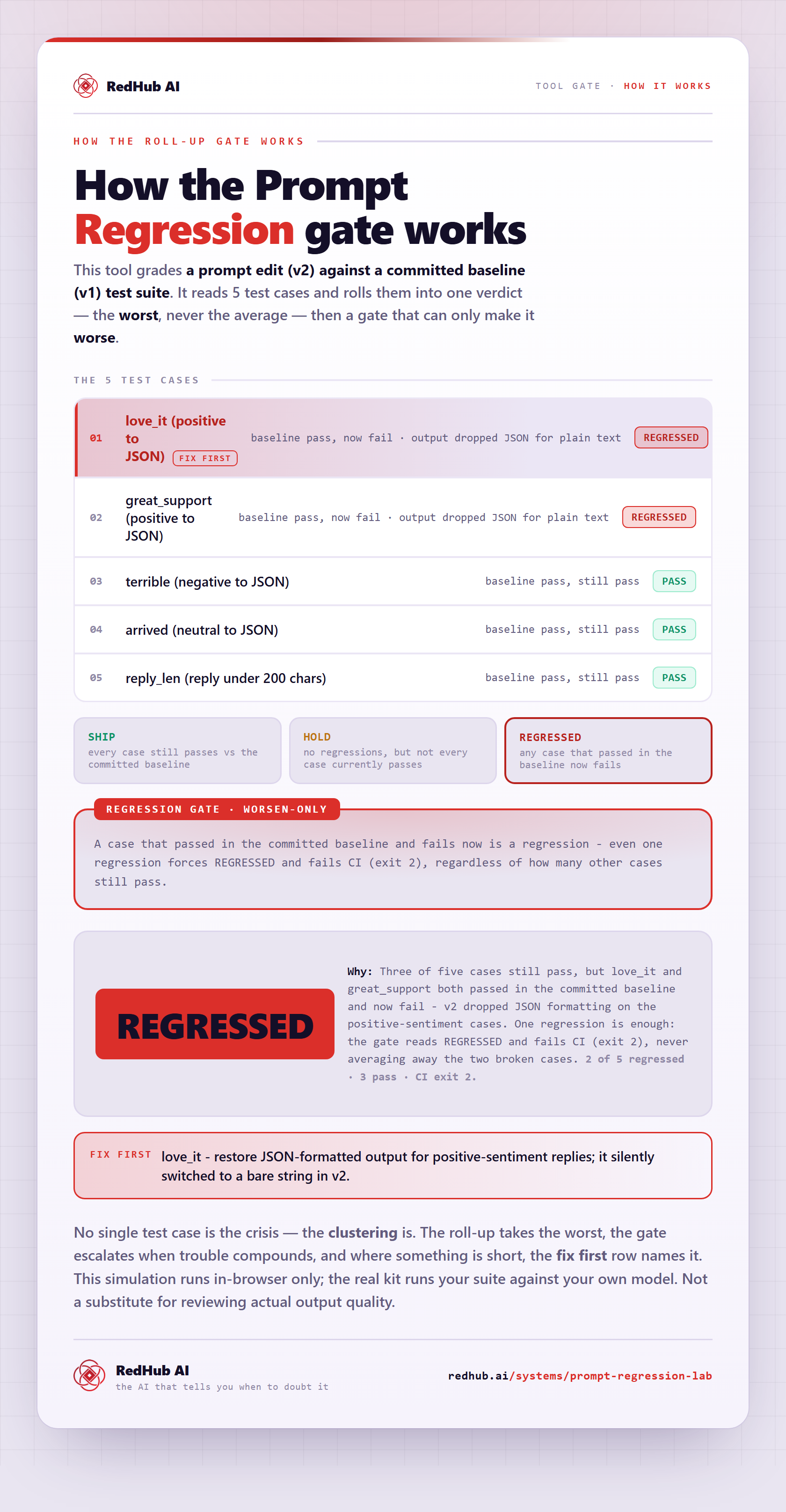
The gate this post refers to, drawn from the tool’s own logic. See the tool.