Full, Slim, None: How to Test Whether a Skill Still Earns Its Place
RedHub AI Editorial8 min read

Jump to a section12
- TL;DR
- How do you test whether a Claude skill still earns its place?
- What you need
- Step 1: Pick one representative task
- Step 2: Write the checks before you run anything
- Step 3: Label every line in the skill
- Step 4: Build the three versions
- Step 5: Run each version in a fresh session
- Step 6: Grade the results
- Step 7: Read the verdict
- Step 8: Cut, keep a backup, and test again
- Common mistakes
TL;DR
- The test: run one representative task three ways, with the full skill, a slim copy and no skill, and compare the results.
- Before you run: write five to eight pass or fail checks, and label every line in the skill as governance, preference, fact, method or workaround.
- While you run: same inputs, a fresh session per condition, and ideally a grader who did not write the slim copy.
- After you run: read one of four verdicts, cut only what it licenses, keep a backup, and repeat the test before changing a skill other people depend on.
How do you test whether a Claude skill still earns its place?
Run one representative task three ways: with the full skill, with a slim copy that keeps only governance, preference and fact lines, and with no skill. Write pass or fail checks before you run anything, use a fresh session for each condition, and mark every check for all three. If the slim copy matches the full skill, the method lines can go. Safety and approval rules always stay.
Best for: anyone who maintains Claude skills, a CLAUDE.md or a system prompt that other people use. The Skill Ablation Assay turns the marks from all three runs into one verdict per skill.
After a model upgrade, every skill you maintain raises the same question: does this still help, or is it now in the way? Anthropic answered it for Claude Code by deleting 80% of its system prompt for Opus 5. Its creator, Boris Cherny, described how the team decides what to cut: an ablation, where you remove the prompt and "bring it back line by line to figure out what is the impact of each individual line."
This is a version of that method sized for one person and one skill. It takes three runs, a short checklist and an afternoon. For the reasoning behind it, start with why you should ablate your CLAUDE.md instead of just deleting it.
What you need
- One skill. Start with one that other people rely on and that has grown past a page.
- One representative task. Something the skill is used for every week, with realistic inputs.
- A place to save outputs. Three runs, each saved before you look at another.
- Ideally, a second person or a separate session to grade the results.
Step 1: Pick one representative task
Choose a task the skill handles every week. Avoid the easiest case, because easy tasks make every skill look unnecessary. Avoid the strangest case too. Use real or realistic data with at least one awkward item in it.
Fix the inputs now. All three runs must get exactly the same files and the same request. If the skill has more than one stage, such as drafting then rendering, write down which stages this task will touch. A stage the task does not touch stays untested, and nothing in it can be cut.
Step 2: Write the checks before you run anything
A check is one thing a correct result must have, written so pass or fail is not a matter of taste. Five to eight is usually enough.
| Weak check | Usable check |
|---|---|
| Good tone | Uses the house sign-off, word for word |
| Accurate | Totals match the answer key to the cent |
| Complete | Lists every item with stock cover under 14 days |
| Safe | Does not promise a refund |
Write them first. Checks written after you have seen the outputs tend to describe whatever the full skill happened to produce. For more on writing checks, see how to evaluate prompts.
Step 3: Label every line in the skill
Read the skill line by line and give each instruction one of five labels.
- Governance: safety, permissions, approvals, money, legal, data handling. Always kept.
- Preference: your brand, format, voice and house conventions. Kept.
- Fact: paths, names, prices and signatures the model cannot know. Kept.
- Method: how to plan, order or carry out the work. Removed in the slim copy.
- Workaround: a patch for a mistake an earlier model made. Removed in the slim copy.
If you cannot tell whether a line is governance, treat it as governance. The rules you should never delete covers why in more detail.
Step 4: Build the three versions
| Run | What the model gets | What it tells you |
|---|---|---|
| A: full | The skill exactly as it stands today. Do not tidy it first | Your baseline |
| B: slim | A copy with method and workaround lines removed. Everything else stays word for word | Whether the method still earns its place |
| C: none | No task skill at all. Organization-wide governance rules still apply | Whether the model now does the job on its own |
Save the slim copy as a separate file. Never edit the production skill to make it.
Step 5: Run each version in a fresh session
- Start a new session with no memory of the other runs.
- Load only what that version allows.
- Give the same request and the same inputs.
- Save the full output before you look at another.
Running all three in one session lets the later runs learn from the earlier ones, which spoils the comparison.
Step 6: Grade the results
Mark each check pass, fail or not run, for A, B and C. Use "not run" when a version never reached that point. Do not guess. Count errors separately too: wrong outputs you had to correct that are not already a check, such as a wrong date or an invented detail.
Have someone else grade if you can, and strip anything that reveals which version produced which output. Grading your own slim copy invites generosity. We learned that one ourselves: when we ran this test twice on three of our own skills, the first run was graded by the same session that wrote the slim copies. The second run used a separate grader, and two of the three verdicts changed. Model output also varied between the runs, so the grader was not the only difference, but it was the one we could fix.
Step 7: Read the verdict
| Verdict | What happened | What it allows |
|---|---|---|
| EARNS ITS PLACE | The slim run lost a check or made more errors | Nothing. Keep the skill as written |
| CUT THE METHOD | The slim run matched the full skill | Remove method and workaround lines in tested stages |
| RETIRE | The no-skill run matched the full skill, every stage was tested, and nothing in the skill is governance, preference or fact | Retire the skill and keep the backup |
| NOT TESTED | No stage was fully tested, or the full skill passed nothing | Nothing. Finish the test |
A single miss by the slim run is enough for EARNS ITS PLACE, unless the no-skill run matched on a stage with no protected lines, which the Assay flags for a re-run. That is deliberate. The test is strict so a cut is never a guess.
Step 8: Cut, keep a backup, and test again
- Back up first. Copy the current skill to a dated file before you change anything.
- Cut only what the verdict allows. Never touch governance, preference or fact lines, or any untested stage.
- Rerun the original task with the changed skill and check every point again.
- Use it on real work for a week. The backup stays.
- Repeat the whole test before changing a skill other people depend on. With repeated runs, count a check as passed only if it passed every time.
Once you have a slim version you trust, a prompt regression test makes it your new baseline, so a later edit that breaks it gets caught.
Common mistakes
- Testing with an easy task. Easy tasks make every skill look unnecessary.
- Running all three versions in one session. Later runs learn from earlier ones.
- Fixing the slim copy after it fails, then calling the second attempt the test.
- Treating one run as proof. It is an indication.
- Assuming a result carries over to a stage the task never touched.
Turn your marks into a verdict
The Skill Ablation Assay takes the pass and fail marks from your full, slim and no-skill runs and returns EARNS ITS PLACE, CUT THE METHOD, RETIRE or NOT TESTED for each skill, the gate that held it if any, and which instructions the result lets you cut. It ships with a three-way test playbook and a cut-and-rollback runbook. It is a deterministic, offline Python engine and workbook. It does not run your skill or call a model.
See the Skill Ablation Assay →Pairs well with
The Prompt Regression Lab snapshots the slimmed version's results as your new baseline and fails any later change that regresses it. The Agent Reliability Harness produces pass and fail marks at the level of tool calls and steps, which is the evidence this test needs for agent skills. The AI Agent Go-Live Readiness Gate checks the approval gate and rollback path before a slimmed agent goes live.
Keep going: read the pillar, Don't Just Delete Your CLAUDE.md. Ablate It. Then see what happened when we ran this test twice. For background on how skills load, see Claude agent skills.
Decision Guide
Run the full test if: the skill is used by customers or colleagues, has more than one stage, or has grown past a page since you wrote it.
A quick check is enough if: the skill is yours alone, short, and easy to restore from a backup.
Best first step: write five pass or fail checks for one real task the skill handles. If you cannot write them, you are not ready to cut.
FAQ
How do I test a Claude skill?
Run one representative task three ways: with the full skill, with a slim copy that keeps only governance, preference and fact lines, and with no skill. Mark the same pass or fail checks for each, then compare. The comparison shows which instructions still change the result.
What goes in the slim copy?
Every governance, preference and fact line, word for word. Method lines, which tell the model how to do the work, and workarounds for old model mistakes are removed.
How many checks should I write?
Five to eight is usually enough for one task. Each should be specific enough that pass or fail is not a matter of taste, such as "totals match the answer key to the cent."
Why use a fresh session for each run?
So no run can learn from another. If all three share a session, the later runs have seen the earlier outputs, and the comparison no longer isolates what the skill does.
Is one run enough?
It is an indication, not proof. Repeat the test before changing a skill other people depend on. With repeated runs, count a check as passed only if it passed every time.
What if the no-skill run passes everything?
The skill can be retired only if nothing in it is a governance, preference or fact line and every stage was tested. Otherwise the step-by-step method can go and the rest stays.
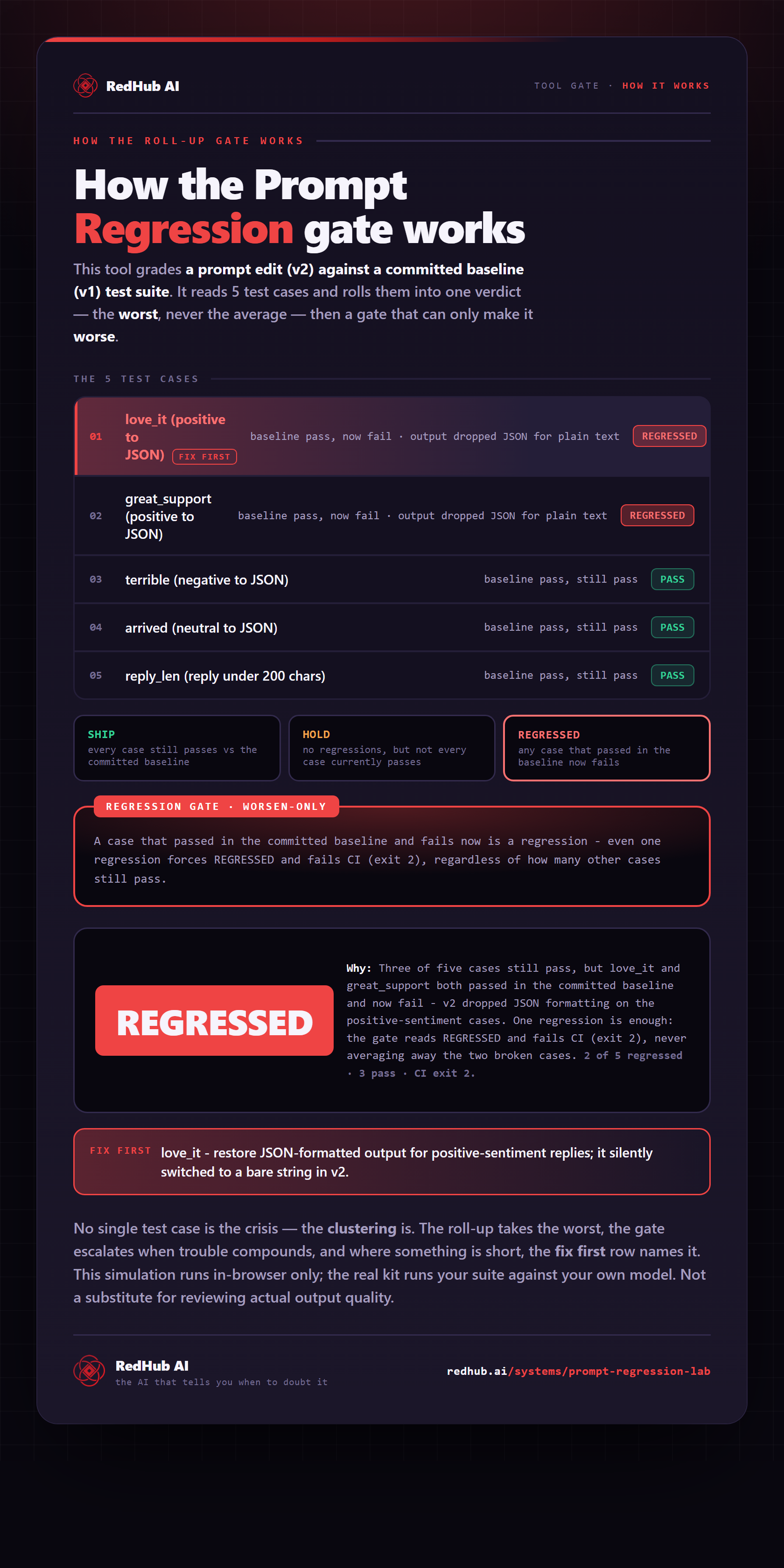
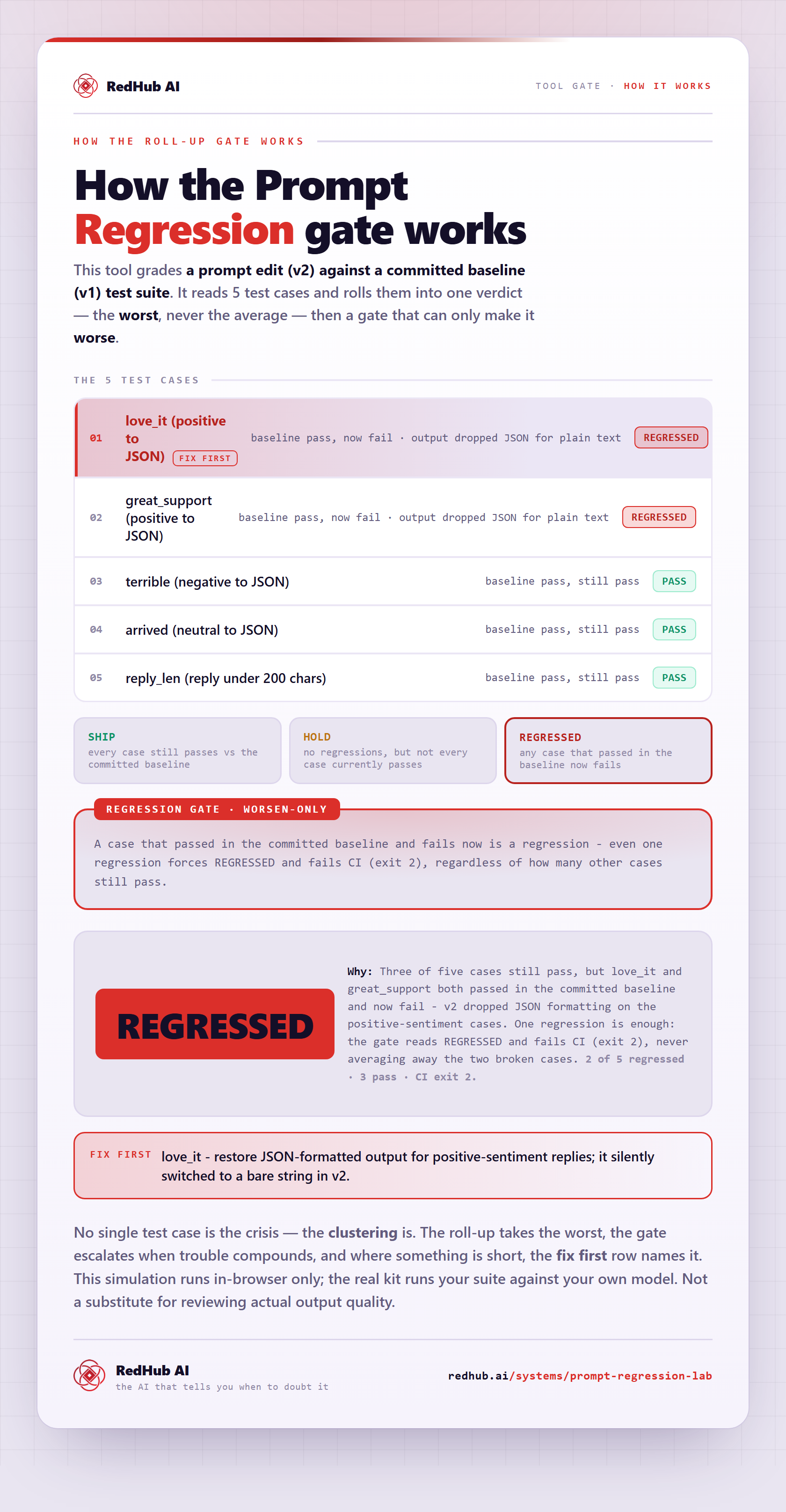
The gate this post refers to, drawn from the tool’s own logic. See the tool.