Don't Just Delete Your CLAUDE.md. Ablate It.
RedHub AI Editorial9 min read
Jump to a section12
TL;DR
- The headline: Anthropic deleted 80% of Claude Code's system prompt for Opus 5, and its creator suggests you delete your CLAUDE.md, skills and hooks every six months.
- His advice for users: delete, use the model, and add an instruction back only when it repeatedly stumbles without it.
- What his team does: an ablation. Remove the prompt, bring it back line by line, and measure what each line does. The code left in the harness is "almost all" about safety and permissions and static analysis.
- Do this instead: test each skill three ways (full, slim, none), cut only what your test exercised, and never cut a safety rule on the strength of a quiet week.
Should you delete your CLAUDE.md after a model upgrade?
Test it before you delete it. Old instructions often correct mistakes a newer model no longer makes, and some now get in its way. But a few days of normal use only tests the tasks you happened to run. Run one representative task with the full file, a slim copy and nothing, then cut only what the results show is unneeded. Keep safety, permission and approval rules, and keep the old version for rollback.
Best for: anyone who maintains Claude skills, CLAUDE.md files or system prompts that other people rely on. The Skill Ablation Assay turns the results of that three-way test into one verdict per skill.
Every instruction in a skill was written to fix something. A model got a date format wrong, so someone added a line. It skipped a check, so someone added a step. Months later the model is two generations newer, the file is three times longer, and nobody knows which lines still do anything.
That is why one piece of advice is everywhere right now: delete your CLAUDE.md and see what happens. It comes from a credible place. This guide covers what Anthropic said, the difference between the advice it gives users and the method its own team runs, and a way to borrow the team's method for your own skills.
What Anthropic said
At Y Combinator's Startup School, the day after Opus 5 shipped, Claude Code creator Boris Cherny confirmed that the team deleted 80% of Claude Code's system prompt. You can watch the full YC talk (opens in a new tab). His reason was simple. Much of the prompt "was correcting for these behaviors that the model should have known," and the new model just does them.
He also gave the advice that became the headline. For people using Claude Code, every six months: delete your CLAUDE.md, delete your skills, delete your hooks. "See what the model does and it might surprise you."
Asked how to rebuild afterward, he described a simple loop: delete, then use the model, watch where it fails, and "only when you see it repeatedly stumble on the same thing, that's when you add it back." That is sound advice. Guessing which instructions a new model needs is a poor bet.
What his team does is stricter
When Cherny described how the Claude Code team decides what to cut from its own prompt, he described something more formal, the kind of experiment researchers call an ablation. You "delete the entire system prompt and then you bring it back line by line to figure out what is the impact of each individual line." He called ablation a kind of eval: you delete things to see what changes. The team also keeps its evals from one model to the next, until a model maxes them out.
That is the difference worth noticing. The team has a measuring stick. Most people deleting their CLAUDE.md this month have a few days of normal work and a feeling about whether it went fine. For a personal setup, that may be enough. For a skill your team or your clients rely on, borrow the team's method instead.
Three things a quiet week cannot tell you
1. Whether you tested the part you cut
A skill often has stages. A content skill might draft, then render, then publish. If your week only involved drafting, you learned something about drafting. You learned nothing about rendering. Deleting the rendering instructions on the strength of that week is a cut with no evidence behind it. Silence from a stage you never ran is not a pass. More on that in what "add back what breaks" cannot see.
2. Whether a rare rule still matters
Some instructions are supposed to fire rarely. "Ask before deleting files." "Never send a refund without approval." "Keep the legal disclaimer on every quote." A rule like that can sit unused for a month and still be the most important line in the file. A few days without it proves nothing, because the situation it guards against never came up. See the CLAUDE.md rules to keep when you cut the rest.
Notice what is left in Anthropic's own product. Cherny said that if you look at the code in the Claude Code harness today, after many tools and features were removed, "almost all of it is about safety and permissions and static analysis," plus interface code. That was about the harness code, not the prompt. Still, the code that survived is mostly guardrails, while the prompt lines that went were corrections for old model habits.
3. Whether the result would repeat
Model output varies, and so does grading. The same task can pass on Monday and miss on Tuesday. We found this in our own skills: when we ran the same three-way test twice, two of three skills got a different verdict the second time. One run of anything is an indication, not proof.
The safer version: test it three ways
A skill ablation test asks one question: does this skill still change the result? To answer it, run one representative task three ways.
| Run | What the model gets | What it tells you |
|---|---|---|
| A: full skill | The skill exactly as written | Your baseline |
| B: slim copy | Only the governance, preference and fact lines. The step-by-step method is removed | Whether the method still earns its place |
| C: no skill | Nothing task-specific at all | Whether the model now does the job on its own |
The slim copy is the key idea. A skill usually holds two kinds of lines. Some tell the model how to do the work, step by step. Those are the lines a smarter model tends to outgrow. Others tell it what matters to you: your rules, your preferences, your facts. A newer model cannot work those out for itself, however good it is. The slim copy keeps the second kind and drops the first, so you can see which kind was doing the work.
Before you run anything, write down what a correct result looks like as a short list of pass or fail checks. "The totals match the answer key." "It asked before changing the price." Then mark each check for each of the three runs. The full walkthrough is in how to test a Claude skill.
Four verdicts, not two
"Keep it or delete it" is too blunt. The three runs support four different answers.
- EARNS ITS PLACE. The slim run lost something the full skill delivers. Keep it as written.
- CUT THE METHOD. The slim run matched the full skill. The step-by-step lines can go. The rules, preferences and facts stay.
- RETIRE. The no-skill run matched too, and nothing in the skill is a governance, preference or fact line. The model no longer needs it.
- NOT TESTED. The evidence does not license any cut.
Expect a skill that carries any rules, preferences or facts to land on CUT THE METHOD at best, never RETIRE. All three of our own did. The method was the scaffolding. The rules were the reason the skill existed.
For a picture of the whole method on one page, see Three Runs, One Verdict.
Three rules that keep the experiment honest
- Evidence decides. The verdict comes from what the three runs did, not from how long the skill is or how old it looks. No run, no verdict.
- Untested licenses nothing. A stage your test did not exercise keeps every instruction. One untested stage holds the whole skill short of RETIRE.
- Governance is not optimized away. A skill that carries a safety, permission or approval rule cannot be retired. If you are unsure whether a line is that kind of rule, treat it as one.
Then keep the previous version of anything you change. A cut you can roll back in a minute is an experiment. A cut you cannot roll back is a gamble.
When to run it
The natural moment is right after a model upgrade, which is when Cherny's team does it, he recommends it for Opus 5, and old workarounds are most likely to be in the way. For the wider risks of switching models, see why AI model upgrades break production workflows. Start with the skills other people depend on, since those are the ones where a bad cut costs the most. Skip the ritual for one short skill you can re-read in a minute. Just test it by hand.
Once you have a slim version you trust, lock it in. A prompt regression test makes the slim version your new baseline, so a later edit that breaks it gets caught.
Turn your three runs into one verdict
The Skill Ablation Assay takes the pass and fail marks from your full, slim and no-skill runs and returns EARNS ITS PLACE, CUT THE METHOD, RETIRE or NOT TESTED for each skill, the gate that held it if any, and which instructions the result lets you cut. It is a deterministic, offline Python engine and a workbook, with a test playbook and a cut-and-rollback runbook. It does not run your skill or call a model, and it never treats a safety rule as something a good score can remove.
See the Skill Ablation Assay →Pairs well with
The Prompt Regression Lab snapshots the slim version as your new baseline and fails any later change that regresses it. The Agent Reliability Harness produces pass and fail marks at the level of tool calls and steps, which is the evidence the Assay needs for agent skills. Before a slimmed agent goes live, the AI Agent Go-Live Readiness Gate checks that its approval gate and rollback path still hold.
Keep going: read what happened when we tested our own skills twice, what "add back what breaks" cannot see, the rules you should never delete and how to test a Claude skill step by step. For background on how skills load, see Claude agent skills.
Decision Guide
Run a three-way test now if: you just moved to a new model and a skill other people rely on has grown past a page.
Leave it alone if: the skill is mostly rules, approvals and facts about your business. Those are the lines a smarter model still needs.
Best first step: pick one skill and write five pass or fail checks for one real task it handles. If you cannot write the checks, write those before you cut anything.
FAQ
Did Anthropic delete 80% of Claude Code's system prompt?
Boris Cherny, who created Claude Code, confirmed at Y Combinator's Startup School that the team deleted 80% of it for Opus 5. He said much of it corrected behaviors the new model now gets right on its own.
Should I delete my CLAUDE.md?
Test it first. Deleting it outright skips the measuring. Run one real task with the full file, a slim copy and nothing, and cut only what the results show you do not need. Keep safety, permission and approval rules, and keep the old version so you can roll back.
What is an ablation?
A test where you remove something on purpose to measure what it was doing. For prompts, that means deleting instructions and checking whether the results change. Cherny described bringing the prompt back line by line to find the impact of each one.
Why not just delete everything and add back what breaks?
Because a few days of use only tests what you happened to do. A stage you never ran and a rule that fires once a quarter both look unneeded after a quiet week. Neither has been tested.
What is the difference between cutting the method and retiring a skill?
Cutting the method removes the step-by-step instructions and keeps the rules, preferences and facts. Retiring removes the whole skill, which is only right when the model does the job with no skill at all and nothing in it is a governance, preference or fact line.
How often should I test my skills?
After each model upgrade, and before changing any skill that customers or colleagues depend on. Cherny suggests deleting CLAUDE.md, skills and hooks every six months to see what the model does without them. A three-way test is the measured version of that habit.
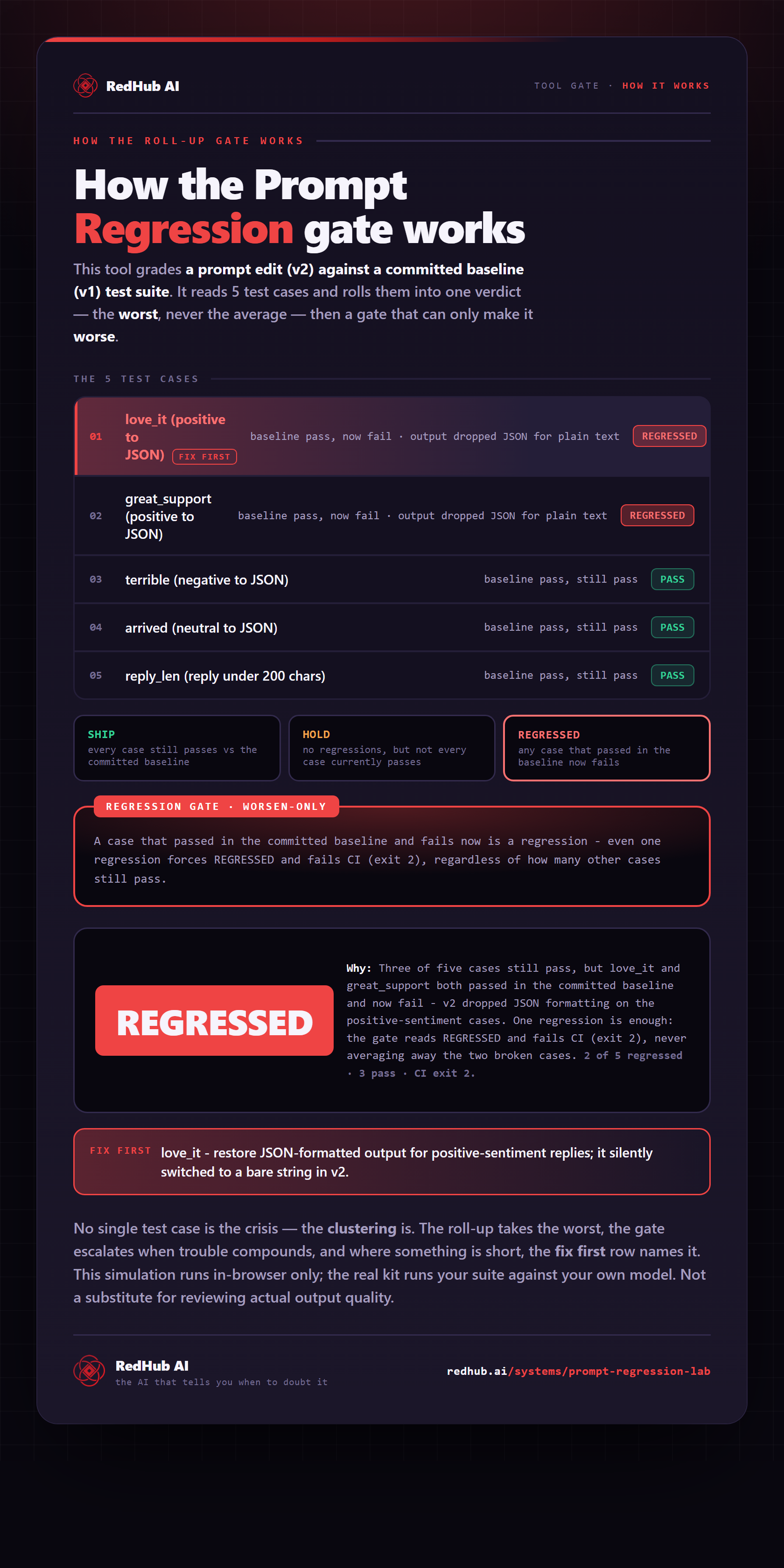
The gate this post refers to, drawn from the tool’s own logic. See the tool.