YouTube A/B Testing: How to Call a Real Winner
RedHub AI Editorialupdated September 7, 20266 min read

Jump to a section9
TL;DR
- What it is: YouTube A/B testing means running two thumbnails or titles and checking whether the gap between them is real, not noise.
- Why it matters: "it got more views over three days" is not proof — small samples produce big-looking gaps by chance all the time.
- How to check it: a two-proportion significance test tells you whether the gap clears a real statistical bar, or whether you need more data first.
- Bottom line: the honest answer is sometimes "keep testing" — and that's a better answer than a fake winner.
What is YouTube A/B testing?
YouTube A/B testing means showing two versions of a thumbnail or title — to comparable audiences — and measuring which one earns a higher click-through rate. The part most people skip is checking whether that gap is statistically significant, or just the kind of random variation that shows up constantly in small samples. A real test names a winner only when the numbers clear that bar, and says "keep testing" — with an estimate of how much more data is needed — when they don't.
Best for: anyone who's ever declared a thumbnail "the winner" after a few days. The YouTube Packaging & Retention Engine ($99) runs a real two-proportion significance test on your thumbnail and title A/B tests.
Here's the trap almost every creator falls into at least once: you run two thumbnails, one pulls ahead after a couple of days, and you call it the winner. The problem is that a couple of days of data on a couple thousand impressions is usually too small a sample to tell a real difference from ordinary noise. YouTube A/B testing only works if you check for that — otherwise you're not testing, you're guessing with extra steps.
This post is part of our YouTube packaging series — and it's the strongest tie to the measurement problem the whole series is about.
Why "it got more views" isn't proof
Flip a fair coin 20 times and you'll sometimes get 12 heads and 8 tails. That's not evidence the coin is unfair — it's just what small samples of a random process look like. Thumbnail click-through rates behave the same way on a small number of impressions: a version can look ahead by a full percentage point purely by chance, and reverse the next day. The only way to tell a real gap from a random one is to run the numbers through an actual test, not a glance at the dashboard.
What a significance test actually checks
A two-proportion significance test asks one plain-English question: given how many impressions and clicks each version got, how likely is it that a gap this size happened by chance alone, if the two versions were truly equal? If that likelihood is low enough — typically below 5% — the test calls the gap real and names a winner. If it's not low enough, the honest answer is that you don't have enough data yet, and the test can estimate roughly how many more impressions per variant would be needed to know for sure.
Key insight: a test that always calls a winner isn't more useful — it's less trustworthy. The valuable feature is the willingness to say "not yet," because that's what keeps you from scaling a coin flip.
Two real examples, two different honest answers
In the Engine's own worked example, a face-vs-no-face thumbnail test came back with a 4.00% click-through rate for one version and 4.60% for the other. That gap cleared a real significance check (z = 4.68, p < 0.001), so the Engine called variant B the winner. A separate title test — "How I" versus "How to" — showed a similar-looking gap on paper: 5.00% versus 6.00%. But on the sample size collected, that gap did not clear significance (z = 1.07, p = 0.283). The honest verdict was "keep testing," with an estimate of roughly 8,155 impressions per variant needed to confirm a gap that size. Two tests that looked comparable on the surface. Two completely different honest answers.
Try it yourself: a live significance checker
This is a simplified demo of the same statistical idea behind the Engine's A/B check. Enter impressions and clicks for two variants and see whether the gap clears significance, or whether the honest verdict is "keep testing":
YouTube A/B significance checker (demo)
A simplified demo of a two-proportion significance test — the same statistical idea behind the Engine's A/B check, not its exact production code. Try lowering variant B's clicks toward variant A's and watch the verdict flip to "keep testing."
What to do when the test says "keep testing"
Nothing dramatic — you keep both versions running and let the sample grow. The test will typically estimate roughly how many more impressions per variant would confirm a gap of the size you're currently seeing, so you have a rough sense of how much patience the test needs. What you shouldn't do is force a decision early because waiting feels unproductive. A false winner scaled across future videos costs far more than a few extra days of data collection.
| Situation | Wrong move | Right move |
|---|---|---|
| One version ahead after 2 days | Declare it the winner and switch | Run the significance check before deciding anything |
| Test says "keep testing" | Force a pick because waiting feels slow | Keep both running until the sample clears the bar |
| Test clears significance | Assume it'll repeat on every future video | Roll it out on similar videos, then keep testing new ideas |
- Run both versions long enough to collect a real sample — not just until one pulls ahead.
- Check significance before declaring anything, using the same math the checker above runs.
- Accept "keep testing" as a valid, honest result — not a failure of the test.
- Roll out a confirmed winner on similar videos, then start your next test.
A significance-checked winner only tells you the packaging worked for the click — it doesn't tell you whether the video held the audience once they clicked. That's a separate, equally important check: see audience retention: how to read your retention graph. And everything you're testing here — the thumbnail and the title — is covered in depth in how to design a YouTube thumbnail and how to write a YouTube title.
Stop scaling coin flips
The YouTube Packaging & Retention Engine ($99, one-time) runs a real two-proportion significance test on every thumbnail and title A/B test you feed it — and it only calls a winner when the numbers back it up.
Get the Engine — $99 →Decision Guide
Use this approach if: you're running or planning to run thumbnail or title A/B tests and want to know whether the results are real before you act on them.
Skip it if: you're not yet testing multiple versions of anything — start with a single strong thumbnail and title first, using the design and writing guides.
Best first step: plug your current or most recent A/B test numbers into the checker above and see whether your gut call matches the honest verdict.
FAQ
What is YouTube A/B testing?
Running two versions of a thumbnail or title and measuring which earns a higher click-through rate — checked for statistical significance, not just a glance at which one has more views.
How long should I run a thumbnail test before deciding?
Until the sample clears a significance check, not a fixed number of days. Smaller gaps between versions need more impressions to confirm; a significance test estimates roughly how much data you need.
Why isn't "it got more views" enough proof?
Small samples produce random-looking gaps constantly, the same way flipping a coin 20 times doesn't always land 10-10. Only a statistical test can tell a real gap from ordinary noise.
What does "keep testing" mean as a result?
It means the current gap between two versions isn't large enough, relative to your sample size, to rule out chance. It's an honest result, not a failed test — and it usually comes with an estimate of how much more data would confirm it.
Do I need a big channel to run significance-checked tests?
No. Smaller channels just need proportionally more impressions to detect the same size gap. A real significance test accounts for that automatically instead of assuming every channel needs the same sample.
Can a winning thumbnail guarantee more views on future videos?
No. A confirmed winner tells you what worked on this test, on this video. It's a strong signal to try a similar pattern again — not a guarantee it repeats, since every video and audience context differs slightly.
What's the difference between a significant CTR win and a good video?
A significant win in click-through rate only proves the packaging earned more clicks. It says nothing about retention — a thumbnail can win the click and still lose the audience if the video doesn't deliver.
Test it like the numbers matter
A real two-proportion significance test on every A/B test, and an honest "keep testing" when the sample isn't there yet. One-time $99, instant download. 30-day guarantee.
Get the YouTube Packaging & Retention Engine — $99 →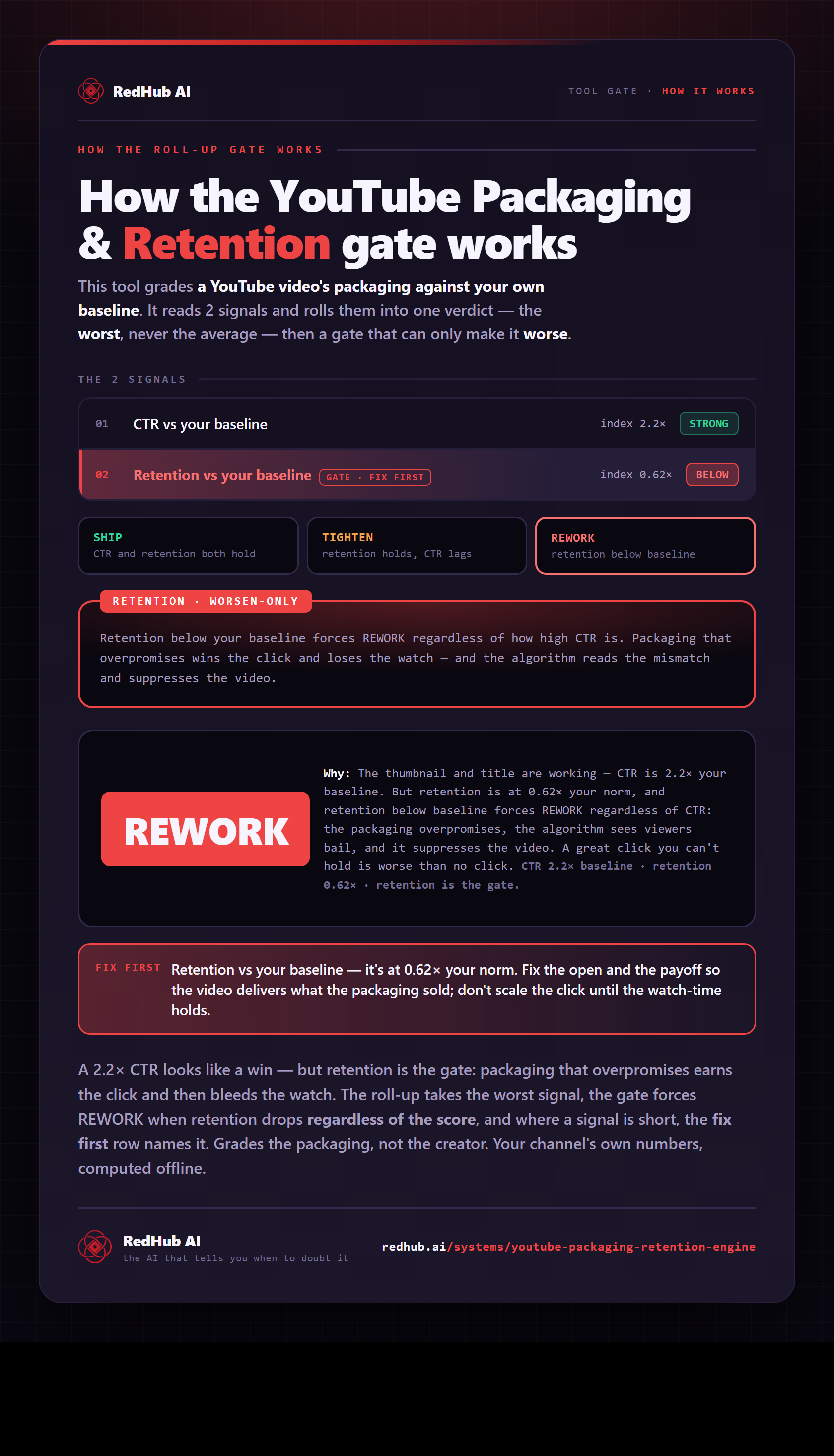
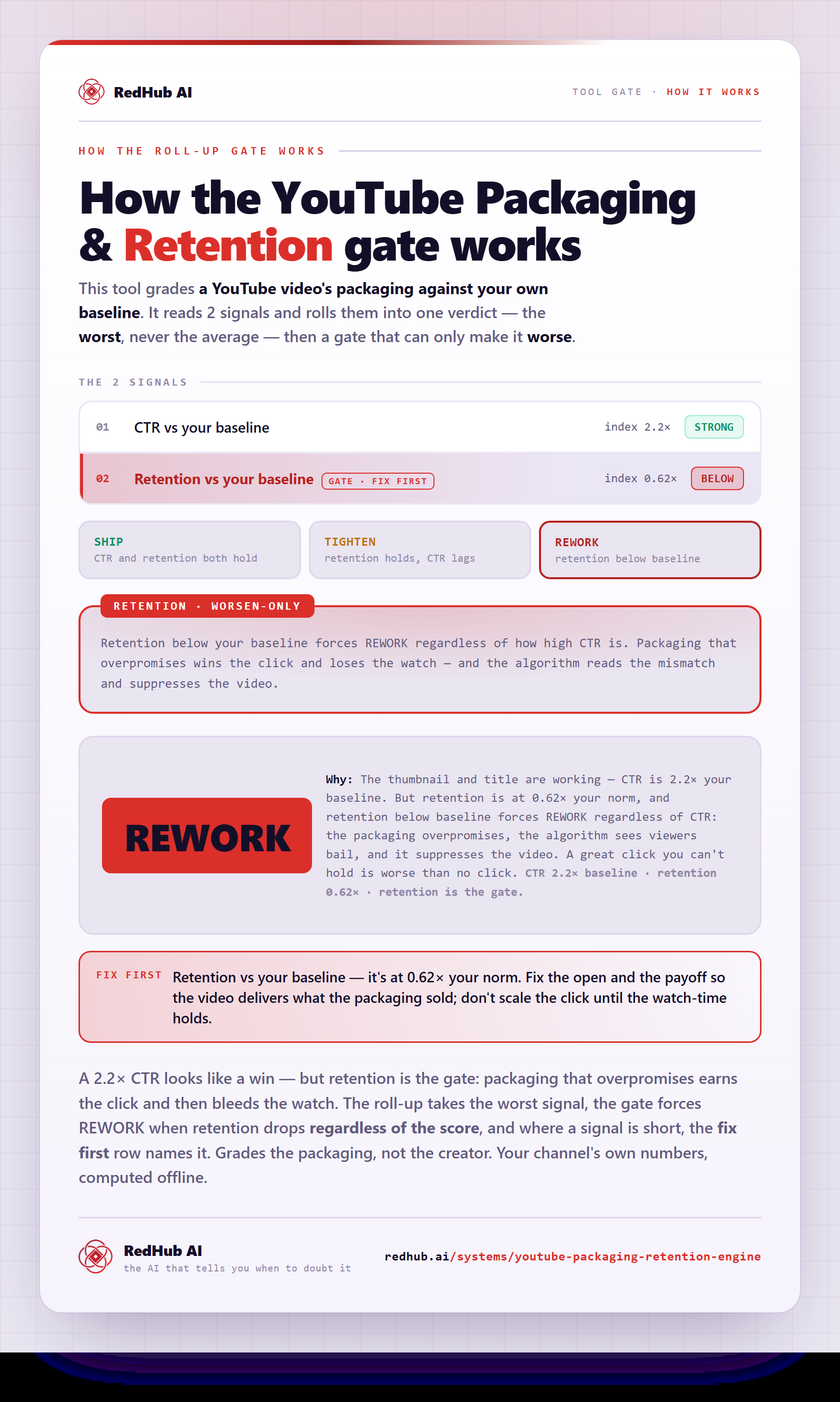
The gate this post refers to, drawn from the tool’s own logic. See the tool.