YouTube Packaging: Why the Click Comes Before the Video
RedHub AI Editorialupdated September 7, 20267 min read
Jump to a section11
TL;DR
- What it is: YouTube packaging is your title and thumbnail — the two things that decide if anyone ever clicks play.
- Who it's for: creators and channels making good videos that aren't getting watched.
- How it works: packaging earns the click, retention earns the watch — and both are testable against your own channel's numbers, not a generic rule of thumb.
- Bottom line: a great video with weak packaging never gets seen. A great thumbnail on a video that doesn't deliver gets seen once. You need both, checked against real data.
What is YouTube packaging?
YouTube packaging is the combination of your title and thumbnail — the pair a viewer sees before they ever press play. It's the single highest-leverage thing you control on a video, because a great video with weak packaging never gets a chance, and a thumbnail that oversells a video just borrows attention it can't keep. Good packaging isn't a feeling. You can score it, A/B test it, and check it against your own channel's real numbers instead of guessing.
Best for: creators who make solid long-form videos but can't tell if a title, a thumbnail, or the video itself is the actual problem. The YouTube Packaging & Retention Engine ($99) scores every video against your own baseline and answers that question directly.
Your video could be the best one you've made all year. If the title and thumbnail don't earn the click, none of that matters — nobody will ever find out. That's YouTube packaging: the title-and-thumbnail pair that decides whether your work gets a chance at all. It comes before the video in every sense that matters, because a viewer judges the pair in about a second, long before they've watched a single frame.
This guide is the map. Each part of the packaging system has its own deep-dive, linked as we go.
Why packaging decides everything before the video starts
Viewers don't watch your video and then decide whether to click. They see a thumbnail and a title in a search list, a suggested-videos rail, or a subscription feed — surrounded by a dozen competing thumbnails — and decide in an instant. The video's actual quality never enters that decision, because the video hasn't been watched yet. Packaging is a proxy the viewer trusts to predict the video. Get the proxy wrong and a great video sits unwatched.
Packaging has two jobs, not one
The first job is obvious: earn the click. The second job is easy to forget: set the right expectation, so that once someone clicks, the video actually delivers what the packaging promised. Miss the second job and you create the trap that quietly costs channels the most growth — a high click-through rate on a video people leave early.
That mismatch is a real, measurable pattern. In one worked example from the Engine itself, a video titled "I tried the viral $5 microphone" pulled a strong 8.9% click-through rate — well above a 4.0% baseline — but its average percentage viewed came in at just 28%, well below a 45% baseline. The thumbnail and title over-promised, viewers noticed within seconds, and left. That's not a packaging fix. That's a video fix.
Key insight: a high click-through rate on a video with weak retention isn't a win — it's the exact mismatch that gets suppressed in recommendations. Packaging can win the click. It cannot win the watch if the video doesn't deliver.
Packaging is testable, not a feeling
A 4% click-through rate is excellent on some channels and weak on others — it depends entirely on your own channel's normal range, not an industry number you read somewhere. That's why "is this thumbnail good?" is the wrong question. The right question is: does this video's packaging and retention sit at, above, or below your own baseline? Answer that, and you get one of three verdicts:
| Verdict | What it means | What to do |
|---|---|---|
| SHIP | Click-through rate and retention are both at or above your baseline. | Scale the pattern — repeat it. |
| TIGHTEN | Retention holds, but the click-through rate lags your baseline. | Rework the title and thumbnail. Keep the video. |
| REWORK | Retention is below your baseline — including the high-CTR mismatch above. | Packaging can't fix this. Fix the open and payoff, or the video. |
The four-part packaging system
Packaging breaks cleanly into four skills, and each one has its own guide:
- How to design a YouTube thumbnail that gets clicks — contrast, one idea, faces and emotion, and legibility at thumbnail size.
- How to write a YouTube title that gets clicked — curiosity paired with clarity, without tipping into clickbait that tanks retention.
- YouTube A/B testing: how to call a real winner — why "it got more views" isn't proof, and what a significance check actually looks like.
- Audience retention: how to read your retention graph — the intro cliff, the mid-video dip, and what fixes each one.
How to test packaging honestly
Most thumbnail "tests" aren't tests at all — they're a three-day glance at whichever version happened to post first, on whichever day the algorithm was feeling generous. A real test runs both versions long enough to check whether the gap is statistically real, not noise.
In the Engine's own worked example, a face-vs-no-face thumbnail test posted a 4.00% click-through rate for one version and 4.60% for the other — a gap large enough to clear a real significance check (z = 4.68, p < 0.001), so the tool called a winner. A separate title test — "How I" versus "How to" — showed a similar-looking gap on paper (5.00% vs. 6.00%), but on the sample size collected, that gap wasn't significant yet (z = 1.07, p = 0.283). The honest answer was "keep testing," with an estimate of roughly 8,155 impressions per variant needed to know for sure. Two similar-looking gaps. Two different, honest verdicts.
Running the packaging loop each week
- Diagnose last week's uploads against your own baseline — SHIP, TIGHTEN, or REWORK, one verdict per video.
- Rework the TIGHTEN videos. Retention already holds, so a new title and thumbnail is usually the fastest win you have.
- Run one significance-checked A/B test on a new thumbnail or title idea — and accept "keep testing" when that's the honest answer.
- Read the retention graph on anything that comes back REWORK, so you fix the actual drop-off point instead of guessing.
- Bank what SHIPs as a packaging pattern worth repeating on your next few uploads.
Stop guessing which packaging worked
The YouTube Packaging & Retention Engine ($99, one-time) scores every video against your channel's own baseline, runs a real two-proportion significance test on your thumbnail A/B tests, and never calls a winner — or a SHIP — that the numbers don't back up.
Get the Engine — $99 →Where to go next
Once packaging and retention are being measured honestly, the next bottleneck is usually production or planning, not packaging. If videos are taking too long to make, the Authority Video Engine ($199) is the production-workflow layer that turns a video idea into a recorded upload. If the real blocker is knowing what to make next, the Content Engine for One Person ($39) is a lightweight system for staying consistent as a one-person team.
One note on scope: everything on this page is about long-form YouTube. If you're also building a vertical short-form presence — TikTok, Reels, Shorts — that's a genuinely different creation lane with its own hooks and cadence, covered separately by the Organic Social & Short-Form Video System.
Decision Guide
Use this approach if: you're making long-form YouTube videos and can't tell whether a slow-performing upload is a packaging problem or a content problem.
Skip it if: your videos aren't getting made in the first place — that's a production or planning problem, not a packaging one.
Best first step: pull your last 5 uploads' click-through rate and average percentage viewed, compare each to your own channel average, and sort them into SHIP, TIGHTEN, or REWORK by hand before you automate anything.
FAQ
What is YouTube packaging?
The title and thumbnail pair a viewer sees before pressing play. It's the single biggest factor in whether a video gets watched at all, separate from the video's actual quality.
Does a good thumbnail guarantee more views?
No — and be wary of anything that claims it can. A good thumbnail improves your odds of earning the click; distribution still depends on the platform, your retention, and some luck.
What's the difference between a packaging problem and a content problem?
A packaging problem shows up as low click-through rate with retention that holds once someone clicks — the video works, the packaging isn't earning the click. A content problem shows up as low retention, no matter how strong the click-through rate is — the video isn't delivering on its promise.
How do I know if my problem is packaging or the video itself?
Check average percentage viewed against your own baseline. If retention holds and only click-through rate lags, it's packaging — retitle and re-thumbnail. If retention is below baseline, packaging can't fix it; the open or the payoff needs work.
Do I need a big channel to test packaging?
No. Smaller channels just need more impressions to detect a smaller gap between two versions. A real significance check accounts for that automatically — it names how much data you need rather than guessing.
How is a measurement tool different from a thumbnail-maker tool?
A thumbnail maker helps you build the image. A measurement layer tells you whether that image actually earned the click and held the audience, against your own numbers — the two are complementary, not competitors.
What does the YouTube Packaging & Retention Engine include?
A stdlib Python engine, a spreadsheet workbook that mirrors it, a Packaging & Retention Playbook, a Title/Thumbnail/Hook Patterns guide, and 5 sample videos plus 2 sample A/B tests. $99, one-time, at redhub.ai.
Know if it's the packaging or the video
SHIP / TIGHTEN / REWORK on every upload, and a significance-checked winner on every thumbnail test — never a guess. One-time $99, instant download, yours to keep. 30-day guarantee.
Get the YouTube Packaging & Retention Engine — $99 →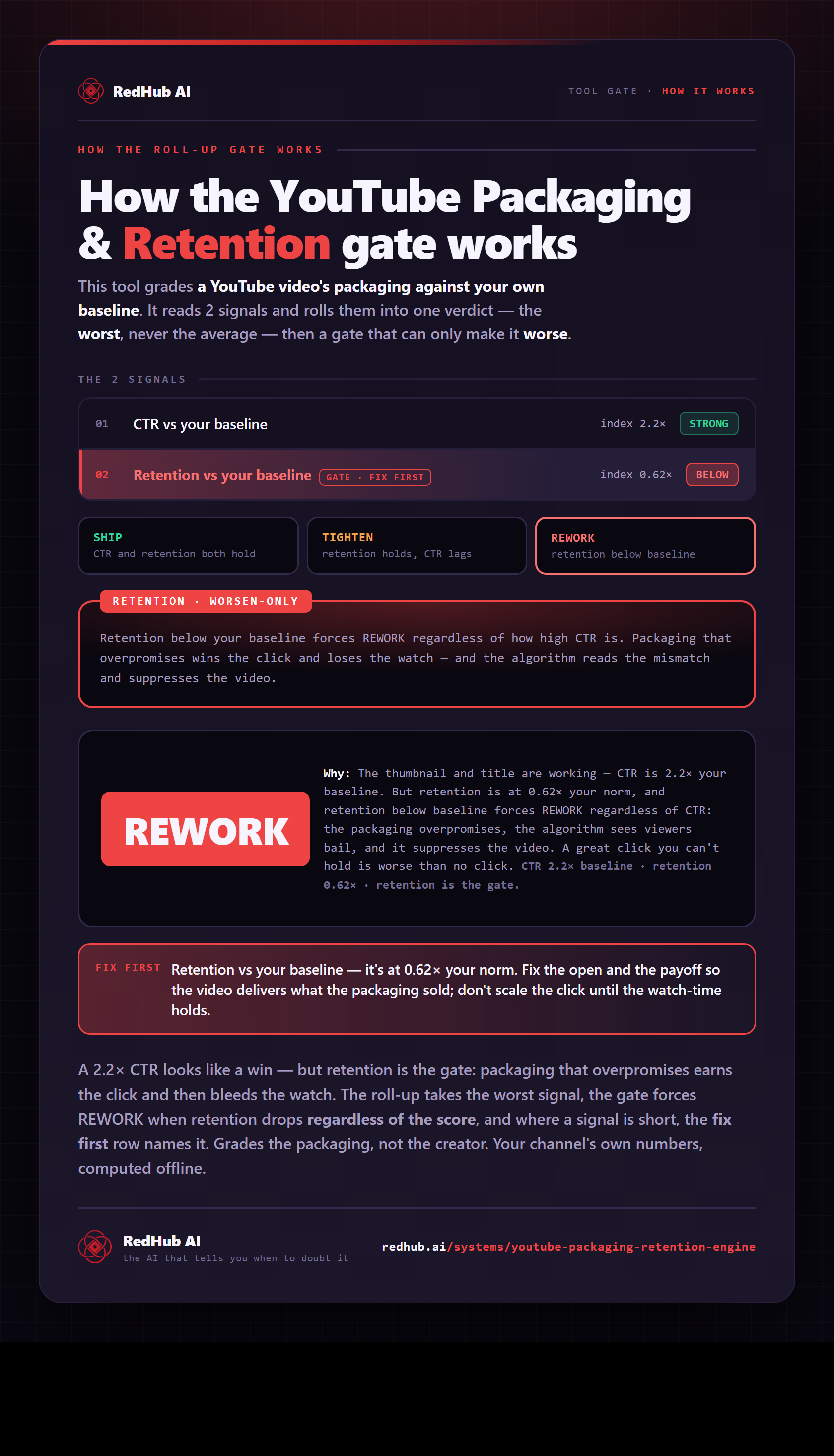
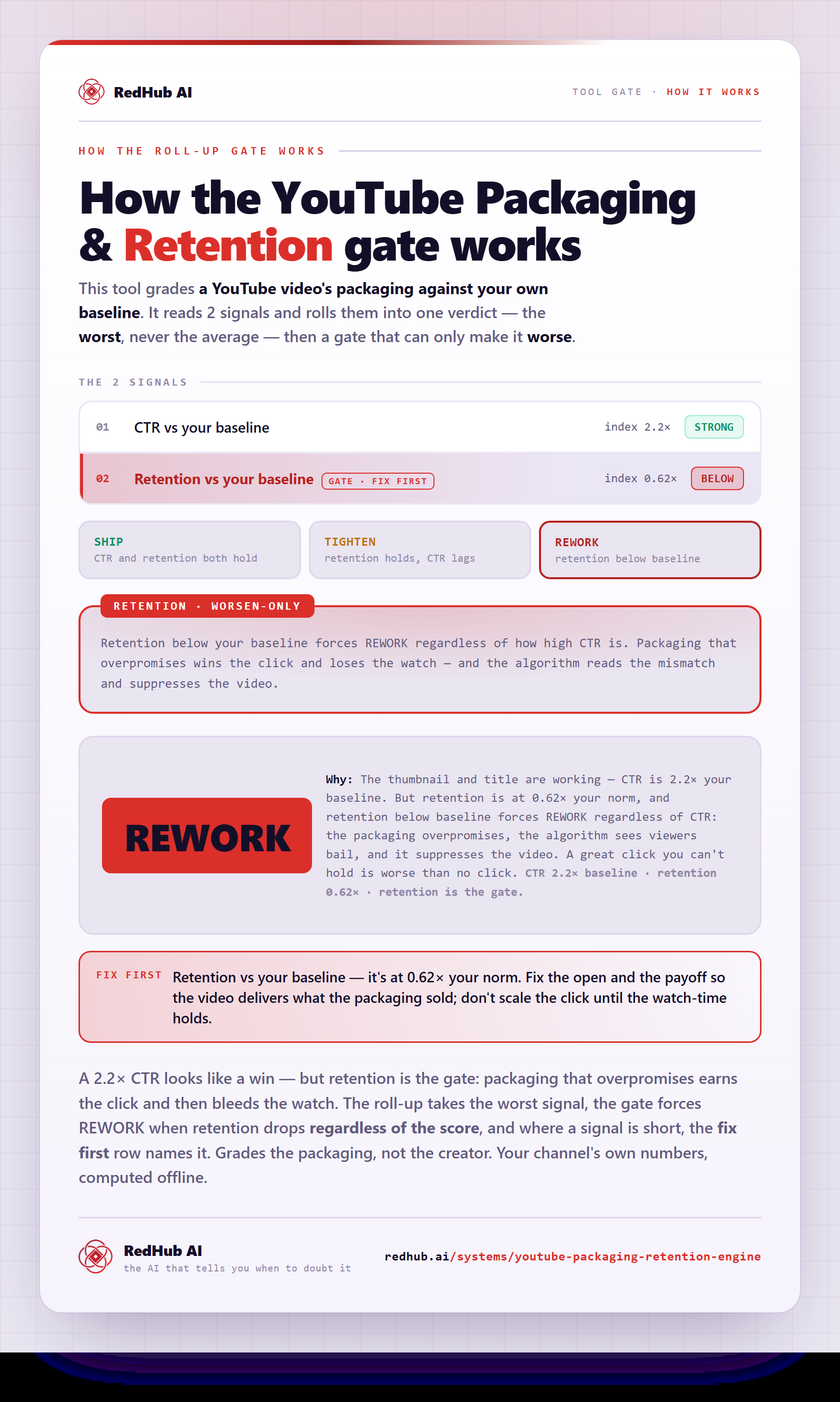
The gate this post refers to, drawn from the tool’s own logic. See the tool.